2 months ago
5
2 months ago
5
Even back then, he had an inkling he wanted to be a cop and was drawn to group activities as a member of the Air League youth group and the Preston Scottish Pipe Band.
Good at maths, he enrolled at the Preston Institute of Technology but dropped out because he detested the English component.
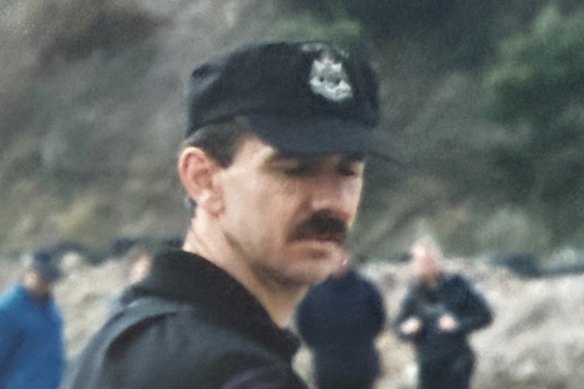
On the road with the SOG. Bill Duncan with the mandatory 1980s moustache.
Hard to believe as he leaves policing with two BAs and a Masters in counter-terrorism. He is back in Australia only for a short time as he is heading back to Asia to complete an intense course learning Vietnamese.
Bill spent six years in the army then 18 months working for a bank before deciding to join Victoria Police in 1987. By late 1990, he was trying out for the SOG.
What the selection course lacked in sophistication it made up for with sheer brutality. Such as standing silently for what seemed like hours, arms outstretched while holding rabbit droppings in your fingers while an instructor would be asking: “What’s so hard about holding rabbit poo?”
There is no answer to that. “The instructors get in your face saying, ‘This is not for you, do yourself a favour and quit now’. The aim was to get into people’s heads and what they were looking for was determination.”
Since then, methods have changed, using the training style of the FBI hostage teams.
“Now there is no feedback – the instructors observe and write on tablets. This is a generation that needs positive feedback. It eats at self-belief, and they talk themselves out of it,” Duncan says.
“At Mount Disappointment we had been doing the fireman’s carry (carrying a man over your shoulders). Then we were given a choice. Sprint up the mountain or do the fireman’s carry. We were sick of carrying blokes and picked the sprint because you can fake that. They said, ‘Sure, this is a democracy.’
“Then they said the sprint would be done wheelbarrow-style (one man walking on his hands while the other holds his legs). Do you know how difficult that is? Doesn’t take long until you face-plant into the rocks.”
Loading
The course was three days. It started with 20 candidates. It ended with four. He was the only one who ended up joining.
In a police career of 38 years he would spend more than 31 at the SOG, ending as one of the officers in charge.
In his first stint Duncan raided the Hells Angels more than once, scaling walls to gain access or simply blowing a hole in the wall of a fortified clubhouse.
He became known as “The Ferryman” for his capacity to drive a van packed with fellow SOG members, slowing to allow them to leap out ready to act.
In 1992, the armed robbery squad, National Crime Authority and the Special Operations Group combined in Operation Thorn.
Police had inside information that a team of bandits was after a huge haul. “We knew it was going to be either the Tip Top Bakery (payroll) or Ansett at Melbourne Airport,” says Duncan.
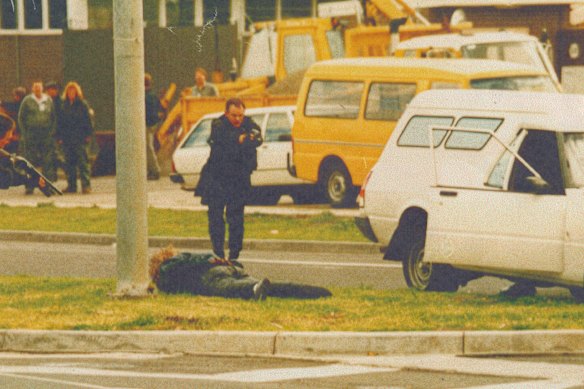
SOG police arrest Stephen Asling after three bandits tried to escape with $1 million from the Melbourne Airport in 1992. One of the bandits, Normie Lee, was shot dead.
While the bandits trained for the raid, the SOG trained for an intercept. It was odds on who would win.
“We trained for eight weeks,” he says.
On July 28, the bandits were followed to the airport. Their driver was Stephen Asling and the raiders were Normie Lee (notorious for the Great Bookie Robbery) and Stephen Barci.
Loading
They grabbed three sacks of cash containing over $1 million. As the two gunmen jumped into the back of the stolen van, Asling planted his foot, leaving some of the cash and his two partners sprawling out on the deck.
With two bandits on foot Duncan slowed letting his team, literally, hit the ground running. Lee was shot dead, Asling stopped when the SOG smashed into his van and Barci was shot and survived. “I looked up as Barci was spinning and going down.”
During the gangland war the SOG was called out to conduct raids. For the crooks, it was a blessing that the gunmen bursting into the house were not a hit team.
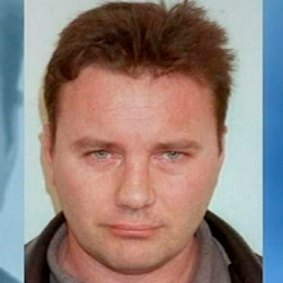
Michael MarshallCredit: Nine News
The SOG plans a job and leaves as little as possible to chance.
In October 2003, a Purana Taskforce bug picked up a hitman as they killed Michael Marshall in front of his son in South Yarra. The SOG was scrambled to make the arrest.
The killer had just finished a call from a public phone box to gangland boss Carl Williams when three SOG vehicles performed a mobile intercept. It must have been impressive.
“There was a pedestrian standing there with his hands in the air and when we directed a driver to go around she ran over the offender’s foot,” says Duncan.
Loading
There were stints outside the SOG and six months off when he fractured a vertebra planting explosives on a rope course. “It didn’t go well.”
Duncan travelled widely to study counter-terrorism and complete elite explosives courses, giving the group the capacity to explode into buildings without killing people inside the building or police outside.
Sadly, since 2002 the SOG has been preparing for events such as Bondi - described as active shooters. There are three responses: Immediate Emergency Action requires police to charge in; Emergency Action, where there is some time to prepare; and Protracted Deliberate Action, such as a siege.
For decades, police were trained to use force as a last resort – to cordon and contain and wait for negotiators.
Duncan says police need to read the play, saying attempts to negotiate with the Sydney Lindt Café gunman in 2014 were destined to fail. “He wouldn’t even come to the phone. It was always going to end badly.”
Systems have been streamlined to get the SOG to a crisis quickly, with a helicopter pad at police headquarters to transport a team instantly.
No matter how quickly they respond, it will usually be too late. He says US data shows an active shooter event lasts no more than 11 minutes.
“There are three keys. Stop the killing, stop the dying, which means police need some medical training, and stop the damage,” says Duncan.
General duties police are expected to respond even when outgunned. We now expect cops armed with handguns that they train with twice a year to go up against homicidal maniacs armed with high-powered rifles, such as the two gunmen in Bondi.
Duncan says a good shot may be able to hit a target with a handgun up to 20 metres. A fair shot with a longarm can hit a target from 150 metres.
The father and son kill team fired 100 shots in six minutes. Police returned fire less than four minutes after the first shots. The detective whose shots are believed to have killed one gunman and injured the other is one of many heroes from Bondi.
Ahmed al-Ahmed, the man who took the gun from one of them and was shot in the process, should be made Australian of the Year.
At the media conference the morning after, the impressive NSW Premier Chris Minns made an impassioned plea to call out antisemitism.
A member of my profession chose that moment to regurgitate false claims that some police froze in fear. Minns shut him down, strongly supporting the NSW police response. “Their bravery, their courage in those circumstances saved countless lives.”
I suspect the last angry man that reporter faced would be a boozy colleague when the drink tab finishes at his office Christmas Party.
Grief becomes anger and anger becomes blame. It becomes the fault of immigration policies, demonstrators, weak gun control or fabricated claims of police inaction.
There are two people to blame – the gunmen. One – facing 59 charges including 15 counts of murder – will rot in jail if convicted, and the other will rot in the ground.
And soon, good people will reclaim Bondi as theirs.
John Silvester lifts the lid on Australia’s criminal underworld. Subscribers can sign up to receive his Naked City newsletter every Thursday.