3 months ago
25
3 months ago
25
On most of the days he goes riding, Ferdi Saliba has plenty of company.
The lifetime resident of Deer Park leads the Brimbank bicycle users’ group, a gaggle of mostly retired cycling enthusiasts, aged from 50 to 92, who gather twice a week to ride the trails.
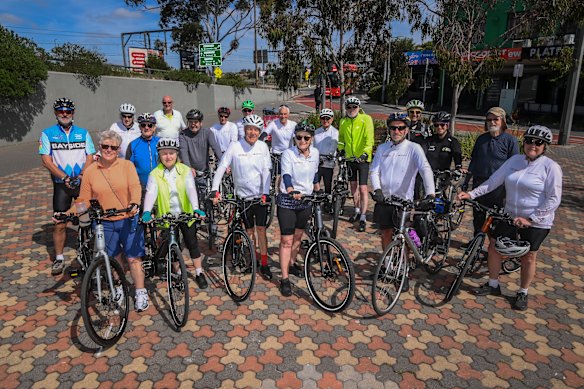
Ferdi Saliba (front, third from left) and his riding companions in the Brimbank bicycle users’ group.Credit: Justin McManus
But when Saliba cycles to Brimbank Central’s shops or the local medical clinic, he rarely sees another rider.
“You can’t really ride much around Deer Park … If you want to go to the main shops, you’d have to negotiate some roads with heavy vehicles,” he says.
It’s not just main roads filled with container trucks, or bike trails with missing links, that put people off riding in Deer Park, Saliba says.
“They just haven’t got the time,” he says. “They’re still busy working to support a family, paying off mortgages and that sort of stuff.”
Census data indicates Deer Park is an economically disadvantaged suburb.
The median weekly household income is $1459, which is more than 20 per cent below the Victorian average.
The low-rise suburb in Melbourne’s outer west is also car-dependent. Sixty-seven per cent of its working population commutes by car, compared with 54 per cent of Victorians overall.
The combination of car dependency and economic disadvantage is a potentially lethal one for residents of Deer Park. Census data also reveals that 6.6 per cent of residents have diabetes, compared with the statewide figure of 4.7 per cent.
New research from Swinburne University has joined the dots between population density and obesity, revealing that in sprawling suburbs, disadvantaged people are far more likely to be overweight than their richer neighbours, even when they share the same postcode.
According to the research, if you live in a low-density suburb and you are disadvantaged, your waistline will be on average five centimetres wider than your advantaged neighbour.
In medium-density suburbs, the bulge is less pronounced – waistlines are 2.61 centimetres wider on average for those on lower incomes. In high-density suburbs, the difference virtually disappears. Researchers found a “statistically insignificant” difference of just 0.54 centimetres in waistline girth between poor and affluent people who participated in the study and lived in high-density areas.
The study, released in academic journal Preventive Medicine Reports last month, analysed 12 years of longitudinal data on obesity from thousands of city dwellers who participated in the Australian diabetes obesity and lifestyle study, the largest Australian study of its kind.
Lead researcher Sungkavi Selvakumaran, a PhD candidate at Swinburne University’s School of Health Sciences, said the study’s findings suggested that socioeconomically disadvantaged people might be more vulnerable to the constraints on movement associated with lower-density suburbs, such as poor access to local shops, services and public transport.
A low-density suburb was defined in the study as having 15.3 people per hectare or fewer, and higher density as 21 people or more.
Selvakumaran said density was not the only factor. Compact neighbourhoods characteristically enable access to everyday needs without resorting to car travel.
“It’s not just about density but all the other built environment factors that go with it, so in a high-density neighbourhood you’re also looking at … more access to your destinations, green spaces, recreational facilities, your everyday amenities like shops and public transport,” Selvakumaran said.
The findings of the study suggested that increasing population density could help address socioeconomic inequalities in waist circumference, and should spur government and urban planners to prioritise walkability and compact neighbourhoods in new urban areas, she said.
Loading
“Our cities are growing because people are becoming more attracted to capital cities for a variety of reasons, so how we manage that growth is something we need to consider because it seems to have real implications for health and equity.”
Along with the US, Australia has the lowest-density cities in the world. A United Nations study, published last month, ranked Melbourne 490th of 510 cities for population density. Perth ranked 510th.
Melbourne’s outer suburban growth corridors are projected to continue to absorb most of its population growth in the next decade, despite a government target to direct 70 per cent of growth to established suburbs.
Selvakumaran said increasing the population density of Australian cities could have a positive impact on people’s health, but only if extra housing was built around walkable neighbourhoods with accessible shops and services.
In Brimbank, Saliba says the network of shared user paths is growing incrementally, though it’s not nearly as extensive as in inner Melbourne.
“The council has put in a reasonable amount of infrastructure. There are several large gaps or missing links that really need to be completed to join the new veloway.”
Start the day with a summary of the day’s most important and interesting stories, analysis and insights. Sign up for our Morning Edition newsletter.
Most Viewed in Politics
Loading