3 months ago
25
3 months ago
25
The Opera House was built with lottery money. Now a national lottery is being championed with a new goal
Sixty eight years ago, tickets in the biggest lottery ever held in NSW went on sale to help build the Sydney Opera House. First prize of $200,000 - a life-changing fortune in 1957 - benefited hundreds of winners from cooks to CEOs until the final round was drawn in September 1986.
Now three of Australia’s most eminent promoters of arts philanthropy have thrown their weight behind a proposal to create a national cultural lottery to fund thesector amid rising costs and stagnating government funding.
University of NSW Chancellor and philanthropist David Gonski, former head of Creative Partnerships Australia Fiona Menzies and media lawyer Michael Napthali say resurrecting an Opera House-style lottery is a “simple and clever initiative” to future-proof funding for the arts.
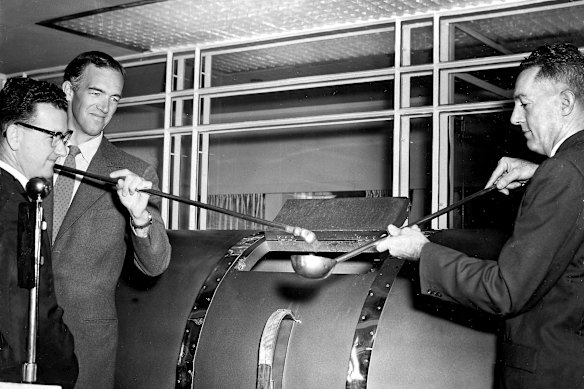
Architect Jørn Utzon drawing the winner of Sydney Opera House lottery number three in April 1958.Credit: Fairfax Archive
It’s one of five key recommendations the experienced trio have made, alongside a fixed-term incentive for giving to help arts organisations rebuild their reserves decimated in the COVID lockdowns; capital gains concessions for artworks donated from private collections to galleries that would unlock unseen treasures to the public; and greater acknowledgement and celebration of the donors who actively engage in arts.
Napthali, a board director of Bell Shakespeare, said the fundraising mechanism need not be strictly a lottery - it could be a scratchie or a raffle - but run by the Commonwealth to provide a discretionary pool of funds to underpin the work of performing arts companies and creative organisations.
“Its public policy attraction is the enfranchisement of lottery participants in the immense good which greater culture brings to society, thus rendering ticket holders contributors to the good which a lottery can bring to all in our community,” he told this masthead.
“In this sense, it’s a very egalitarian policy which acknowledges Australians’ love of a punt.”
The idea for a lottery is one of several key proposals raised at an arts tax summit set for September 25 in the very same Opera House that the lottery built. The Victorian and South Australian governments have announced they are joining forces with NSW to develop a suite of tax reform initiatives to take to the Commonwealth for the next national cultural policy.
NSW Arts Minister John Graham has urged the sector to think big at this moment of rare political alignment between the states and federal government.
Victoria’s Minister for Creative Industries, Collin Brooks, said: “Arts and cultural institutions are a part of what makes Victoria great. By backing our creative industries and having a strong voice in this important, national conversation, we’re supporting local talent and driving economic growth.”
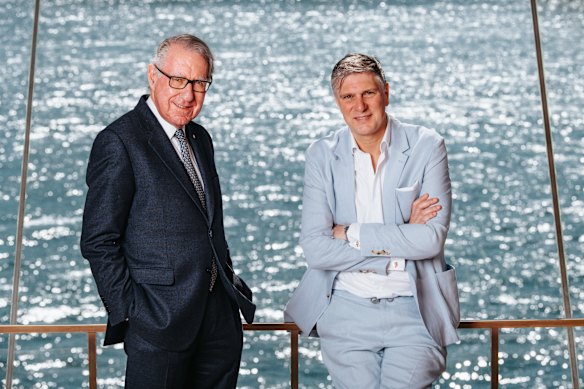
Resurrecting the idea of a national lottery to benefit the arts: David Gonski and Michael Napthali. Credit: James Brickwood
Many of the 300-plus submissions have urged the Tax Office to boost tax deductions to 150 per cent. Singapore offers 250 per cent deductions, Britain allows charities to claim a 25 per cent top-up for small donations. Sydney Theatre Company supports an additional tax deduction of 50 per cent for gifts of up to $1000 and 25 per cent between $1001 and $10,000.
Gonski led one of Australia’s biggest public-private partnerships in the arts, raising more than $100 million to build the Art Gallery of NSW’s $344 million contemporary art campus.
Many donors do not necessarily donate for the tax deduction, he noted. Motivated by a deep love and appreciation for the art form, they want to know their gift makes a difference - especially important to the younger generations of high-net-worth families who are often giving through trusts and foundations.
One extra option is introducing a new class of public honours dedicated to philanthropy.
Loading
“Publicly recognising and celebrating support from donors and businesses is crucial,” Menzies said. “It’s important to the donors, who have often given their time and expertise as well as their money. And by celebrating them publicly, it serves as an example and encourages others to do the same.
“Matched funding is a great way to engage donors. They feel that their contribution will go further and it gives them that sense of collective action.”
As for the national lottery, it is not without its challenges, the trio admitted. The actual licence for lottery services, established under the Sydney Opera House Act of 1961, was privatised.
Previous ideas to resurrect a lottery have been opposed by gaming entities fearful that such a scheme might erode their revenue. On the other hand, state governments are accused of inaction over problem gambling.
But the numbers are compelling enough to justify review: the Sydney Opera House lottery sold 86.7 million tickets and raised $102 million across 496 draws. In Britain, the National Lottery is one of the biggest sources of income support for cultural industries and heritage has raised well over $104 billion in its 30-year history.
Start the day with a summary of the day’s most important and interesting stories, analysis and insights. Sign up for our Morning Edition newsletter.
Most Viewed in Culture
Loading