2 months ago
19
2 months ago
19
Racing Victoria and Morrison strongly denied the claims.
At the heart of the matter were the Melbourne Cup safety protocols.
In her application to the commission for an order to stop bullying, Forbes alleged she had been pressured by Racing Victoria to become more flexible and allow international horses at “high risk of injury” to run in the Melbourne Cup.
Proceedings were brought to an end by this week’s settlement, meaning they will never be tested in court. When Morrison was contacted for comment, Racing Victoria confirmed Forbes had resigned but would not comment further. Forbes was unable to comment under the terms of the settlement.
Changes at the top
Forbes’ departure will continue a period of change for Racing Victoria leadership that began in February 2024.
Loading
That was when Thoroughbred Racehorse Owners Association chairman Jonathan Munz filed a motion to spill the board, a move designed to force change at the top.
At the time of the emergency general meeting, Munz accused racing’s executive of being “lazy and incompetent”.
He called for then CEO Andrew Jones to be sacked, demanded that Racing Victoria cut $10 million of “spending wastage” and slash another $10 million from its integrated media businesses.
In the following months, Jones and executive general managers Ben Amarfio and Matt Welsh resigned.
No mention was made of Forbes, the general manager of veterinary services at Racing Victoria, or her department.
In fact, discussions about Forbes’ future did not appear on the radar until a small blip caused her consternation on August 21 last year.
She was surprised to read a post from Independent racing journalist Bruce Clark posted on X, saying: “Seems like new Racing Victoria CEO Aaron Morrison moving swiftly to stamp his authority and reshape his team with General Manager Racing Matt Welsh and General Manager Veterinary Services Grace Forbes under immediate review – if not already moved on.”
Clark had more to say later that same day in his blog, Clarkofthecourse: “Matt Welsh as head of racing, now confirmed as gone as the first casualty of the Morrison era. Expect Grace Forbes, as manager, veterinary services, to soon follow Welsh’s path out the door.”
Clark did not reveal a source behind his commentary. But Forbes, who was overseas at the time of Clark’s post, believed she had cause for concern.
In her application to the Fair Work Commission this spring, Forbes claimed no one at Racing Victoria had done anything to deny the story or publicly clarify that her job was safe.
Communication breakdown
The blowtorch was turned on Racing Victoria’s Melbourne Cup safety protocols on the eve of last year’s spring carnival.
Five Melbourne Cup runners were scratched during eight drama-filled days by stewards acting on vets’ advice. Those scratchings led to a backlash from affected trainers and owners.
Irish powerhouse Aidan O’Brien labelled the testing process “ridiculous” after his runner and race favourite, Jan Brueghel, failed a CT scan at Werribee and was ruled unfit to run.
“Most scans are a view and an opinion,” O’Brien told UK racing program At The Races.
But O’Brien runners had not fared well in the Cup. Two of his gallopers suffered fatal injuries in the race – The Cliffsofmoher in 2018 and Anthony Van Dyck in 2020.
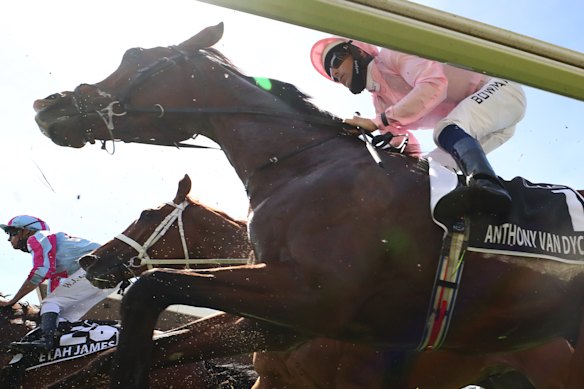
Racing Victoria is moving to the next phase of its Equine Limb Injury Prevention program.Credit: Getty Images
The disappointment of having horses scratched in 2024 was also felt by Australian connections.
Cranbourne duo Trent Busuttin and Nat Young released a statement to say they were “perplexed” by rulings against their runners Brayden Star and Muramasa, while renowned syndicator Terry Henderson claimed there was a lack of communication and consultation when their Australian OTI runner Athabascan, co-trained by John O’Shea and Tom Charlton, was ruled out with an irregular heartbeat.
Henderson later met with RV stewards, Forbes and the industry’s integrity department to voice his concerns about the process.

Racing Victoria chief executive Aaron Morrison.Credit: Racing Photos
He would later say there was “an acceptance that there needs to be a lot more information provided to connections in future when these horses are scratched in the way that they are”.
“I think that will help the industry enormously. It will certainly take away a lot of the angst that many feel when their horses are withdrawn,” Henderson said.
Loading
In April this year, Forbes alleged she was called into a meeting with Morrison and head of integrity Jamie Stier and asked to be more flexible when inspecting horses.
In her application to the Fair Work Commission, she accused them of wanting international horses trained by the likes of O’Brien and Charlie Appleby to be passed to run in the Cup, regardless of whether they were fit to race.
Racing Victoria denied the claim. It said the suggestion the industry was not “prioritising the welfare of our horses is completely rejected”.
A decision was also made earlier this year not to send Forbes to Britain to run Racing Victoria’s Melbourne Cup testing regime for international horses.
That duty was assigned to UK-based vets David Sykes and Amanda Piggot, who had a history of engagement and communication with international stables.
Morrison also travelled to England before the Royal Ascot carnival in June to meet international trainers at Newmarket to discuss Melbourne Cup protocols.
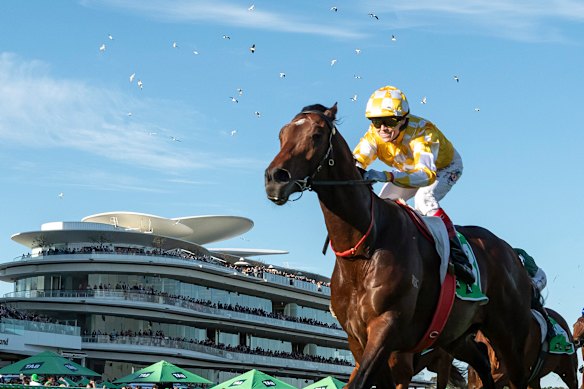
Sir Delius was scratched from this year’s Melbourne Cup. Credit: Getty Images
Forbes took personal leave in June this year, and in August lodged an application with the Fair Work Commission for an order to stop workplace bullying. She lodged a case with the Federal Court on October 30.
Ten international horses ran in this year’s Melbourne Cup, including Al Riffa, a highly rated stallion trained by O’Brien’s son, Joseph. Only five internationals took part in last year’s race.
But the lead-up to the 2025 Melbourne Cup was not without controversy.
While Forbes was on personal leave, Racing Victoria stewards scratched race favourite Sir Delius, trained by Gai Waterhouse and Adrian Bott, because an independent panel of vets ruled that it was at heightened risk of injury if it continued racing during the spring.
Need for change
After a spate of Melbourne Cup deaths that involved six international runners and an import trained in Australia, the race was under extreme pressure from animal rights groups in 2020.
Tough measures had to be taken. Following a review that involved input from a number of racing experts, including trainer Chris Waller, new safety protocols were introduced.
Loading
Those rules included international horses having to pass full-body scans before being allowed to travel to Australia, a process that involved injecting horses with a radioactive dye to undergo nuclear scintigraphy.
In an interview at the start of last year, Forbes likened her team’s philosophy to the AFL.
“In football, their aim is to pick up a hamstring injury at an early stage, and that way the player might miss one or two games, and then they’re back,” she said.
“Whereas if they miss the signs at an early stage, and they suffer a really serious injury, where they tear the hamstring, they often will be out for longer and maybe even require surgery.
“The horses are really the same. The aim for us [as industry vets] and for the trainers is to detect an injury at a really early stage.”
Forbes embraced technology. She introduced compulsory CT scans for all Cup runners to identify horses at risk.
Those scans were then reviewed by an independent panel of specialists from Australia, the UK and the US.
But Forbes was also mindful of an industry that had long relied on traditional approaches.
“In my opinion, nothing can replace good horsemanship, watching the horse, or running a hand over its legs,” she said.
Loading
Settlement deal
Forbes’ application for an anti-bullying order was set down for a three-day hearing at the Fair Work Commission this month.
Harrington told commissioner Trevor Clarke that the vet wanted to return to work.
But Harrington said there was no evidence that Racing Victoria had taken any steps or imposed any guidelines, or introduced any safety net, for her return.
The three-day hearing did not advance beyond a few words. No evidence was given by Forbes, nor her treating psychologist.
Instead, both parties engaged in 12 hours of mediation across two days before announcing they had agreed in principle to a confidential out-of-court settlement.
The financial cost to the racing industry was not released.
News, results and expert analysis from the weekend of sport are sent every Monday. Sign up for our Sport newsletter.