3 months ago
32
3 months ago
32
When a country is traumatised, leadership can be as simple as a hug. Nearly 30 years after the Port Arthur massacre, one of the defining images of the harrowing days which followed that tragedy is of John Howard embracing Dr Bryan Walpole, an emergency surgeon exhausted from attending to the wounded and the dead.
There was a tentativeness in the body language of Howard as he put his arm around the Hobart doctor – still wearing his white lab coat – on the cathedral steps of a memorial service. There was none from Dr Walpole, who buried his anguished face in the shoulder of the then-prime minister.
Anthony Albanese is a more instinctive hugger than Howard and a man more open with his emotions. Within hours of the mass shooting at Bondi Beach, he urged us to wrap our arms around the Jewish community. At a time when Jewish Australia and much of the nation is grieving for those murdered, the prime minister would have been a natural fit for the role of consoler-in-chief.
Instead, there is a coldness and a distance between Albanese and the family and friends of the Bondi victims. There is also a deep rift, unmended by the prime minister’s delayed, full-throated commitment to addressing antisemitism four days after the Bondi killings, between Albanese, his government, the Australian Labor Party and Jews who for the past two years asked for them to do more to stop the hate.
The father of the youngest of the Bondi victims, a 10 year-old-girl named Matilda who was shot dead as she was celebrating the first night of Hanukkah with her family on the beach, did not spare Albanese an ounce of his anger or his grief. “He failed Matilda,” he said of the prime minister.
Labor has a Jewish problem. If this wasn’t clear before Bondi, it is now. It runs much wider than the prime minister’s office and deeper than the normal partisan divide which cleaves nearly every issue in Australian public life. Executive Council of Australian Jewry co-chief executive Peter Wertheim, when asked to characterise the problem, is succinct: “It’s a moral paralysis.”
This is criticism from a friend. Sydney-based Wertheim, the son of an Auschwitz survivor, has an enduring relationship with Albanese. The pair famously campaigned together 24 years ago to stop the Boycott Divestment and Sanctions Movement from taking root at Marrickville Council in Albanese’s Sydney electorate and since then, have retained a mutual trust and respect.
Does he believe Albanese when the prime minister vows to eradicate antisemitism? “Nobody does. In his own mind, he is emotionally committed to that. But I think he is struggling. The nation is struggling, because the depth of evil we saw on Sunday is so far beyond the range of Australian life and experience.”
Inside the ALP, Jewish people who have dedicated much of their working lives to the party are dismayed, not just at the horrific events at Bondi, but how Labor has responded to a growing crisis within their community since October 7, 2023.
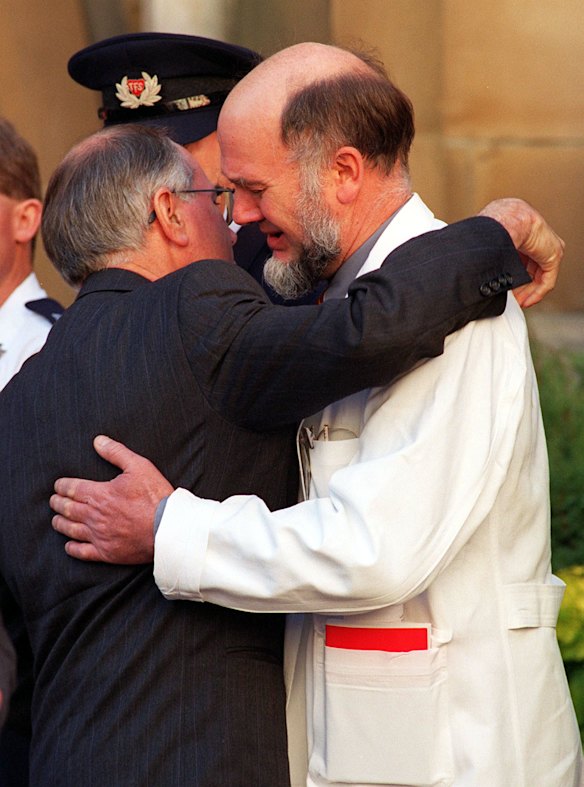
John Howard hugs Dr Bryan Walpole in the days after the Port Arthur massacre.Credit: Rick Stevens
“There is a very clear perception within the Jewish community that Labor governments, both state and federal, have not done enough to combat not just antisemitism but the normalisation of hate speech,” says Phil Dalidakis, a former minister in Victoria’s Andrews government. Michael Danby held the federal seat of Macnamara for Labor in Melbourne’s inner south, before current MP Josh Burns, for 21 years. “The cumulative effect of their policies is to create an atmosphere where people feel vulnerable,” he says.
On the night after the Bondi killings, this sense of vulnerability was palpable as Jews interrupted Hanukkah celebrations to attend impromptu vigils and community gatherings. In Melbourne, Victorian Premier Jacinta Allan, after chairing a meeting of cabinet, directed all of them to join her that night at the Caulfield Shule, in the middle of the city’s bagel belt, to demonstrate their solidarity.
The premier and ministers were cordially greeted as they arrived at the shule, a modern orthodox synagogue, a little after 7pm. Congregants shook their hands and thanked them for coming. But once everyone was seated and Zionism Victoria president Elyse Schachna formally announced Allan’s attendance, her presence was loudly jeered and booed. When Josh Burns was announced, they booed him as well. All the Liberal names dropped, including Victoria’s new Opposition Leader Jess Wilson, received enthusiastic applause.
A man seated in the pew behind me remarked it felt more like a football crowd than a congregation. This was a tribal rejection of federal and state Labor.
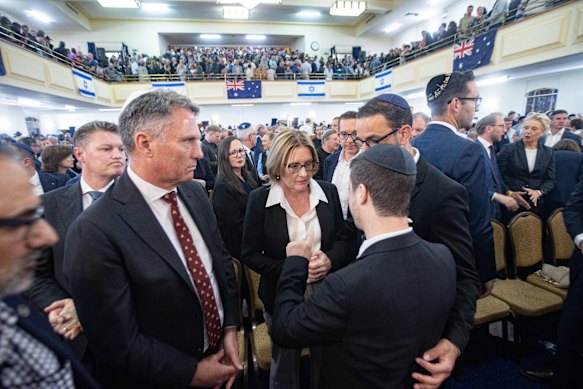
Premier Jacinta Allan is spoken to by a Jewish community member at the Caulfield Shule while Deputy Prime Minister Richard Marles and local MP Josh Burns look on.Credit: Simon Schluter
Burns is a Jewish MP who has campaigned against antisemitism. Just weeks after October 7, he travelled to Israel with a bipartisan delegation of state and federal MPs to make clear Australia’s support. Six months later, his electoral office was vandalised and daubed with antisemitic graffiti. He understands what Jew hatred feels like because, for the past two years, he has lived it.
Allan was sworn in as premier just 10 days before Hamas’ atrocities in southern Israel and the start of the Gaza war. Since then, her government has outlawed the display of symbols associated with proscribed terror groups such as Hamas and Hezbollah, strengthened the state’s anti-hate laws, introduced a criminal offence of serious vilification and banned protests outside places of worship. If you check the list of what the prime minister’s special envoy, Jillian Segal, asked from the states in her plan to combat antisemitism, Victoria is a poster child for implementation.
Micky Fisher, a Jewish lawyer who has worked in ALP campaign headquarters for the 2022 Victorian elections, believes Allan reached a turning point in her understanding of and response to antisemitism in the ashes of the Adass Israel arson attack. Before Bondi, the deliberately-lit fire which gutted the Ripponlea synagogue was Australia’s most notorious antisemitic episode. “Since Adass, if you analyse what Jacinta Allan has done, you will find very little policy daylight between her and Chris Minns,” Fisher says.
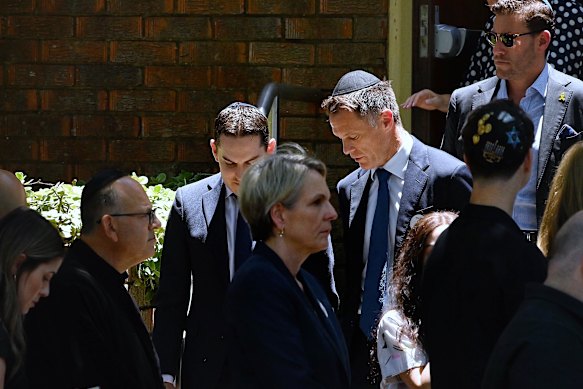
NSW Premier Chris Minns and federal Minister Tanya Plibersek joined mourners at the funeral of 10-year-old Matilda, the youngest victim of the Bondi massacre.Credit: Kate Geraghty
Schachna says that after Bondi, Jews are looking for something more. “The premier is a friend of the Jewish community and that matters,” she says. “But she is also the premier of Victoria and this moment demands leadership. After years of escalating antisemitism, Victorians are feeling unsafe and worn down. The crisis won’t be addressed by walking the middle line or managing competing pressures. It requires clear, decisive action to confront extremism.”
The day after the community gathering, Allan attends a Hanukkah service at Victoria’s parliament. Just before it started, Melinda Tassone, a 56-year-old Jewish accountant born in Australia, walks up to Allan and politely but forcefully, unloads. “We feel really, really let down,” she later explains. While Allan is addressing those gathered beneath the soaring, coffered ceiling of the Queen’s Hall, Tassone quietly pulls an Israeli flag out of her bag and wraps it around her shoulders.
Loading
Australia’s Jewish community is politically diverse and its relationship with Labor governments not uniform. Albanese was unwelcome at the funeral service of Bondi victims but Ron Levy, a Jewish professor from the College of Law, Governance and Policy, says that if the prime minister had come to the Monday night vigil at the Emanuel Synagogue in Woollahra where he attends, he would have been warmly received. He says the orthodox/progressive split within Judaism is also political and while the Jewish community here, as in Israel, has drifted harder to the right since the start of the war, there are still plenty of pro-Labor Jews who understand the party’s difficult task in balancing the post-Gaza interest of Jews and Muslims and more broadly, competing rights in a liberal democratic state.
Philip Mendes, the director of the Social Inclusion and Social Policy Research Unit at Monash University, has observed, documented and experienced what he describes as a growing intolerance towards Jews within some trade unions and progressive institutions, including political parties. He observes that NSW Premier Chris Minns, despite leading the state where Sunday’s horrendous mass shooting unfolded, appears trusted by the Jewish community in a way that Albanese and Allan are not.
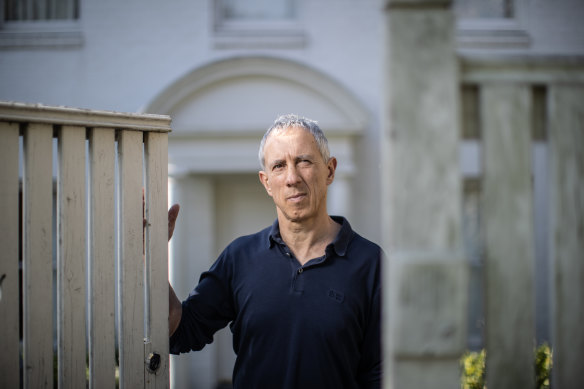
Philip Mendes says Anthony Albanese and Foreign Minister Penny Wong appear to have a lack of empathy for Jewish Australians. Credit: Simon Schluter
“He seemed to recognise the seriousness and the gravity of the issue from the beginning – that it is a matter that requires government, police and legal intervention,” Mendes says. The formal inquiries which will examine all decisions taken before, during and after the Bondi shootings will test this assessment. Mendes says Albanese and Foreign Minister Penny Wong, by contrast, appear to lack empathy for the Jewish community.
“There is a perception they are just trying to manage an issue, that they don’t see the Jewish community as part of their network and constituency,” he says.
Danby calls it a mechanical approach. “The zeitgeist that people are picking up, from the leadership down the grassroots, is these people are not sympathetic, don’t have their backs and keep making mechanical statements while letting the thing rip beneath the surface.”
Beneath the parliamentary ranks of the ALP, party life can be challenging for Jews. Within the NSW division of Young Labor, there are only a handful of Jews and most of them will soon be too old to keep their memberships. At last month’s state conference, they passed a resolution which opened a window into the harassment and bigotry that Jews have faced at local branch meetings.
“Many young Jewish members remain proud Labor people, campaigners, organisers and unionists, but are increasingly absent from Young Labor spaces,” it warned. “That is not because Jewish people have turned away from the Labor’s values but because at times, Young Labor has not lived up to them.
“When our Jewish members have sought solidarity from our comrades, too often they have been met with silence, qualification, or excuses ... Bigotry at branch meetings has gone unchallenged. Others have turned a blind eye when campus allies have targeted Jewish students irrespective of their political beliefs. Young, progressive, and enthusiastic Jewish students who want nothing more than to contribute to our movement are being pushed away by our growing tolerance for intolerance.”
Loading
Dean Sherr, a former adviser to Dalidakis, Burns and Albanese and an active Jewish member of the party, says this reflects a broader political schism across progressive politics. “Within the broader Labor movement there is a strong undercurrent which is very critical of Israel and much to the left of the parliamentary parties, both state and federal, as with most issues,” he says.
“Palestine has been held up as the litmus test in certain sections of the progressive world. You have to accept the prescribed, progressive position on Palestine or you’re a Zionist and you’re cast out.” A challenge for the Labor Party, he says, is to resist this pressure and hold a more moderate line.
Fisher says all state and federal leaders have condemned antisemitism but to restore the trust of the Jewish community, they need to identify and address the principal cause. “Whatever motivated these terrorists, Sunday sits at the apex of two years of vilification and incitement,” he says. “Jews are being demonised because Israel, and their connection to Israel, has been demonised and delegitimised, well beyond criticism of its government and the war. That is the essence of what is driving this hatred.”
Albanese has acknowledged his government could have done more to counter Jew hatred before the Bondi killings. On Thursday, he belatedly adopted Segal’s recommendations. He said new laws, which are yet to be drafted, would target hate preachers and hate speech. David Gonksi will lead a new taskforce which will focus on weeding antisemitism out of universities. Home Affairs Minister Tony Burke will be given more power to deny visas to people who express hatred for Jews. This follows two parliamentary inquiries into antisemitism on campus and calls since July by Jewish leaders for all governments to put Segal’s recommendations into action.
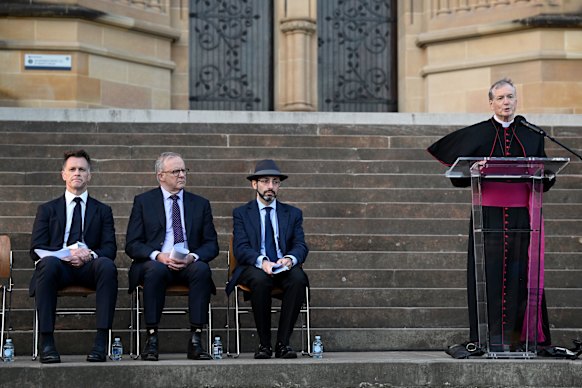
NSW Premier Chris Minns, Prime Minister Anthony Albanese and Rabbi Benjamin Elton listen to Sydney Catholic Archbishop Anthony Fisher at an interfaith ceremony in Sydney on Wednesday.Credit: AAP
In the meantime, Jewish businesses targeted by bigotry last week closed their doors until further notice. Within two days of the Bondi shootings, the Surry Hills bakery of celebrity chef Ed Halmagyi was tagged with a bright-red, inverted triangle symbol used by Hamas’ Al-Qassam brigades to identify Israeli targets.
The same symbol, which has been openly adopted by pro-Palestine protest groups in Australia, was last year used to target Melbourne wine seller Tim Cohen. It was also painted on Albanese’s electoral office and the US Consulate in Sydney and prominently displayed at a free Palestine protest event on Bondi Beach. Cohen has since closed his business and on Wednesday, Halmahgyi announced he could no longer ensure the safety of his staff, their families and his customers. “After two years of almost ceaseless harassment, vandalism and intimidation directed at our little bakery, we have to be realistic about the threats that exist going forward.”
The day after the Bondi attacks, the Goldstone Gallery in Collingwood also posted a note on its website saying it had closed due to safety concerns. The gallery was established by Nina Sanadze, an artist doxed alongside 600 Jewish creatives in the early months of the war, to give ostracised Jewish artists somewhere to show their works. Above the short message, Sanadze reproduced a famous, black and white photograph, taken in 1931 Germany, showing an unlit Menorah sitting in a window sill across the street from a Nazi flag.
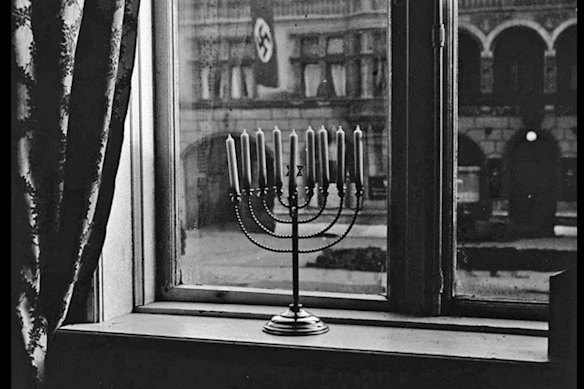
A 1931 photograph of a Jewish menorah on a window ledge in Nazi Germany. Credit: Alamy Stock Photo
On the steps of Sydney’s St Mary’s Cathedral, Rabbi Ben Elton from Sydney’s Great Synagogue, speaking in the company of the prime minster, urged all Australians to finally accept what we must confront.
“Over the past two years antisemitism in Australia has run riot. It has not been checked. It has not been stopped. Whatever has been done has been insufficient. On Sunday evening that became an unarguable fact. The time for evading, of muddying the issue, is over. The time for distracting, for gaslighting, for manufacturing complexity where it does not exist, is over.
“We can have all the political disagreements in the world and we should be able to express them reasonably. But hateful rhetoric has to stop. Demonisation has to stop. Pandering to movements that want to kill every Jew, everywhere, has to stop.”
Start the day with a summary of the day’s most important and interesting stories, analysis and insights. Sign up for our Morning Edition newsletter.