3 months ago
31
3 months ago
31
It’s December 23, 1951, and Sydney is experiencing one of the worst traffic jams in the history of the motor car. Thousands of vehicles are going nowhere across three kilometres of Epping Highway in Eastwood, north-west of the city centre. Some are locked up and abandoned by their owners.
The police force’s chief of traffic sends out a call to every available officer to help unblock the road, calling in squad cars from as far afield as Liverpool, 40 kilometres away. “I have never seen anything like it,” the chief tells a reporter.
The cause turns out to be uniquely seasonal: hundreds of “thoughtless motorists” who have stopped to gawp at the home of a local millionaire (a dwelling called El Rancho del Loro, named after a pet parrot) that has been festooned with some 6000 Christmas lights and a three-metre-high model of Santa disappearing down its chimney.
The festive season remains a particularly challenging time to be on the road, and not just because of distracting Santas.
Traffic is at its best when it can flow, everybody maintaining a consistent pace and appropriate gaps to the vehicle in front, braking gently, accelerating evenly, maximising the road’s capacity to enable vehicles to move safely. But throw in a dose of “Christmas craziness”, as Professor Hai Vu at Monash University calls it – with more cars in unexpected or unfamiliar places, ditherers, lane-change maniacs, tailgaters, drivers dashing to pick up that forgotten turkey – and it can quickly go awry. “We tend to think of Christmas as a holiday period,” he tells us, “but for the traffic engineering people, it’s actually quite a complex and unpredictable dynamic.”
Yet are traffic jams inevitable? What can be done to avoid them? And what are “phantom jams”?
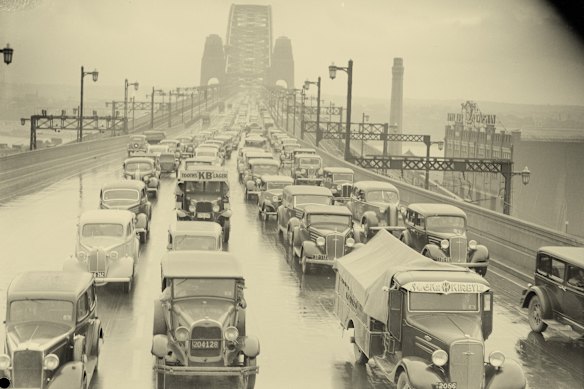
Bumper-to-bumper on the Sydney Harbour Bridge in 1937.Credit: Mitchell Library, State Library of New South Wales
Are traffic jams simply a fact of life?
Traffic jams are not a new phenomenon. In ancient times, Rome and Pompeii were notorious for their chariot tailbacks; and even before the car, New York was prone to gridlock, The New York Times reporting in 1879 a blockage on Broadway comprising horse-drawn “hacks, coupes, trucks, drays, butcher carts, passenger stages, express wagons, grocers’ and hucksters’ wagons, two-wheeled ‘dog carts’, furniture carts and piano trucks”.
But it was the advent of affordable cars such as Ford’s Model T (which arrived in Australia in 1908) that really started the troubles we experience today. “It is quite obvious that we have too much traffic for our city streets,” the Melbourne Herald complained in 1923, calling for more roads to serve the emerging “motor car” suburbs.
Being stuck in traffic is a uniquely irritating experience – not knowing how long you’ll be trapped, unable to relax as your best-laid plans slowly implode.
Barely five years later, motorised traffic had become such a problem in Sydney that the city held a public inquiry desperately seeking solutions, hearing from a certain Dr J.C.C. Bradfield that its “streets were never planned for traffic 10 times faster than horse traffic”. The good doctor noted parked cars blocking lanes, narrow streets snarling progress and fruitless “spasmodic efforts” by authorities to combat “chaotic” conditions – the kind of problems that have never been adequately addressed since.
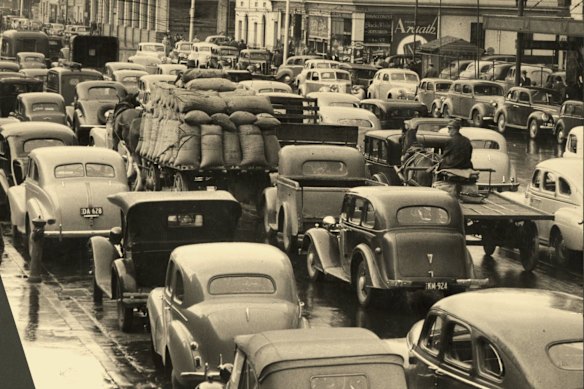
Cars and trucks jam Flinders Street in Melbourne in 1950. Credit: State Library of Victoria
Being stuck in traffic is a uniquely irritating experience – not knowing how long you’ll be trapped, unable to relax, frustration building as your best-laid plans slowly implode. “Damn this traffic jam,” sang James Taylor in 1977, echoing our collective pain. “I left my job about five o’clock, it took 15 minutes to go three blocks, just in time to stand in line with a freeway looking like a parking lot.”
To be fair, by world standards we don’t have it particularly bad in Australia. A 2011 poll of “commuter pain” by IBM ranked Mexico City as the worst of 20 cities surveyed (based on indicators such as travel time and how angry the traffic made people feel) followed by Shenzhen, Beijing, Nairobi, Johannesburg, Bangalore and New Delhi.
Spare a thought for motorists trapped on a 100-kilometre stretch of freeway outside Beijing in 2010 for 10 days straight, kept alive by enterprising noodle hawkers charging inflated prices; or for those fated to navigate the Apapa-Oshodi Expressway in the Nigerian “megacity” of Lagos, which a writer for The Atlantic, Joshua Hammer, endured in 2012, describing six hours trapped in just one notorious bottleneck “beset by flooding, construction, illegal truck-parking, collisions, packs of hoodlums, tanker fires and occasional blasts”.
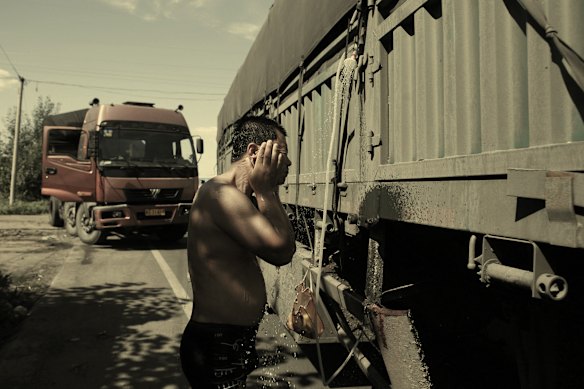
A driver showers with a makeshift contraption rigged to his coal truck during a days-long jam on the Beijing-Tibet Expressway in 2010. Credit: Getty Images
In India, it’s not uncommon to find your progress blocked by an elephant or a sacred cow; the Bangladeshi capital, Dhaka, is awash with so many arterial-clogging rickshaws that they’ve lost count: estimates range from 100,000 to a million. In New York’s Manhattan, traffic dropped close to walking speeds in midtown last year (though its new congestion charge has freed things up a little – more on that below). A four-hour round trip “super commute” is no longer remarkable in US ring-road cities such as Houston, Phoenix and Atlanta – places where the automobile once promised suburbanites the freedom to effortlessly live in one place and work in another, but has since reneged.
Even the wealthy Middle Eastern emirate of Dubai, with all the money in the world to build roads and flyovers and bypasses, can’t keep up with increasingly appalling traffic, its morning rush typically lasting from 6am to 10am, cars condemned to a torpid crawl on the main thoroughfare, Sheikh Zayed Road.
“We will never have sufficient road capacity to handle all traffic without congestion,” laments Michael Schreckenberg at the University of Duisburg-Essen in Germany, where he is a physics professor with a particular interest in traffic flow. “Traffic jams are a natural occurrence and will always exist … We must learn to live with traffic jams to some extent.”
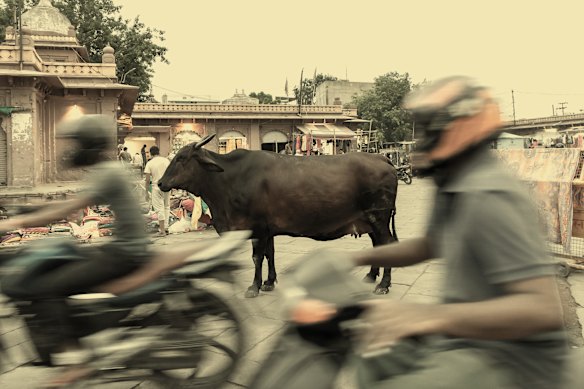
Mooooove over: Traffic will always part for a cow in India, including this one in Jodhpur in 2019.Credit: Getty Images
Shouldn’t we just build more roads?
Forever spending billions building more roads or improving existing ones can do surprisingly little to ease congestion in the long run – eventually traffic, like water finding its natural level, catches up. Think of Sydney’s Parramatta Road or Melbourne’s Hoddle Street: however many new lanes they add, both arterials are full to bursting come rush hour. Moscow’s infamous Garden Ring, around the Kremlin, was once up to 18 lanes; now a modest 10 at its widest, it is still often gridlocked. “Roads are invitations to drive on them,” notes Schreckenberg.
In 1962, US economist Anthony Downs called this effect “induced demand”. Downs was among the first of a new breed of scientist-engineer-economist types who have made it their business to study traffic and deduce what might be done to make it flow more freely.
‘Explorers are imaginative, high-strung, aggressive drivers who constantly search for some new route ... Sheep are more placid, patient and resigned.’
“The opening of a new expressway reduces peak-hour congestion on many previously existing streets because large numbers of commuters shift onto the new expressway,” Downs observed in the journal Traffic Quarterly. “At first, they are able to make much better time on the expressway. However, word of [this] soon spreads, and even more commuters shift from other routes onto the expressway. Gradually, the time required for commuting on the expressway rises as peak-hour congestion increases.”
Downs divided motorists into “explorers” and “sheep”. “Explorers are imaginative, high-strung, aggressive drivers who constantly search for some new route that will save them one or two minutes’ driving time. Sheep are more placid, patient and resigned. They tend to follow the leader and to travel the same route unless some significant change in their environment occurs.”
But if some explorers discover a faster route, a handful of sheep will follow and, eventually, the roads reach a new equilibrium, a phenomenon later dubbed the “Downs Law of Peak-Hour Traffic Congestion”.
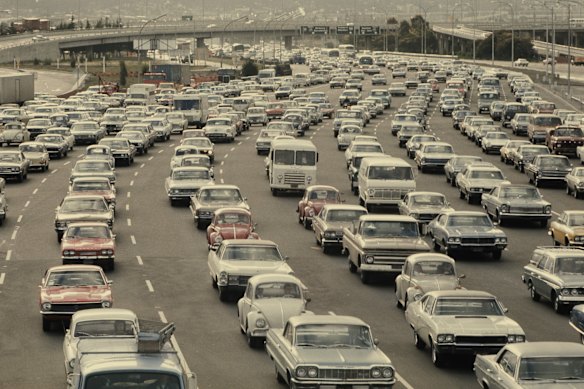
A Los Angeles freeway in the ’70s.Credit: Getty Images
In the 1960s, the Belgian physical chemist Ilya Prigogine (who would later win the Nobel Prize in Chemistry for his contributions to non-equilibrium thermodynamics) likened traffic to “the magnificently co-ordinated flight of a large flow of birds or the remarkable darting collective motion of a school of fish”. Carlos Daganzo, a civil engineer at University of California Berkeley, in 2002 divided drivers into “slugs”, who prefer to be in the slower lanes, and “rabbits” who prefer to overtake them whenever possible. Others have compared motorists to drops of water or molecules of gas in attempts to predict their behaviour.
‘My wife often complains that I drive too slowly. But at the same time, I observe the traffic around me because I do think about it ...’
“Traffic engineering is a relatively young field,” says Nirajan Shiwakoti, a professor at Melbourne’s RMIT who studies transportation. “It’s not like structural engineering, which has been around for a long time. That’s why we have been borrowing concepts from fluid mechanics. While human behaviour was known to matter, it took decades to properly model it.”
Schreckenberg tells us he often deliberately drives in traffic jams to see whether driver behaviour corresponds with his team’s theoretical modelling. “My own driving style is defensive. My wife often complains that I drive too slowly. But at the same time, I observe the traffic around me because I do think about it, whether the assumptions we make are actually correct. So I consider completely different things. How much risk do others take, what dangers are present, and so on.”

A bottleneck at a toll booth in Nanning, China, as a public holiday draws to a close. Credit: China News Service via Getty Images
What are “phantom jams”?
For Australian cities, the cause of most bouts of gridlock is usually prosaic. Too many vehicles squeezing onto not enough road at the same time causes what Schreckenberg – nicknamed the “Jam Professor” – describes as “sheer overload”. Then there’s weather (flooding rain or low, blinding sun) making motorists more cautious than usual; public transport cancellations; demonstrations; the increasingly congested school run (relatively few children these days walk or bike to class, preferring to travel in luxury SUVs); accidents (and accident gawkers), roadworks, lane closures and bottlenecks such as freeway exits.
Finally moving again, the traffic clears and it’s as if what had caused the momentary panic has simply vanished ...
About half of jams are “recurring” – the rush hour on, say, Sydney’s Military Road or Melbourne’s Springvale Road – and the rest are “non-recurring”, perhaps caused by a random fender-bender, according to Dong Ngoduy, an associate professor in transport engineering at Monash University.
Loading
In 2023, traffic researcher Ankit Bhardwaj and colleagues, writing in The Journal of Engineering, also identified “slowdown jams” where fast traffic gradually grinds to a still-moving but frustrating creep and “sudden jams”, where free-flowing vehicles suddenly come to a standstill for several minutes or even hours. These sudden jams, they say, are caused by “momentary bursts in the traffic” that overload a given stretch of road, noting these tend to be worse in developing nations thanks to “chaotic driving patterns and traffic mismanagement”.
Then there are so-called “phantom jams”, somehow appearing out of thin air (and a favourite subject with the experts we spoke with). We’ve all experienced it: one minute you’re cruising along at 80 km/h, the next you’re slamming on the brakes. Finally moving again, the traffic clears and it’s as if what had caused the momentary panic has simply vanished, hence “phantom”.
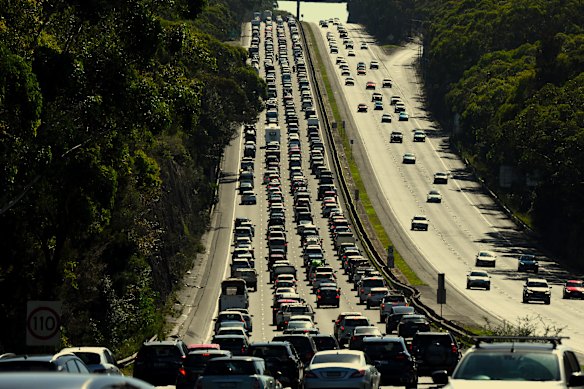
Holiday traffic heading north out of Sydney on the Pacific Highway in April.Credit: Getty Images
The cause can actually be pinpointed, though, says Schreckenberg: “You can identify individual drivers responsible for the traffic jam waves. There really are individuals who trigger this.”
As one motorist disrupts the flow by driving aggressively or unpredictably, others are forced to take evasive action, speeding up, slowing down or changing lanes to stay safe, generating a chain reaction behind them as more and more drivers are forced to react.
‘We check the phone, we’ll look out the window, we rubberneck. Sometimes we overreact to what’s going on in front of us. Those small things on an individual level can quickly amplify ...’
“There’s so many things that can go wrong when you’re driving,” says Zuduo Zheng, a professor of transport engineering and an Australian Research Council future fellow at the University of Queensland. “We are human and we are not perfect. We try our best, you know, to keep a reasonable distance, but sometimes we’ll get distracted, right? We check the phone, we’ll look out the window, we rubberneck. Sometimes we overreact to what’s going on in front of us. Those small things on an individual level can quickly amplify, eventually forcing some drivers to come to a complete stop to avoid a rear-end collision.”
In 2007, a group of Japanese physicists demonstrated the phantom effect in an experiment on a circular test track at Nakanihon Automotive College, near the city of Nagoya. They directed 22 drivers to maintain a speed of 30 km/h, spaced out evenly. There was no reason the drivers could not circulate freely forever. But before too long, tiny fluctuations in speed prompted some of them to dab the brakes, initiating a wave of disturbance that propagated back through the chain of cars, bringing a “cluster” of them to a stop, in a mini-jam.
“The vehicles inside the cluster of the jam stop completely, and the vehicles outside move freely,” they later observed in the New Journal of Physics. “The vehicle at the front of the cluster starts to accelerate and escapes from it, while another vehicle reaches the back of the cluster.”
‘Maybe you can get there a little bit faster. But in the end, if everybody would do this, we would get nowhere.’
Another name for it is a “stop and go” jam, says Michiel Bliemer, Professor of Transport Planning and Modelling at the University of Sydney. “Because we stop temporarily, and then suddenly we drive again, and then we stop again and we drive again. Those are specific types of jams that occur when the number of vehicles on the road is close to capacity,” he says. “Any small disturbance in this quite unstable situation can disrupt the traffic flow.”
He adds: “When you leave a lane, you essentially leave empty space behind. So that’s inefficient. Push yourself into another lane and the vehicle behind you has to brake. So it creates all these disruptions. Maybe you can get there a little bit faster. But in the end, if everybody would do this, we would get nowhere.”
These disruptive waves are not only frustrating, says Schreckenberg, they can be deadly. “You drive out of a traffic jam and think you’ve made it. But then the next wave of congestion comes along, and then your concentration is lowered. And that’s where a lot of accidents happen. You can easily see that in the statistics.”
There is some poetic justice, meantime, for the drivers who cause the jam in the first place and who you might think get away scot-free, leaving chaos in their wake, he says: “They end up stuck in a traffic jam caused by someone in front of them who behaved exactly the same way.”
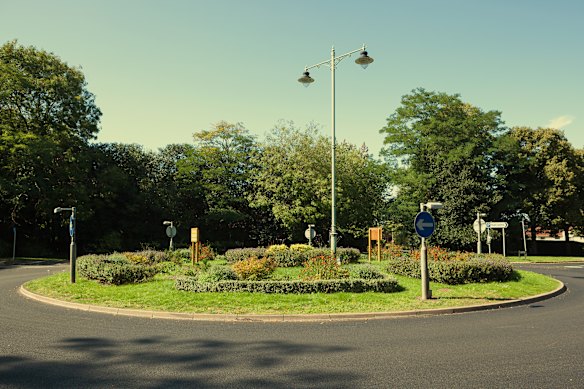
An early roundabout in Britain, circa 1909, in Letchworth Garden City. Credit: Getty Images
So what can actually be done to reduce jams?
Sick of enduring narrow streets choked with goods wagons, the ancient Romans made some of the earliest attempts to control traffic, devising one-way systems to funnel flow and at one point even declared a daytime ban on carts and chariots in Rome’s centre, “except to transport construction materials for the temples of the gods or for other great public works or to take away demolition materials,” as Tom Vanderbilt notes in his entertaining book about motorists’ behaviour, Traffic: Why We Drive the Way We Do. Many of those ideas remain current: Melbourne’s Little Collins Street, for example, is one-way but a section of it is closed to through traffic from noon to 2pm weekdays.
The Romans are still finding new ways to grapple with congestion, its carabinieri recently introducing small electric Fiat Topolinos to fight crime in the cobbled backstreets. In the modern era, though, the primary state of the art is traffic controls that can adapt to prevailing conditions. One-way roundabouts do this passively, allowing easy passage when traffic is light but automatically regulating flow when it starts to build up (note that a recent attempt to reinvent the roundabout as a diamond shape by Sydney’s Liverpool Council was a short-lived disaster, causing some motorists to comically make three-point turns before it was hastily removed).
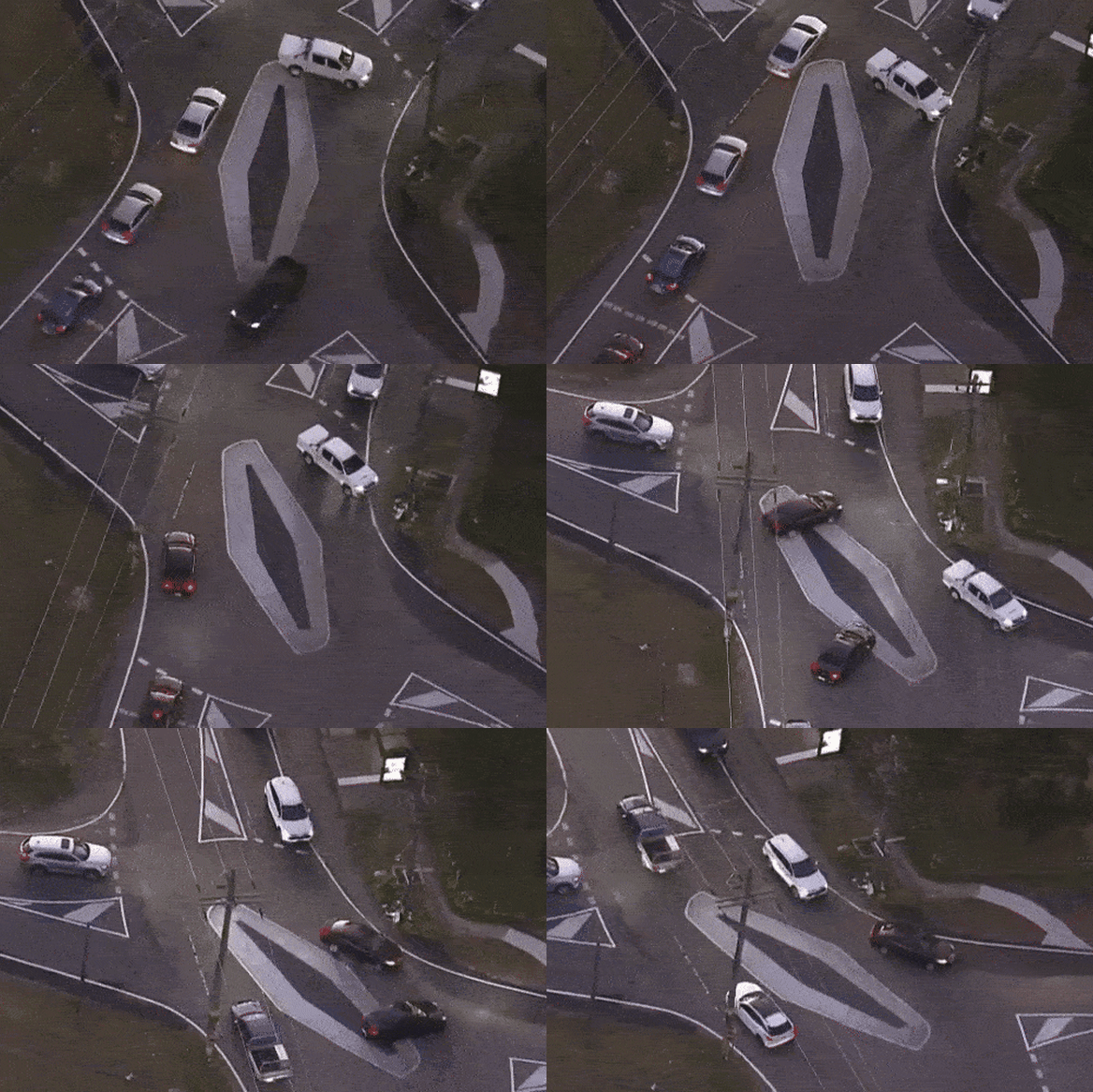
Aerial footage shows a ute doing a three-point turn to get around the diamond in Liverpool. Credit: Nine News
Gas-fuelled traffic lights were invented in the 1800s, though they tended to blow up; the first of what we might recognise as a modern set appeared in Salt Lake City, Utah, in 1912; five years later, the city had lights at six intersections linked by a manual switching apparatus. By 1920, Los Angeles had lights that operated on automatic timers. (That year also saw the introduction of the yellow light, the pause between red and green, though how best to employ it is still disputed. In Britain, for one, the yellow light heralds both incoming red and green light changes. “How yellow light is perceived worldwide is heavily dependent on different cultures, an unsatisfactory situation,” says Schreckenberg.)
For traffic engineers interested in jams, though, the breakthrough innovation came much later when traffic lights could be controlled remotely, or triggered by sensors built into the roads, responsive to the flow of vehicles. Developed in the 1970s, SCATS, for Sydney Coordinated Adaptive Traffic System, was one of the first systems that could detect traffic and calibrate red/yellow/green change times to minimise delays. Lights today use a similar system now networked to others in their vicinity, to ensure you hit green all the way, or to drip-feed heavy traffic through key intersections as efficiently as possible.
Ramps with mini traffic lights that control how many vehicles enter a motorway … are one of the most effective traffic management measures.
Other key innovations, our experts say, include lanes that can switch direction to account for peak-hour flows (such as Melbourne’s Queens Road, which has three lanes inbound in the morning peak and two lanes outbound, but reverses this to provide three lanes outbound in the evening peak); and ramps with mini traffic lights that control how many vehicles enter a motorway and merge with other traffic during peak periods. This is one of the “most effective traffic management measures”, Bliemer tells us, because it minimises the impact of new vehicles on the smooth flow of high-speed traffic and reduces the risk of phantom jams. Variable speed limits are another useful tool, helping major roads to clear traffic before the next wave arrives.
Some cities have also tried so-called congestion pricing, which charges motorists to enter particular zones, usually the central business district, or notoriously congested roads. Singapore, one of the first nations to introduce congestion pricing, in 1975, charges between 50 Singaporean cents, or about 58 cents, and $S5, to travel on tolled roads, the goal being to keep traffic moving at between 20km/h and 30km/h on arterials and 45km/h and 65km/h on highways.
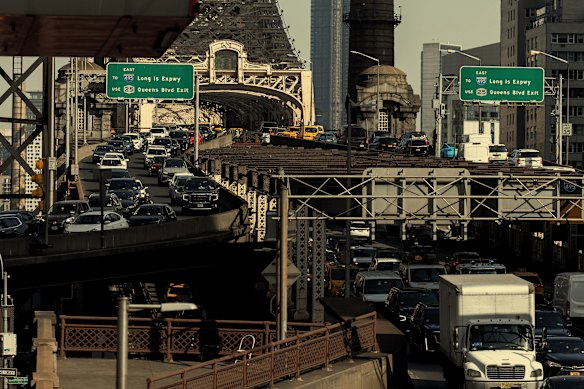
Traffic enters New York’s Congestion Relief Zone in April.Credit: Getty Images
In London, you pay a flat £15 ($30) if you want to enter the Congestion Charge Zone (which includes Soho, Covent Garden and Westminster) between 7am and 6pm weekdays and noon and 6pm on weekends (though it’s free on Christmas Day). New York’s similar scheme was introduced this year after several false starts (it’s still being legally contested after President Donald Trump vowed to get rid of it). It covers all of Manhattan south of 61st Street (roughly from the bottom of Central Park) and charges car users $US9 ($13.50) to enter during the day. Traffic reportedly dropped by 11 per cent over the first six months (and there have been fewer complaints of excessive honking).
The success or otherwise of London’s scheme has been more complex to quantify – due to population growth, more delivery vehicles and more ride-share services, pedestrians and cyclists using some road space – with the result that traffic speeds today are roughly the same as they were before the charge was implemented in 2003.
Loading
In Australia, our experts tell us, congestion pricing is unlikely to be politically palatable any time soon because it can easily be argued that it is inequitable (pocket change for the wealthy, an unfair burden for everybody else). “Acceptability would be a major challenge,” says Bliemer, who also notes that a cordon-style system (typically controlled by gantries and transponders or number plate-recognition technology) would be tricky in a city such as Sydney, where traffic congestion is not confined to the CBD. We do have variable toll charges on roads, however, such as Melbourne’s new West Gate Tunnel (which charges an additional $6.54 for cars exiting into the city between 7am and 9am on weekdays) and the Sydney Harbour Bridge ($4.27 during mornings and evening weekday peaks, $3.20 off-peak) – congestion pricing by another name, perhaps.
‘High-quality public transport may not completely remove traffic, but it helps most people avoid it while still getting to where they need to be.’
As for directly encouraging motorists to take public transport or walk or ride a bike instead, as cities such as Singapore also do – which would seem a surefire way to ease congestion on the roads – well, it’s not that simple. A 2021 paper by Rafael Prieto Curiel and collaborators published in Royal Society Open Science concluded that, “Providing citizens with more travel options, local shops and services with mixed land use can decrease car use.” But it also stated: “Still, changing mobility behaviours is challenging and might require interventions such as congestion charges, dynamic tolling, parking bans and removing free parking to reduce single-occupancy vehicle commutes, increase public transport use and promote active mobility.”
A 2023 discussion paper from the Public Transport Users Association of Victoria, meanwhile, looked again at the problem of roads always filling to capacity. “If people shift from cars to public transport, the effect is the same as from building a new road: it frees up road capacity, so people respond by driving more. So to a large extent, the traffic shifted to public transport will just be replaced by new traffic.” It is theoretically possible, they say, “for public transport improvements to reduce road congestion, but it requires quite special conditions – in particular, a political willingness to continue investing in more public transport expansion as patronage grows, and not to be tempted to add lots of new road capacity at the same time”.
Bottom line, as the PTUA’s Daniel Bowen told us: “High-quality public transport may not completely remove traffic, but it helps most people avoid it while still getting to where they need to be.”
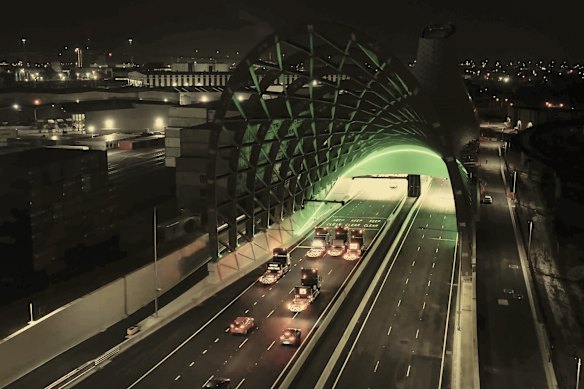
The first cars drive through the West Gate Tunnel in Melbourne in December.Credit: Victorian Government, still from a video
Will self-driving cars help?
Artificial intelligence is offering to better predict traffic conditions so they might be dealt with ahead of time. But new technologies are not always as effective as their proponents claim. In 2015, Uber’s then-chief executive, Travis Kalanick, told a conference: “If every car in San Francisco was Ubered, there would be no traffic.” That’s impossible to test but evidence subsequently suggested that ride-share services actually add to congestion by increasing the number of cars on the road.
Mapping apps can have adverse effects, too, says Schreckenberg. They might help prevent really big jams by guiding motorists onto lesser-used routes, he says, “But since the capacity of these routes is significantly lower than that of the highway, you very quickly end up with traffic jams for just a few people.”
Which brings us to the Next Big Thing for traffic engineers: the fully connected and autonomous vehicle, able to talk to everything around it, stop and go in unison with others and seamlessly co-operate at intersections where traffic lights will no longer be necessary. Groups of cars could even travel inches apart at 150km/h in “platoons”, says Bliemer.
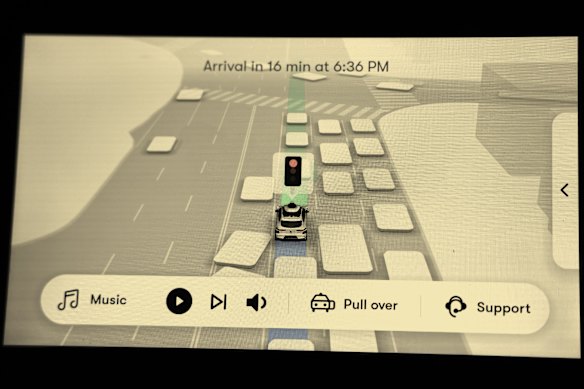
The backseat passenger screen of a self-driving “robotaxi” in Santa Monica, California in 2024. Credit: Getty Images
“My hope is that it will happen one day,” says Monash’s Hai Vu. But even this brave new world may not, ultimately, eliminate traffic congestion, says Dong Ngoduy, suggesting that these vehicles might initially improve flow by driving better than we slug/rabbit humans can, but they might also induce more travel demand. “In my view, their impact on traffic is quite debatable.”
‘Because they have a larger headway in their programming, they will actually create less capacity on the road and probably [create] a little bit more congestion.’
Michiele Bliemer, University of SydneyAnd until every car on the road is autonomous, manufacturers would need to be extremely cautious, says Bliemer, accounting for unpredictable self-driving humans still in the traffic mix. “There is likely not a lot to gain in traffic jams because the car manufacturers that are currently building them are setting the algorithms quite conservatively so their headways – the space they keep to the previous car – are relatively large because human drivers take much more risk. So because they have a larger headway in their programming, they will actually create less capacity on the road and probably [create] a little bit more congestion.”
Loading
The major hurdle, agrees Shiwakoti, is this transition period. “It could be a game-changer. But the challenge is how we transition from level-four automation to level-five automation.” (Level four is cars that can drive themselves without human involvement in specific conditions while level five is fully autonomous in all conditions.)
Schreckenberg suggests that human behaviour might, at times, be more practical than that of robots. “Self-driving vehicles might cause more traffic jams because they have to adhere to traffic rules, which [human] drivers don’t. Many things actually work quite well today because, let’s say, traffic rules are overridden relatively gently. But it remains to be seen to what extent self-driving vehicles are also able to adapt their behaviour, to be more flexible. Legally, it shouldn’t be possible for a self-driving vehicle to break the law.” Ultimately, he says, traffic jams are likely to stay with us forever. “We will be able to make traffic jams predictable, allowing us to anticipate and plan around them, but we cannot prevent them entirely.”
Get fascinating insights and explanations on the world’s most perplexing topics. Sign up for our weekly Explainer newsletter.