2 months ago
14
2 months ago
14
In 2017, before he was a convicted supporter of the Islamic State terror group, a young Australian named Radwan Dakkak endorsed a book by a Salafi cleric on social media.
A friend, Wissam Haddad, agreed: “a very good book”, he commented on the now-deleted Facebook post.
The book in question, Verily, the Victory of Allah is Near by Sulaiman Al-Alwan, a Saudi national whose students in the early 2000s included one of the future 9/11 plane hijackers, discusses “the permissibility” of jihad aimed at “terrorising the usurping Jews and the transgressing Christians”.
The “benefits” of suicide attacks, he wrote, had been shown because it “shocked the enemies and [had] sown fear in the hearts” and caused “the fleeing of many of the Jews from the lands of Palestine”.
Haddad’s endorsement of the pro-Jihad book, and his link to Dakkak, who in 2020 was jailed over his links to the terror group, is just one example in the western Sydney cleric’s history of radicalism, and his associations with Australian IS devotees.
Haddad’s association with one of the Bondi terrorists, Naveed Akram, has focused significant new attention on the Bankstown-based cleric. On Thursday, the federal government announced a crackdown on so-called hate preachers, and AFP Commissioner Krissy Barrett said clerics who “spew hatred and cause fear are on my radar”.
Also known as Abu Ousayd, the Salafi cleric has, over many years, cultivated a network of followers, some of whom have been convicted of terror offences.
In 2019, Youssef Uweinat, a now-27-year-old who was convicted of being an IS recruiter, wrote in an encrypted message in 2019: “you don’t know how much shit were (sic) in cuz, they know we are all linked .... me … abu ousayd, the boys they got locked up”.
In August, among the hundreds of thousands of people who crossed the Sydney Harbour Bridge supporting Palestine, Haddad was spotted in the crowd along with about a dozen associates, including Uweinat, with the black flag of IS.
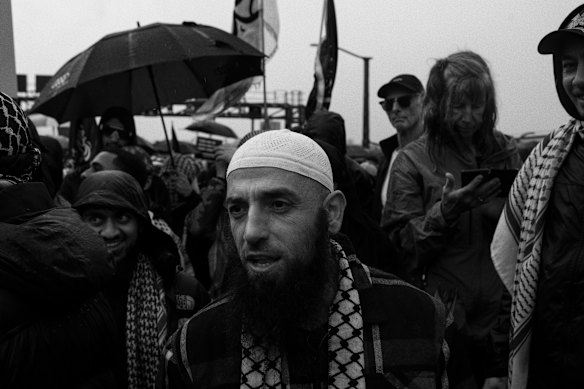
Wisam Haddad at the March for Humanity.Credit: Andrew Quilty
Yet despite terror raids which found IS material at his home, links to the extortion and intimidation of a religious rival, and a Federal Court ruling this year which found he vilified Jews by posting his “fundamentally racist and antisemitic” lectures online, Haddad has so far avoided serious criminal sanction.
That ability to evade police has befuddled and enraged many members of the Muslim community, who despise Haddad’s hardline rhetoric.
But, in revelations which will raise questions about the tactics of law enforcement agencies in dealing with hardline fundamentalists, two senior members of Sydney’s Muslim community have told the Herald that in a private meeting with NSW Police a decade ago, a senior officer conceded they would not shut Haddad down because his Islamic centre was “a good intel source”.
Haddad was, in effect, a “honey pot”, the two sources who were at the meeting say police told them.
“All the police keep doing is arresting the kids he radicalises and leave him out there,” one of the Muslim leaders at the meeting said.
“And the community has been saying for over 10 years, why haven’t you arrested this individual? He is destroying lots of these young men.
“He grooms these guys. He puts the gun in your hand, gives you ammunition, does everything except tell you to shoot it.”
Loading
The officer who reportedly made the comment has since retired. A police spokeswoman said the force was “unable to substantiate the claims” made by the two sources as a result.
Haddad first came to the attention of the public in the early 2010s, as the owner of the radical Al Risalah Centre, a bookshop and prayer room in Bankstown. His close friends included the notorious IS fighter Khaled Sharrouf, who became infamous after posting a photograph of his seven-year-old son holding a severed head in 2015.
Other associates included Sheik Mustapha al Majzoub, who gave a sermon at Al Risalah five months before he was killed in Syria in August 2012.
It was also around this time that Haddad founded what he described as “Australia’s first street Dawah initiative”.
A form of proselytising popular among some hardline Salafi Muslims, street Dawah, where volunteers preach on street corners and outside train stations, has been linked to violent extremists both in Australia and overseas. At least seven of the 15 men detained during counter-terrorism raids in 2014 knew each other through a street Dawah group in Parramatta, for example.
In 2012 the group held a “brothers’ day out” at a shooting range in Menai, in the city’s south. Video from the day shows Haddad alongside Ahmed Elomar, the brother of slain ISIS fighter Mohamed Elomar.
“Let me tell ya we got some sharpshooters on board,” text inserted over the video states.
“That’s right we teach them how to shoot……”
Haddad has been linked to multiple high-profile cases – including the intimidation and extortion of a neighbouring business and religious rival – and has been described as a “spiritual leader” of a pro-IS network in Australia.
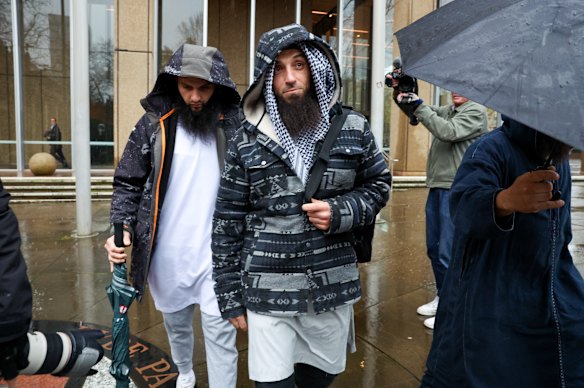
Wissam Haddad (centre) leaves the Federal Court in Sydney after a court found he contravened the Racial Discrimination Act in three lectures.Credit: Edwina Pickles
He said in a statement there was “no evidence to support this allegation”, and that he had never been “charged, tried, or convicted” of ISIS membership. Indeed, the only criminal charge Haddad has been convicted of related to the discovery of weapons during a raid on his home in 2015.
He has, however, appeared in court judgements related to Australian IS devotees.
Tapped phone calls recorded before police broke up a six-man terror cell in 2014 and 2015 included a conversation between aspiring jihadist Sulayman Khalid and another member of the cell, a minor, in which they discussed “wanting to make a decision” over whether to “fight overseas, or commit to a domestic terrorist attack in Australia”.
The transcripts contained in the court judgement state the minor, referred to as IM, told Khalid that Haddad was “right here” and that he wanted to ask whether they should “make banana over there or here”.
Banana was a code word the terror cell used for firearms.
Another decision shows that when a high-risk terror offender listed Haddad’s home as his intended address if he was released on parole in 2014, a judge noted his bookshop was “said to be a haunt of adherents of violent extremism”.
More recently, in 2023, when Nowroz Amin, a committed IS supporter who was jailed for preparing for a terror attack in Bangladesh, was released from prison, Haddad appeared alongside convicted terrorists such as Issac El-Matari and Dakkak on a list of people he was banned from associating with.
In recent years, Haddad, whose brand of Salafism is traditionally vehemently at odds with Hamas, has frequently sermonised about Israel, and the war in Gaza, in a pivot many Muslim leaders see as an attempt to stay relevant following the outbreak of the war in Palestine.
As the ABC has previously reported, Haddad – who has strongly denied any knowledge of the Bondi shooting – posted a photo of Uweinat online following the Harbour Bridge rally: “The only flag that counts!” he wrote.
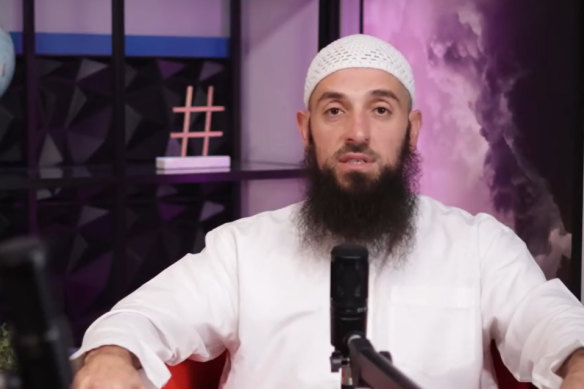
The Executive Council of Australian Jewry has launched legal action against Islamic preacher Wissam Haddad.
This week the Herald reported that alleged Bondi gunman Naveed Akram came to the attention of ASIO due to his association with an IS cell, which had multiple members linked to a separate street preaching group in Bankstown.
In 2019, Akram appeared in a series of photos and videos in social media for the Street Dawah Movement, an organisation linked to a series of other Islamic State supporters including Joseph Saadieh, Moudasser Taleb and Youssef Uweinat.
That group has since distanced itself from Akram and other IS supporters which came into its orbit, and a spokesman called the Bondi shooter a “snake” who they believed was mentally ill.
While Haddad has also distanced himself from Akram, releasing a statement saying there were “no verified photos” of the two together, he did not address whether he knew the alleged shooter. In the statement, he said it was “misleading” to call Akram one of his followers.
He did not respond to specific questions from the Herald.
Bondi Beach incident helplines:
- Bondi Beach Victim Services on 1800 411 822
- Bondi Beach Public Information & Enquiry Centre on 1800 227 228
- NSW Mental Health Line on 1800 011 511 or Lifeline on 13 11 14
- Kids Helpline on 1800 55 1800 or chat online at kidshelpline.com.au
Start the day with a summary of the day’s most important and interesting stories, analysis and insights. Sign up for our Morning Edition newsletter.