2 months ago
17
2 months ago
17
England facing record chase to keep Ashes alive as Head creates history with brilliant century
England will need to produce the highest Test run chase at the Adelaide Oval to keep their faint Ashes hopes alive after a sparkling Travis Head century put Australia on the cusp of a resounding series victory.
Cameron Green’s place in the Australian side may be up for debate after twin failures increased the pressure on the all-rounder, but the usual suspects of Head (142 not out) and Alex Carey (52 not out) propelled Australia to a 356-run lead with six wickets in the bank and two days remaining.
Ben Stokes’ contribution of 83 in England’s first innings saved the tourists from complete embarrassment, but his inability to bowl at all in the 66 overs on day three was a concern – and perhaps a tacit raising of the white flag just days after a Noosa holiday that may have refreshed the squad but did little to improve performances on the field.
Stokes left the field at one point, but returned shortly after. He has bowled some lion-hearted spells in his career, but when his side needed him most on Friday, with the series at stake, he was unable to help.
The highest successful run chase at the Adelaide Oval is the 6-315, made by an Australia side in 1902 featuring Victor Trumper. The next is the West Indies’ 5-239 in 1982.
On a cooler day, Head bludgeoned his second century of the series as an opener, reaching triple figures in front of 53,696 spectators with a lofted drive over the infield moments after Harry Brook dropped him in the gully on 99.
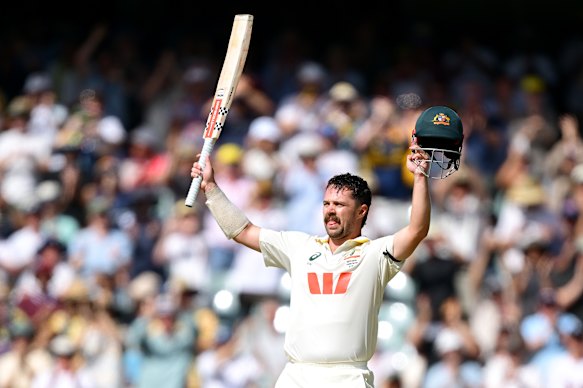
Travis Head celebrates his fourth consecutive century in an Adelaide Test.Credit: Getty Images
England’s catching has been below par throughout the series, particularly during the second Test in Brisbane, and Brook’s late fumble was emblematic of the tourists’ struggles and their inability to nail clutch moments.
With a kiss of the pitch and a raised bat towards his wife, Jess, in the stands, Head grinned like a player who knew the Ashes job was almost complete. A century stand with his South Australian mate late on day three served as further misery for the tourists.
Usman Khawaja’s back injury in Perth opened the door for Head’s promotion up the order and it has played a pivotal role in shaping the series.
It has felt as though a Head century has been included in the price of admission at the Adelaide Oval in recent years. While other Australians boast superior Test averages at the venue – such as Sir Donald Bradman (107.77) and Michael Clarke (94.26) – Head is the hero of the city, the player fans stream in from the pavilion out the back of Adelaide Oval to watch bat.
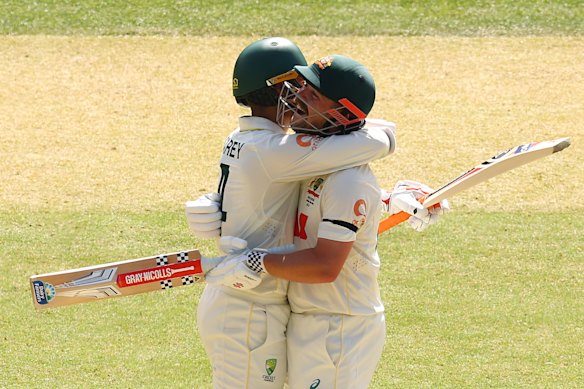
Hometown heroes Alex Carey and Travis Head completely took the game away from England with their late century partnership.Credit: Getty Images
Head joined Bradman (Leeds and Melbourne), Clarke (Adelaide) and Steve Smith (Melbourne) as Australians to score four centuries in four consecutive Test matches at the same venue. The only player to do it five times is New Zealand’s Kane Williamson at Hamilton’s Seddon Park.
Jake Weatherald’s difficult match continued when he was trapped lbw by Brydon Carse for a 10-ball one, but replays showed the ball pitched outside leg stump, and had he reviewed the decision, he would have been given not out. Head, positioned well to the off side at the non-striker’s end, could not get a clear look at the line and did not urge his opening partner strongly enough to review.
Marnus Labuschagne (13) and Khawaja (40) were steady, but it was Green’s dismissal for seven – following a duck in the first innings – that was most alarming in an otherwise dominant day for Australia.
After playing and missing at Josh Tongue the ball before, Green felt no need to rein in his shot selection and edged the next delivery.
From 18 Tests, the 26-year-old’s batting average in Australia is at a moderate 28.62. His bowling remains a valuable asset, but with Beau Webster wondering why he is not in the team, Green needs a score to cement his place in the line-up for the long term. He is at risk of becoming one of Australian cricket’s great underachievers.
The Jofra Archer–Stokes partnership of 106 runs was England’s best ninth-wicket stand in an Ashes Test in 99 years. Their heated exchange on the morning of day two, when Archer was not bowling to his field, was smoothed over by a dogged knock from the England No.10 as England were bowled out for 286, trailing by 85 runs.
Loading
It was a fighting innings, featuring lovely, classic strokes that had Stokes patting his teammate on the back rather than pointing the finger. Without Stokes and Archer in this series, England would have faced humiliation on an even greater scale. Their teammates could do worse than to show a fraction of their tenacity.
When Stokes was bowled by Mitchell Starc, 17 runs shy of a second Test century in Australia, he flung his bat in the air and was livid at his dismissal, knowing deep down that it likely marked the end of an Ashes campaign few could have predicted would be so one-sided.
Most Viewed in Sport
Loading