3 months ago
26
3 months ago
26
You can complain about progress, you can fight it, but you can’t beat it, so you might as well join it.
As Pat Cummins’ Australians shovel piles of misery onto the ashen heap that is English Test cricket, the march of technology has become a focal point for their flagging ideology.
Radio broadcasts of cricket began in 1928. The famous “synthetic broadcasts” of Bodyline in 1932-33 featured telegrams turned into running commentary with sound effects made by knocking a pencil on a coconut shell to imitate willow meeting leather.
Now the focal point of that echo has been fine-tuned by a microphone built into a stump – progress made real. High-resolution cameras and super slow-motion replays reveal pimples on seagulls 150 metres away. The human eye cannot match the modern machines, but somehow we still need the real bodies in the middle. The human visual pathway “sees” life at about 30 frames a second; cameras reach thousands per second.
The increased use of televised replays in the 1980s hastened the push for technology to assist the umpires. The networks kept showing errors on run-outs and stumpings, with umpires all too often invoking the non-existent “benefit of the doubt” for batsmen and being shown up by the technology.
The umpires observed and learnt – what looked with the human eye to be just in was actually just out, and they made more correct calls as a consequence. But still, mistakes were televised, sometimes down to a centimetre or two picked up by cameras.
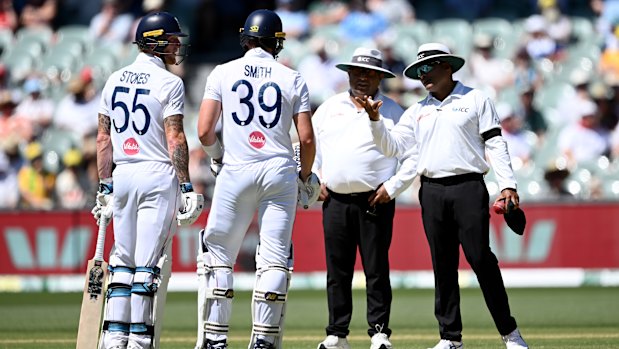
Reviewing the review: England’s Ben Stokes and Jamie Smith speak to umpires Ahsan Raza and Nitin Menon.Credit: Getty Images
Hotspots, ball tracking, pitch maps and sensitive microphones were being built into broadcast experiences, but not into actual matches. Even the highest-quality umpires were being questioned by commentators, players and viewers. Replays for “line decisions” were introduced but not scrutinised by the entity we now know as the third umpire. Replays were thrown up on the scoreboard screens for the onfield umps to peruse – still a coarse viewing, but nevertheless a step in the correct direction. There is no doubt the quantity of quality decisions increased.
Progress brings us to the third Test of this Ashes series in Adelaide and errors of thousandths of a second when England were left fuming about the accuracy of DRS (Decision Review System) after day-one centurion Alex Carey admitted he edged a ball behind on 72 before going on to score a ton. It was later revealed that an operator error involving the wrong stump microphone cost the tourists his scalp.
As with any technology, questions of accuracy are often posed. Why do you think the traffic law enforcers give you a few kilometres leniency with their cameras and radars? It’s not because of a softness of heart or generosity of spirit; it’s because the accuracy of such machines is not absolute and can be legally challenged. Common sense really.
So too with RTS (Real-Time Snickometer) or UltraEdge. RTS costs less and is easier to install but has a lower frame-per-second rate.
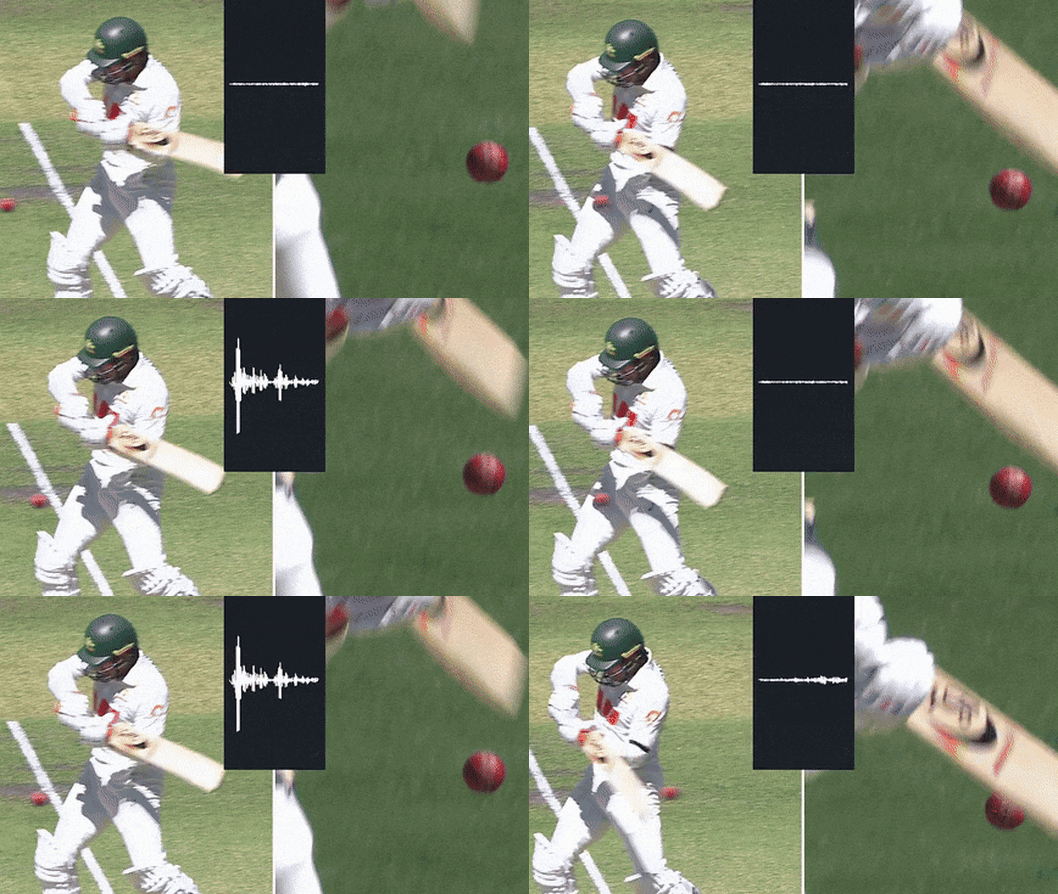
Alex Carey admitted after stumps that he had hit the ball.Credit: 7Cricket
The cost to produce cricket can be staggering, especially Test cricket over five days, if it goes the distance. Countries outside the top three find Test cricket almost impossible to afford and the spread of Tests are stunted due to cost, rather than talent.
RTS displays spikes in sound waves a frame or two after the video shows an edge. Umpires know this and are prepared for what comes up on their monitors. Caught behind decisions are a combination of high frame-resolution video and the sound spikes. Traffic police would be delighted at such precision.
The other factor that goes into a dismissal is what the umpire perceives in real time on the field, and finally whether the batsman is a “walker” or a “talker”. Walkers don’t wait for replays or advice from the bowler. Sometimes they don’t even wait for appeals. They know they are out, and they exit the crease in a halo of humility and integrity.
Professional sport employs professionals to make decisions. Golf may be the only other sport in which players call penalties on themselves. Walkers in cricket are sighted about as often as the Yowie. Talkers tell you where to go even as the bellowed appeal fades to a squeak.
Batsmen are not expected to walk by anyone except the bowlers, who feel they are about to be robbed of a hard-earned wicket. If you “feather” an edge, as Carey said he did, a fine one to the keeper with no deviation, then it is ethically safe to stand your ground. If you slice one to first slip, like Stuart Broad did off Ashton Agar in 2013, then perhaps loitering at the crease is moot.
Carey and Broad were within their rights to wait for an umpire to decide. An umpire has the right to make a call as they see fit. Even the third umpire has that discretion. Nothing has changed since television screens took precedence over eyes and ears.
Whatever the technology, humans need to have the final say. I certainly don’t want some chatbot with an antenna up its dongle deciding a Test.
Loading
To make Twenty20 cricket fascinating, I would like to see a match fully controlled by the sporting version of AI. Tennis manages without lines people, but the judgments there track actual ball paths, not predicted ones, a straightforward algorithm.
I thought England’s vision of the Carey moment smacked of desperation. They were looking to blame an outside agency for a largely self-inflicted predicament.
Umpires and their avatars are often the butt of player failures. Sometimes they are right; often they are not. English keeper Jamie Smith’s faux indignation at his caught behind underlined that notion. England might consider changing their philosophy and/or personnel before they affect the pathway to umpiring decisions.
For all the progress of sports and the interface with technology, cricket remains a truly organic game of leather, willow, earth, wind, sun and weather.
Human force and frailty make it unpredictable, and that is a good thing. Perfect machines will not make cricket a better game.
Most Viewed in Sport
Loading