2 months ago
17
2 months ago
17
“They didn’t follow their policies monitoring him during the birth. They failed to escalate to a doctor. They failed to communicate. They failed to document anything … they missed four CTG interpretations.
Loading
“The list goes on and on and on. It’s just a catastrophic and cultural failure. None of their policies were followed.
“No one can tell me that this isn’t happening right now in other births in that hospital, you can’t tell me that 20 people didn’t follow their policies in just our birth.”
For the birth of her fourth child, Alana was referred to King Edwards for an induction after her 37-week ultrasound found the possibility of a coarctation of the baby’s aorta. This condition was later ruled out, according to the report.
The SAC1 panel found multiple occasions of staff breaching hospital policy beginning 24 hours prior to Tommy’s birth, with a lack of an overnight medical review labelled a “missed opportunity” for an abnormal cardiotocography – or CTG – monitor to have been flagged at morning handover.
CTG interpretations should occur half-hourly, and a “fresh eyes” review by a second practitioner every two hours. The report found “this did not occur”.
Eighteen hours after she was admitted, Alana was transferred to the birth suite, received oxytocin and underwent a process to induce labour.
However, staff failed to perform a CTG immediately prior, which breached the hospital’s policy.
Once the CTG was up and running staff, failed to interpret it every half hour. At one point, two staff reviewed the CTG “collaboratively”, but nothing was documented.
The SAC1 panel found “that both staff may have assumed the other would complete the required documentation”.
There were also mistakes made in the level of oxytocin being administered to Alana, which the Starkies believe contributed to a tear in Alana’s uterus that resulted in Tommy’s oxygen deprivation. A coroner is still investigating the baby’s death.
The investigation uncovered King Edwards’ primary fetal monitoring system relied on technology that was “not validated” for use during labour.
For the Starkies, this resulted in a “missed opportunity for a technological safety net”, according to SAC1 report.
The SAC 1 report is critical not only of Tommy’s birth but also the way his mother was treated in the days that followed.
Missing from the SAC1 findings is an ultrasound report that shows a possible uterine tear that was later confirmed when Alana visited her regular GP. The scan was performed on September 1, almost 24 hours after Tommy’s traumatic birth.
Despite it being reviewed by a sonologist and a consultant the ultrasound report and subsequent CT scan were never added to Alana’s medical records. The possibility of a uterine tear was never discussed with her during a 45-minute open disclosure meeting.
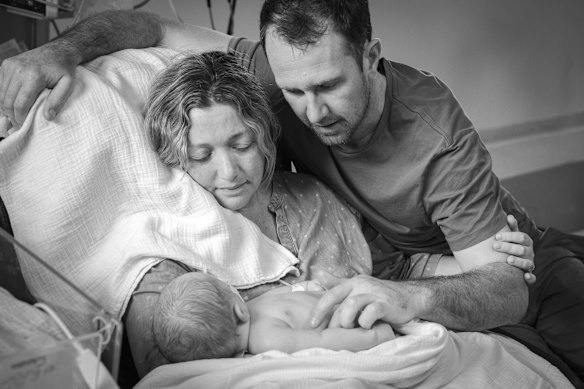
Tommy Starkie and his parents.Credit: Alana and Paul Starkie
“The possibility of its existence was known and therefore should have formed part of the discussion with the patient as part of an effective open disclosure discussion.” the panel wrote.
WA’s Director General of Health, Dr Shirley Bowen, met with the family and apologised, and told 9News Perth this week that Tommy’s birth was a “tragic event”.
“It was a failure to recognise a birth that was in trouble, and we deeply regret this situation,” she said.
“I absolutely regret what’s happened to Alana, and I agree that the policies were not followed for her individual circumstance, but I can assure the public that we do have a safe, quality, high-care system of care at King Edward. I recognise that’s hard given the circumstance we’ve got in front of us.”
Bowen said the ultrasound that could have revealed a uterine tear was in Alana’s digital medical record, and an obstetrician was meeting with the Starkies to discuss the situation further.
The report made eight recommendations, including a major cultural reform program aimed at reducing human and technological error, and boosting staffing levels by adjusting ratios for the labour birthing suite.
It also recommended King Edward review the system used to monitor babies as they are being born, with concerns it “may lack the AI capability of other systems, resulting in a missed opportunity for a technological safety net” in the case of baby Tommy.
A major review of the labour birthing suite’s emergency response processes, a new clinical documentation policy, and an overhaul of the open disclosure of serious adverse events at the hospital formed the remainder of the review’s recommendations.
Alana welcomed the recommendations – “if they’re implemented”.
“If they’re implemented, I do think the recommendations are good, and I do think it will make it safer, but I’ll say this: how do you fix a broken culture, a culture that is broken so badly that this SAC report is showing?,” she said.
Start the day with a summary of the day’s most important and interesting stories, analysis and insights. Sign up for our Morning Edition newsletter.