2 months ago
12
2 months ago
12
By Michael Kirby
December 19, 2025 — 5.00am
Dr Keith Douglas Suter, AM
1948-2025
Foreign affairs commentator, human rights advocate and futurist Dr Keith Suter was once called the “peace campaigner in a three-piece suit”.
His life was devoted to helping those people who turned to him to understand the world we live in, finding solutions to resolve conflict peacefully, and improving the human condition.
Those close to him marvelled at his energy. In a single day he might appear on Channel Seven’s Sunrise program speaking on international affairs, deliver a university lecture, share a cup of tea at Sydney’s Wesley Edward Eagar Centre (an emergency accommodation service) and deliver a keynote address at a corporate dinner.
Suter died peacefully in a Sydney hospital on December 10 after a long illness.
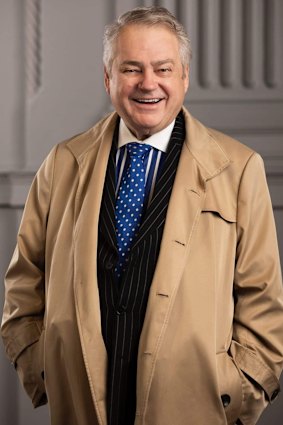
Dr Keith Suter is a foreign policy expert with a special interest in the Middle East.
He was born in London in 1948 into a family of modest means. He left school at the age of 15 (later describing his early education as “disastrous”) to take up a clerical role for the Ministry of Defence in London.
Here he met influential mentors including early suffragette Dame Kathleen Courtney and former naval commander Vice Admiral John Hughes-Hallett. Both sparked his life-long interest in campaigning for human rights, world peace and universal education.
In 1969, aged 21, he left this job to pursue a political science degree at the University of Sussex, the first in his family to attend university. He became a respected teacher and influencer, joining the UK’s United Nations Association, the International Law Association and the Anti-Slavery Society.
As a leader of UN Youth Action he demanded answers from then British prime minister Ted Heath about Britain’s neglect in ignoring UN Security Council Resolutions and for “selling out to South Africa and apartheid”. This gave him a taste for campaigning for human rights and non-discrimination.
Loading
Reporting on his various activities, The Times more than once commented on his “sartorial dress” and talent with one-liners. He became a “peace campaigner in the three-piece suit” who practised his oratory skills at Speakers’ Corner at London’s Hyde Park on weekends.
At this time Suter also embraced Christianity. While studying, he trained as a lay preacher with the Anglican Church and joined the affiliated William Temple Association, a forum for Christian political and social action where “saving individual souls” was the goal.
But saving society from “neglectfulness and indifference” became of greater importance in his life and work.
On receiving a scholarship for the University of Sydney he arrived in Sydney in 1973 to write his first doctorate on the international law of guerilla warfare. Later he completed two further doctorates. He also published 12 books including a bestseller, Keith Suter’s Global Notebook: 50 things you want to know about world issues … but were too afraid to ask.
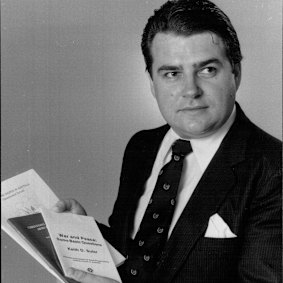
Suter in 1985 as then leader of the Christian Nuclear Disarmament movement, with publications he has written on the subject.Credit: Anthony Lewis/Fairfax Media
Suter found temporary work at the Central Methodist Mission in Sydney and remained an employee for 32 years.
Under the leadership of Sir Alan Walker and, later, Reverend Gordon Moyes, the Wesley Mission allowed him to pursue social responsibility activism in earnest. His platforms ranged from justice for Indigenous Australians, banning uranium mining and campaigning for peace and disarmament, to seeking economic justice for the long-term unemployed.
By 1985 Suter was instrumental in creating and engaging in the Uniting Church’s Trinity Peace Research Institute in Perth. This furthered the public understanding of peace, disarmament and conflict resolution through free public seminars, newspaper articles and radio interviews.
On returning to Sydney in 1990 he worked as a part-time consultant on social policy for the Wesley Mission. The flexibility gave him more time to pursue his unpaid interests and his goal of becoming engaged as a futurist, and scenario planning.
His voluntary committee work was prodigious, including 34 years as a member of the Club of Rome (a global think tank on economic and environmental matters); 32 years as chair of the Australian Anti-Slavery Society; 31 years as chair of the Sydney branch of the International Commission of Jurists (NSW); 29 years as director of studies at the International Law Association; 25 years as chair of the Australian Red Cross International Humanitarian Law Committee; and 13 years as president of the UN Association of Australia, at national and state levels. Suter also served on the executive committee of the World Federation of UN Associations, based in Geneva.
Between 1985 and 2009 he participated as one of 20 members of the Australian Foreign Minister’s National Consultative Committee on International Security Issues.
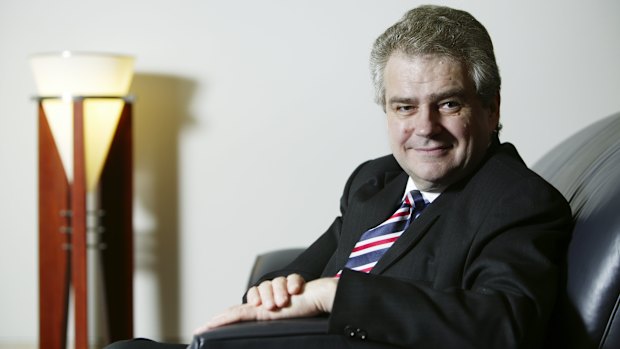
Suter, pictured in 2003. His first degree was in international politics, international law and international economics. He has PhDs in international humanitarian law and the economics of the arms race. Credit: Louie Douvis
In overcoming deadlocks in committee discussions, in his memorable signature style he would offer some humour and speak of “the opportunity to introduce a little glasnost which may lead to perestroika”.
Suter was appointed as a Member of the Order of Australia in 2019. He received the Australian Peace Medal in 1986, life membership of the UN Association of Australia in 1999, an Australian Red Cross Distinguished Service Medal in 2007 and a distinguished service award from the Australian Institute of Company Directors in 2005.
Until weeks before his death Suter continued to participate in media interviews, to write commentaries, speak at conferences and preach to local congregations.
He made Australians who were not particularly religious more informed and resilient to the constant changes of modern life. He “rolled up his sleeves when he saw a problem, devoting great energy to finding solutions, and offering ideas to solve problems”.
“Change is going to occur anyway, so make the most of it. Change your thoughts and you change your world. Success is a state of mind that becomes a way of life,” Suter declared.
Suter is survived by his partner, Jane Phelan, and his brother Clive.
Michael Kirby, Jane Phelan
Most Viewed in National
Loading