3 months ago
60
3 months ago
60
Two and a half years ago, I visited the Iranian women’s national football team at their hotel in Perth. The plan was to interview the then-coach Maryam Azmoon while the team was in Australia for a set of Olympic qualifiers, including against the Matildas. That was the plan, anyway, because it was not a traditional interview, insofar as one person asks questions and another answers with their genuine thoughts.
There was no way to know if Azmoon’s answers were her genuine thoughts, because her Farsi was interpreted to me by the team’s executive manager, in the presence of a media manager believed by sources to be affiliated with the state’s oppressive regime.
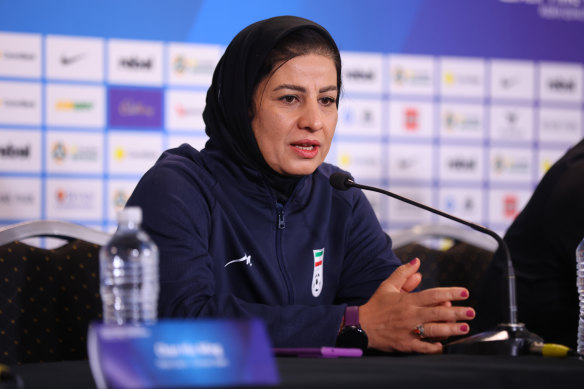
Maryam Azmoon, the then head coach of the Iranian women’s soccer team, at a press conference in Perth in October 2023.Credit: Getty
Under these murky rules of engagement, there was also no concrete way of ascertaining which questions could be asked without jeopardising the safety of Azmoon and the players eating dinner around us, and which could not.
I knew what had been publicised. About the Iranian football fan Sahar Khodayari, aka “Blue Girl”, who died in 2019 after setting herself on fire outside a court in Tehran. That, three months earlier, Brazil’s women’s team had landed in Australia for the 2023 World Cup on a plane bearing a giant image of Mahsa Amini, a 22-year-old Kurdish-Iranian woman whose death in police custody in September 2022 sparked the most widespread revolt against the government since the Islamic Revolution in 1979, alongside one of male Iranian footballer Amir Nasr Azadani, who was arrested during the protests and sentenced to 26 years in prison.
I also knew what had been told to me in confidence. How Iranian media reports that authorities had finally approved the entry of women into football stadiums in the country had been fabricated to appease FIFA, by allowing a small group of hand-picked women inside for photos and videos.
None of these glaring issues were reflected to me by the smiling coach and her chaperone. And I might almost have believed her, had it not also been apparent that Iranian athletes – not to mention footballers who are also women – were absolutely terrified of speaking out in any way for fear of reprisal against themselves and their families.
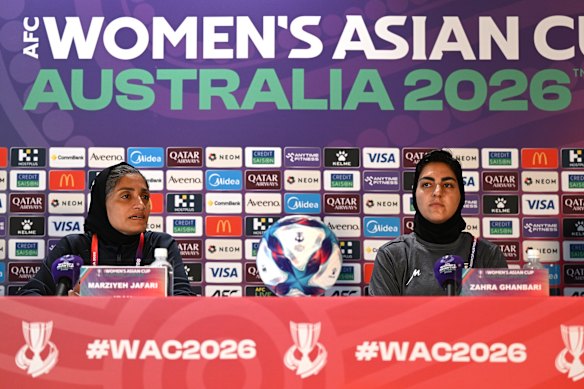
Iran coach Marziyeh Jafari (left) and captain Zahra Ghanbari during the press conference on the Gold Coast on Sunday. Credit: AAPIMAGE
The memory of this disconcerting experience returned on Sunday, when current head coach Marziyeh Jafari and forward Zahra Ghanbari sat down on the Gold Coast for their first press conference at the 2026 Asian Cup and did not once address the fact that their country is headline news. The day before, the US and Israel had launched airstrikes on major Iranian cities, including Tehran, triggering retaliatory missile attacks from Iran. In the hour preceding the press conference, the country’s supreme leader, Ayatollah Ali Khamenei, had been confirmed dead.
One of the total of three questions taken by Asian Football Confederation officials asked Jafari and Ghanbari directly how they felt about Khamenei. “I think we shouldn’t talk about these issues right now,” was Jafari’s answer in Farsi. “A team has come for very important competitions that matter a lot to women. Next question, please.”
Jafari’s reply was not translated, and the AFC media representative injected with: “OK, I think that’s all for your question. Thank you for asking. Let’s just focus on the game itself.”
It would be naive to think Iran’s players and staff do not hold strong views about the decades of atrocities committed on their own people, by their own leader. And, despite being pulverised, this is not yet the end of the regime. It is not the end of the danger. For many female athletes in Iran, simply playing sport marks them as symbols of resistance.
In January, Khamenei’s unprecedented massacre of unarmed and peaceful protesters claimed Iran women’s domestic league player Zahra Azadpour, who was killed by Islamic Republic gunfire in Karaj. The 27-year-old, who represented Mehregan Pardis Tehran, had been called up for national team training camps.
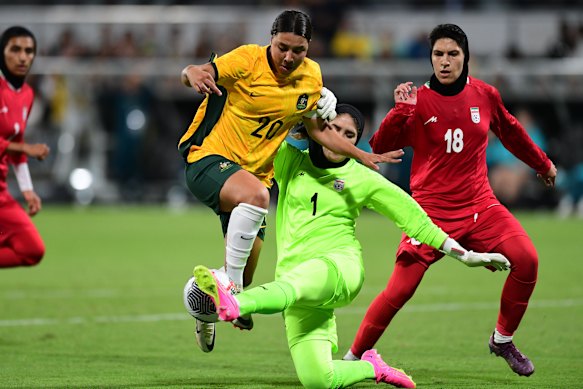
Melika Mohammadi (right) was killed in a car accident two months after playing in Iran’s 2023 Olympic qualifier against the Matildas in Perth.Credit: Getty Images
So for the women’s national football team, having arrived in Australia amid welfare concerns and on the eve of Monday night’s Asian Cup campaign opener against South Korea, a comment or observation of any kind would mark an unprecedented departure from the safety of silence. To view that as too risky would be more than understandable, particularly given Islamic Revolutionary Guard Corps officials or those with close ties to the entity, recently listed as a terror organisation in Australia, may have entered the country as part of the delegation.
It was only in November 2024 that Ghanbari was suspended by Iran’s federation because her headscarf slipped off during a last-minute goal celebration in an AFC Women’s Champions League match. The star forward had just scored the decisive goal to send her club, Bam Khatoon FC, into the quarter-finals, but was left out of the line-up because she had breached strict regulations requiring female footballers to wear the mandatory hijab on the field. Ghanbari was forced to apologise for exposing her hair before being allowed to rejoin the team.
The mandatory hijab is one of many structural barriers to Iranian women playing football. But they have followed the rules because it means they can play, and playing has meant they can experience historic moments like qualifying for the 2022 Women’s Asian Cup in India (the team’s first major tournament) and holding hosts India goalless (their first point) before losing to China and Taiwan.
Now the world’s 68th-ranked nation has qualified for a second Women’s Asian Cup, which doubles as qualifying for the Women’s World Cup, a tournament they are desperate to contest.
All of this appears, from the outside, to be more important to the team and their Iranian supporters than not playing to make a statement against the machine controlling it all. No doubt they also play to honour Melika Mohammadi, the 23-year-old who died in a car accident along with Bam Khatoon FC teammates Zahra Khajavi and Behnaz Taherkhani, two months after playing against the Matildas in that 2023 Olympic qualifier.
“In India in 2022, the group was a little easier,” Jafari said on Sunday. “Now in 2026 we enter with more experience, but the group is more tough. But we want to show in these games the potential of Iranian women.”
On Monday night, during Iran’s 3-0 loss to South Korea at Gold Coast Stadium, the crowd did the talking for them. A cluster of supporters held aloft both Australian flags and the Lion and Sun Iranian flag – the Imperial flag of Iran before the revolution used by those who oppose the Iranian government.
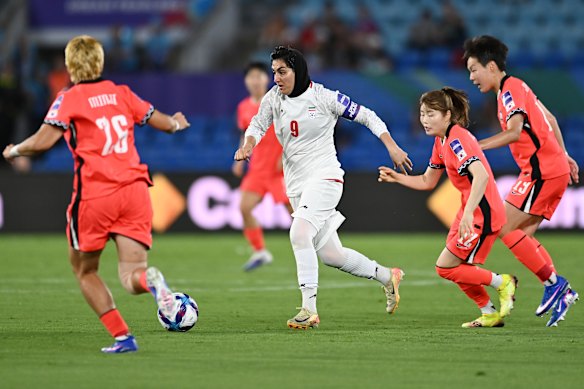
Iranian captain Zahra Ghanbari in action during the 3-0 defeat by South Korea.Credit: Getty Images
One depicted the last Shah of Iran, and the fans shouted slogans supporting Reza Pahlavi during the first half until a security guard approached and the flags went down. They returned just before the final whistle, accompanied by shouts of “Aussie, Aussie, Aussie, oi, oi, oi”.
On the pitch, Iran’s packed defence and desperate interventions restricted their world No.21 opponents to a 1-0 lead at half-time, only to concede two goals after the break. Despite the loss and lack of possession, Iran managed two shots on target.
Jafari said her team were looking forward to Thursday’s second group game against Australia.
“I know we have a tough game ahead,” she said. “In my opinion, playing a tough match is enjoyable because the players can get so much experience for their future.”
News, results and expert analysis from the weekend of sport sent every Monday. Sign up for our Sport newsletter.
Most Viewed in Sport
Loading