3 months ago
29
3 months ago
29
Ricky Banga was working two jobs, his brother was working two jobs and his wife was working night shift. They barely had a day off for four years.
By 2015, it was enough for a house deposit – provided that house cost $380,000 and was on the outskirts of Craigieburn, a far-flung suburb about 30 kilometres north of Melbourne’s CBD.
“We were constantly working,” says Banga, a 33-year-old full-time photographer. “It was very hard to get that 10 per cent.”
Banga and his brother migrated from India in 2011 and 2009, respectively, had been renting for years and wanted a slice of the Great Australian Dream.
Housing affordability in Australia is at an all-time low, and that’s left young people rethinking the dream of home ownership – something previous generations had taken for granted. Some are moving further away from cities to pursue it; others are finding new ways to live in a system that increasingly works against them.
Owning a home wasn’t always the Banga family’s primary goal –“we wanted to get permanent residency first” – but as time went on, and they adjusted to Australia’s culture, the “dream just formed”.
“When we first came [to Australia] ... it wasn’t on our mind to buy a property, but obviously with time we always wanted our own little space where we can bring our family together,” Banga says.
They consider themselves lucky: the same block today would cost at least double what they paid.
“The houses are getting unaffordable now,” he says. “There’s a lot of other expenses when you buy a house, like stamp duty, insurance and everything, which is just out from your pocket. And saving that deposit … that takes you maybe five to 10 years now, which is very hard.”
For many, it’s no longer possible to work long or hard enough to save for a reasonably located house. Jobs for life are gone, education costs are rising, house price growth has outstripped wages and experts say property prices are likely to keep going up.
Australia’s median dwelling value has reached $912,465, the Cotality Home Value Index for January shows, compared with a median annual household pre-tax income of $104,390. It would now take 11 years to save a 20 per cent deposit – the most on record.
People born in the late 1980s are the first generation in which more than half did not own their home by their early 30s, according to Australian Institute of Health and Welfare research.
In 1995, the median value of a Sydney house was $227,781. Melbourne’s was $138,798, compared with about $1,584,000 and $978,000, respectively, by late 2025. ABS data shows that in 1995-96, the average weekly income received by a single person was $370, while in 2025, full-time adult average weekly ordinary time earnings were $2010.
In NSW, another measure of wages has risen 78 per cent in the past two decades, while dwelling values are up 175 per cent, Cotality analysis shows. In Victoria, wages rose 79.9 per cent and dwelling values increased 164.7 per cent.
“There’s a big departure between home value increases and wage increases from the mid-2010s and again in the 2020s,” says Cotality’s former head of research Eliza Owen. “A lot of it has to do with the opening up of Australia for investment. We’ve had a couple of big surges in investment activity in the mid to late 2010s and again in the early 2020s.”
Loading
An extended decline in interest rates between 2008 and 2022 meant that debt was cheap, Owen says, pushing up asset values.
The problem with this is that only people with capital, or housing to borrow against, get access to that credit. Combined with the introduction of negative gearing tax concessions and the capital gains tax discount of 1999, the gap between the haves and the have-nots began to widen.
“Housing is not a good in the same way a handbag or a phone is – it’s also a vehicle for investment, so that leads to greater speculation of the asset over time, attracting a constant portion of people’s income,” Owen says. Add to that a slowdown in supply, and land scarcity due to prohibitive zoning regulations, and it’s the perfect affordability trap.
Some young people are giving up and spending money in other ways. Researchers say this is not irrational behaviour.
Renting for life
Will Mosley, 35, and his wife, Katie, 39, have done the maths – and to live the life they want, home ownership is out of the question.
The couple – a former start-up executive-turned-PhD student, and a strategy manager at a major company – have three young kids and need a house with a backyard near work in Melbourne’s eastern suburbs.
“We wanted to live in a really high-cost area, which is the Camberwell/Hawthorn East area, and we wanted a large enough home that would suit a growing family,” Will says. “You’re looking at about a $2 million investment, plus or minus half a million.”
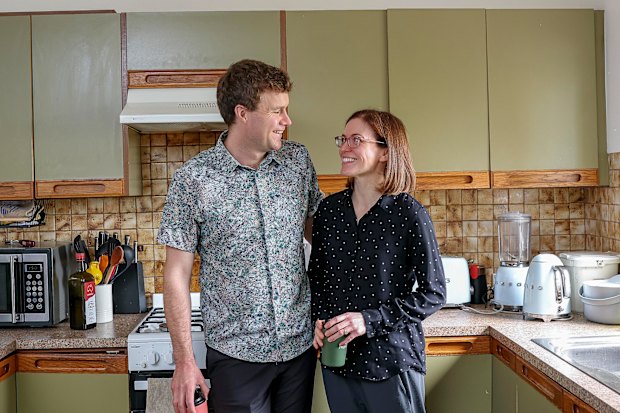
Will Mosley and his wife, Katie, in Camberwell. Credit: Eddie Jim
They attended a few auctions, only to see sales prices rise beyond the advertised guide. “When you start to look at the numbers, and you attend these auctions and inspections, you see how many people have this dream,” Katie says. “For me, as a bit of a non-conformist, I just get curious: what is the other path?”
They realised that while buying a $2 million home would set them back about $185,000 a year, renting would cost about $40,000 to $60,000.
“We can save a lot more money by renting. We get great houses renting – once you’re comfortable paying over maybe $800 or $900 per week, you can find really good quality stuff,” Will says.
Loading
The key is remaining flexible and having alternative wealth plans, they say. The two have invested widely, including exchange-traded funds, superannuation and US investments, and they have emergency savings.
“Putting things into the stock market is more flexible than having a house, gives you more options in the present and future,” Katie says, adding that they can move home if their needs change.
“[Our strategy] is trusting in the market and the longer-term return on those shares while also having the flexibility where, if something does change, it’s not an expensive house transaction where all the money is coming back at once and you might not be timing the market correctly.”
Will and Katie don’t see renting as a stepping stone to home ownership but a rational response to what they consider an unstable market. They’re not sentimental, which helps every time they need to move (three times in the past five years).
First home buyers can afford only one in 20 homes in NSW and one in 10 in Victoria, recent analysis from KPMG shows, forcing many to make compromises on home size, location or even buying a home at all.
Loading
A Macquarie University study in November that looked at the attitudes of people aged under 40 towards home ownership found of the 70 interviewed, 24 per cent were debt-averse. Some some said that mortgage in French means “death contract”.
Lead author and Macquarie Business School professor Elizabeth Sheedy was surprised at the number of people who rejected home ownership or were ambivalent.
“It also struck me that for those … who were home owners, their financial wellbeing wasn’t great,” Sheedy says. “They have buyer’s regret and feel like ownership is not a great experience.”
Servicing a mortgage is expensive and a hassle, as is maintaining a property. “These young home owners have a sense they are in this mortgage prison,” she says. “It’s not just limiting their freedom; it’s also quite risky to have these massive mortgages which don’t leave them with much headroom if something goes wrong, like losing a job or a climate catastrophe.”
Australians are socialised to think of mortgage debt as a tool for building wealth. And in many ways it is. “The positive of home ownership is that you don’t need a high level of financial literacy to become a home owner. There are mortgage brokers to help you through, ways to get information from friends and family,” Sheedy says.
As it stands, older Australians who do not own their own home outright by retirement face bleak financial prospects. Recent research by Super Consumers Australia found a single older renter would need about $659,000 in super compared with $322,000 for a homeowning retiree.
Loading
But for younger generations, this may be changing. Centre for Independent Studies chief economist Peter Tulip says the introduction of compulsory superannuation in the early 1990s has eased the pressure on paying off a mortgage quickly.
“It was the case for our parents’ and grandparents’ generation that paying off the mortgage was the way to save for retirement,” he says. “But the current generation is saving a lot of money in compulsory superannuation … and will have substantial superannuation to retire on.”
This does not mean the desire to own a home has disappeared.
“Home ownership is an important aspiration in Australian culture which is being denied to future generations. Young people just do not have the opportunities for home ownership that their parents and grandparents had.”
Tulip says the first step to solving the crisis is to change zoning rules. “Local councils do not allow enough building in their council areas, and like any market, when you restrict the supply of something, it pushes up the price,” he says.
Loading
“I don’t think anyone has the right to insist that our cities are frozen in their existing state. Nobody has a right to expect a city to look exactly the way it did when their parents or grandparents bought.”
Not everyone is unhappy with change – or above eschewing a big house on a big block of land for something more compact.
Stuart Gordon, a town planner, once owned a four-bedroom, four-bathroom house in Dulwich Hill, in Sydney’s inner west. He and his family were living the Australian property dream.
“We probably had the dream that we would bring up our children in that house. It was a beautiful place,” he says.
About eight years ago, Gordon and his wife separated. He rented a unit in Summer Hill while the next steps were worked out. His three children lived with him every other week. It was not what Gordon, 54, a lifelong house dweller, had planned.
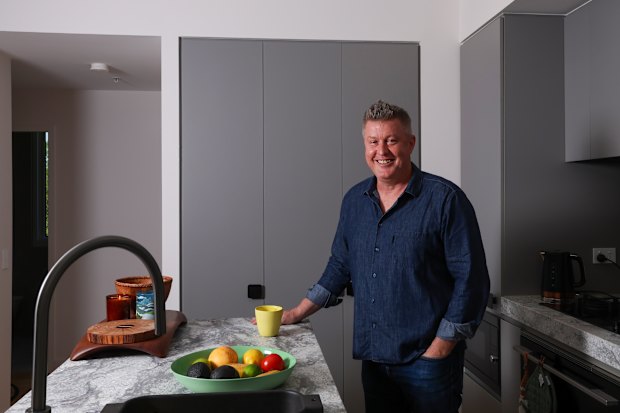
Stuart Gordon, who once lived in a large house in Dulwich Hill, has been converted to apartment living.Credit: Dylan Coker
But over time, he realised his concept of the ideal home was changing. Where previously he was “subconsciously anti-units”, thinking they were cramped, now it was exactly what the family needed.
“It just worked out really well,” he says of the unit that is within walking distance of shops and transport. “The kids really loved it.”
So when the time came to buy another home, Gordon opted for an off-the-plan unit in another inner west suburb, Ashbury, where he already has a community.
“I think that the dream might be changing to just owning a home, rather than owning a house and yard,” he says. “The type of home will matter less to people as long as they have property.”
Others reckon property ownership should be re-thought. Common Equity Housing Limited managing director Liz Thomson hopes for a future that includes diverse rental models that provide long-term tenancy.
CEHL is a housing co-operative that provides secure, affordable and long-term rent to tenants who live in separate dwellings and manage the co-op together.
“What people want is housing security that comes in a number of different homes, not just home ownership,” she says.
Tim Riley, a property developer at Property Collectives, works with groups who want to live in co-housing communities, from finding land to developing a project.
“Some are seeking intergenerational living, but what they have in common is that, invariably, these co-housing designs will have smaller-footprint homes, they will prioritise shared spaces for communal interaction, a more generous common garden and a modest secluded private space,” he says.
Loading
There are 10 such builds in Victoria, influenced by European examples, and Riley wants governments to consider co-housing as a practical solution.
Independent economist Saul Eslake is not optimistic. He says the two main parties are committed to house prices going up, pointing to former Coalition leader Peter Dutton stating at the last election that he wanted house prices to steadily increase, and Prime Minister Anthony Albanese saying that prices in Australia tend to rise.
Federal Housing Minister Clare O’Neil also told radio station triple j that Labor was not trying to bring house prices down.
Eslake says: “Politicians know that, [at] any point in time, there are 11 million Australians who own their own home, and there are about 2.5 million Australians who own at least one investment property. There’s overlap between those two, so that’s close to 12 million votes for policies that would keep house prices going up.”
Unless Australians collectively decide to change the trajectory of housing, politicians will continue to chase the votes, Eslake says. “They will just say: ‘Vote for us, and we will do things that make housing more expensive’. And everyone says, ‘yippee – let’s vote for them’.”
Read part one of this series: What was the Great Australian Dream?