
 3 months ago
62
3 months ago
62
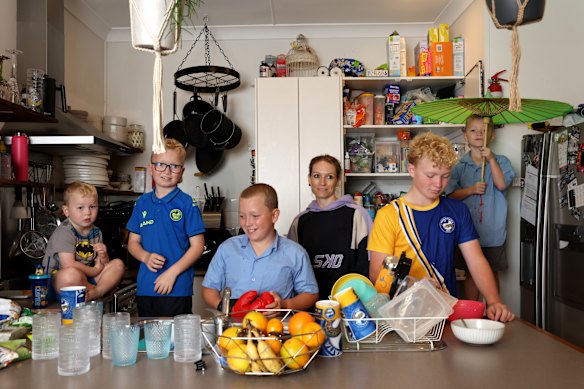
The sun has not yet risen over Batemans Bay, but no light is needed to see there are five boys living in the house ahead.
If the toy trucks and pushbikes we unsuccessfully dodge in the front yard hadn’t given it away, the rugby league replays blaring from the living room would have.
Quiet time for mum Steph Powell is the moments after her alarm rings at 3am. Her husband wakes up at 4am and is out the door within the hour, handing over to a babysitter three mornings a week.
It takes a village – and organisational skills envied by any military commander worth their salt – for the family of seven’s daily routine to run smoothly. People, says dad Mark Powell, think they’re “crazy”.
“I think we’re crazy,” his wife quips back.
Steph has been packing lunches for Taj, 13, Harlo, 11, Hendrix, 9, and Sabre, 7, while calmly mediating the scuffles that have broken out every few minutes since the mysterious materialisation of a boxing glove.
“There’s so many of them, there’s always fighting,” the 39-year-old explains of her demeanour. Mark’s crusade, meanwhile, is the “constant” jumping.
“We try and stop them,” he says. “They jump off the couch. My dad built them the playhouse in the backyard, they jump off that onto the trampoline.”
The 40-year-old has come home after a short shift at one of the local cafes the couple own. He’s already running late for his full-time job as a firefighter.
Mark won’t leave, however, without ensuring Thor and Ziggy – the family’s French bulldog and bull mastiff – are fed.
Further delaying his departure is three-year-old Bodhi, who is losing patience at his father’s feet with his arms outstretched.
Mark picks up his youngest for the coveted cuddle, then heads out.
Much has been made of Australia’s record-low fertility rate, which fell to 1.48 in 2024. Part of that can be attributed to the increase in adults leaving their child-bearing years without children, whether by choice or against their will.
But a maelstrom has swallowed parents who, three decades ago, ordinarily would have had three or more children.
The soaring cost of living, lack of affordable family-sized housing, and a childcare system in crisis have killed that Australian dream for many.
According to census data, single-child families and those with two children increased by 45 and 37 per cent, respectively, between 2006 and 2021.
“Big families”, of course, are not extinct.
Some of Steph and Mark’s neighbours in their NSW South Coast town – where the median house price is about $220,000 lower than in Sydney – have four children, and Steph’s sister has five children.
Even so, the fact that Steph has spent about four of the last 14 years pregnant stands out.
“You get a lot of comments,” says Steph. “Every time you’re pregnant again, it’s ‘Oh, don’t you own a TV? Are you trying for a girl?’” (They’re not.)
She laughs them off.
As does 49-year-old Kylie Hodor, who, at one point, was raising four toddlers under the age of two with husband Damien Hodor, 43, in Sunbury, Victoria.
Their two sets of boy-girl twins – Aria and Jesse, and Zoe and Marley – are 10 and nine years old now, respectively.
The looks, though. They’re something Kylie has not been quick to forget.
Grocery shopping at Aldi – one of the few stores with aisles wide enough to fit the loaded double pram she needed a decade ago – “people didn’t know whether to stare at us or part the waves and just let us through.”
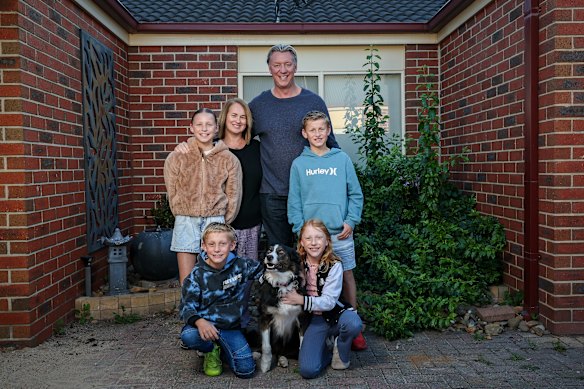
Like the Powells, the Hodors have mastered the art of time management.
Weekend sports are “organised chaos” between netball and basketball on Saturdays, and AFL on Sundays; an impossible juggle without the aid of Damien’s mother, who lives seven minutes away.
“We’re very lucky to have family to be able to help us because not everyone has that,” she says. “It does make a big difference.”
So does living about 40 minutes north-west of Melbourne’s inner city, where the median house price is about $250,000 greater for smaller blocks of land.
It took seven failed rounds of IVF in Australia, an anonymous egg donor in South Africa, and two high-risk pregnancies and premature deliveries, one of which kept Kylie in hospital for four weeks, for her life to begin “as it was meant to be”.
“We don’t take for granted that we have children because at one point, we were told ‘it’s unlikely you’ll be parents’,” she says.
“That’s probably some of the most soul-destroying news when you’re trying so hard to do something that people say is so natural.”
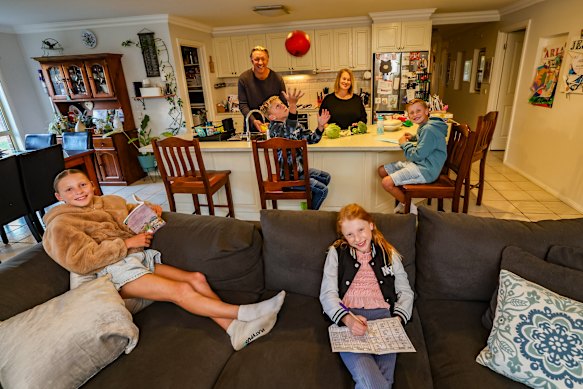
The couple used “every ounce of money” they had, and borrowed from their parents, to have their family. They didn’t have savings to fall back on when the financial reality of double everything – nappies, clothing, formula – hit.
There is a bonus: two-for-one birthday parties. But Kylie uses buy now, pay later services to afford extracurriculars, and, though the children don’t go without, the family has to make strategic choices.
She wouldn’t change anything.
“The journey we took to get here … it’s exactly where we’re meant to be with our large family,” she says.
Nine hours north, Steph agrees. Her favourite thing about babies is being “the most important person in their world”. If they didn’t grow up into surly teens, she would have more.
Would another one change their lifestyle much? The Powells still have an empty seat in their minivan. And, as Steph says, all you have to do is: “Keep them busy and have lots of food.”
The Red Nose Grief and Loss Support Line is available 24/7 for anyone affected by the loss of a pregnancy, stillbirth or death of a baby or child on 1300 308 307.
Start the day with a summary of the most important and interesting stories, analysis and insights. Sign up for our Morning Edition newsletter.

















































