
 5 months ago
253
5 months ago
253
In April 2025, the former rugby league star and recovering gambling addict, Luke Bateman, found himself living in a broken-down caravan in remote Queensland, about nine hours’ drive north-west of Brisbane. He had no mains power or water and only a sketchy connection to the internet. For Bateman, who was then 30, the isolation was the point: out here there were few temptations, no casinos, no booze and certainly no drugs.
During the day, he would work in the scrub, in 40-degree heat, helping his stepfather, Donny, who had a contract to log the local cypress pine. At night, he would return to his camp and barbecue a steak before retiring to his caravan, where he would read. And read, and read, and read. Bateman, who I visited recently, reads virtually anything: in the absence of all else, he’d probably curl up with the instruction manual to his microwave. But his preferred genre was, and remains, fantasy. Dragons, fairies, shape-shifting werewolves: that’s his thing.
“Sometimes I’d be in my tractor for 10 hours a day, hauling logs through the bush and listening to an audiobook about goblins and elves,” he tells me. “If I listened at two-times speed, I could get through, like, 15 to 20 hours of audio a day.”
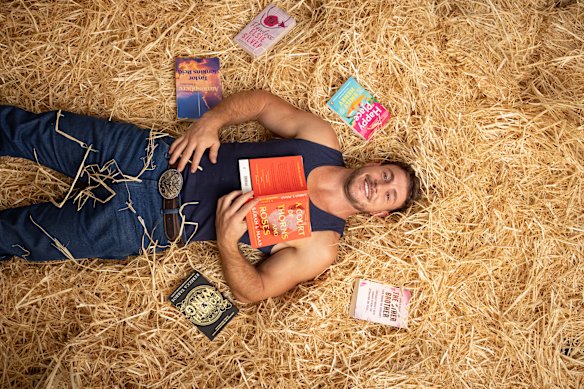
There was only one problem. He was dying to talk about it with someone. “I wanted to have a book club, but I was out here in the middle of nowhere.” He mentioned this to a friend of his, who suggested he try BookTok, a community on the social media platform TikTok devoted to books and literature. “I’d never had TikTok,” he tells me. “But I thought, ‘If I can find like, 10 friends to talk about books with, it’ll be amazing.’ ” The next day, Bateman climbed into the cabin of his work ute and, dressed in a dusty blue work shirt, recorded himself on his phone. “Right, my first ever TikTok video,” he said, grinning broadly. “I’m excited!”
He presented as unaffected and genuine, talking to the camera in a husky baritone that was both cheeky and confessional. “I’ve loved books my whole life,” he said. “Love fantasy. Fantasy is my main go-to.” But being from the country, “I’ve never really had anywhere to talk about it or share those things.” Bateman, who is well-built and good-looking, with a square jaw and hazel eyes, came off as a modern, straight-woman’s unicorn – a book nerd in the body of a hunky lumberjack.
Even in an age of virality, the response to his post was extraordinary. Bateman’s phone all but melted down with messages from rabid bibliophiles, most of them women, desperate for him, and his book recommendations – in that order. “Sir, respectfully, you are the fantasy,” one woman wrote in the comments. “I think I’m pregnant,” wrote another. But it soon became clear that Bateman had a genuine love of fantasy and a deep knowledge of the genre.
In the posts that followed, he unpacked character arcs and the technicalities of world-building and magic systems, and waded gamely into the realm of “smut” and “spice” (fantasy terms for the level of a book’s sexual content). His first post alone amassed 2 million views and tens of thousands of likes. Within weeks, he’d signed a publishing deal with Simon and Schuster Australia to write his own fantasy series. He launched Instagram and Facebook pages, a Substack and a podcast called In the Good Books (which is owned by Nine, publisher of this masthead), where he spoke not only about writing, but male vulnerability and addiction. “People don’t like feeling they’re being marketed to,” says Anthea Bariamis, his publisher. “They respond to authenticity, which is why Luke resonates.”
With more than 1 million followers, including high-profile book lovers Reese Witherspoon and Pink, Bateman has now emerged as Australia’s most popular and unlikely BookTok influencer, determined, as he has put it, to “make reading cool again”, one magic dragon at a time.
Bateman’s female fans often express a strong impulse to track him down and marry and/or kidnap him. But first they would have to find him, which, as I can attest, is not easy.
My journey to Bateman involves a flight from Sydney to Brisbane, a flight from Brisbane to the small town of Roma, an hour’s drive to the much smaller town of Injune (population 429), and a further hour-and-a-half’s drive on a dirt road, dodging cattle and emus, before finally and exhaustedly arriving at Bateman’s camp. There’s not much here: three caravans, a plastic water tank, some stray gas bottles.
One of the caravans is Bateman’s, another for his stepfather, Donny, and one is being used temporarily by a mate of Bateman’s from Brisbane. All around are tall trees, their crowns quavering in the heat and, underfoot, long, pale grass providing what I would consider to be absolutely perfect habitat for black snakes. Bateman owns an apartment in Brisbane, but he lives three weeks every month out here. “I love it, mate,” he says. “It’s quiet. I don’t feel like I’m in the rat race. I can do my own thing.”
On an average day, Bateman will spend about 10 hours in the surrounding bush, chopping down trees, mostly using a feller buncher, an enormous, praying mantis-like machine with a steel proboscis that saws down trees and de-limbs them, all in two fluid and mesmerisingly efficient movements. The logging is heavily policed by the Queensland state forestry department, and there are strict limits on the size and width of trees that can be removed. “And when it’s done, we rehabilitate the area,” says Bateman. (The timber is mostly used for construction.)
One of the reasons Bateman feels at home here is that it’s the same kind of country he grew up in. Born in 1995, he was raised on a cattle farm near Miles, a rural town on Queensland’s Western Downs. He and his twin sister, Sarah, and brother, Sam, two years older “made our own fun”, Bateman tells me. “Rode horses, swam in the dam. There was a bush-bash ute we’d drive around.”
He was a thoughtful, creative kid, “always making up stories in his head”, as his mother, Leanne, puts it. “And he was inquisitive. You’d put a six-inch fence in front of Sam, and he’d say, ‘That’s to keep me in.’ You’d put a 60-foot fence around Luke and he’d still try to get over it.” Leanne, who worked in the library in Miles, read to her children every night. “I’d be reading to Sam while I was breastfeeding the twins.”
All of the kids loved books: Luke gravitated toward fantasy; flying carpets, dark prophesies, anything with magic in it. Outside the home, though, in the wider community, reading wasn’t as popular, and certainly not with boys. “Books were always seen as something women did,” Bateman says. “With the men, there was no place for fantasy. There was no place for emotion. You worked and you shut up and you did your f---ing job.”
Bateman was also sporty. He competed in the state titles in athletics when he was 11 and, at 13, swam for Queensland at the Pan Pacific Championships. But he was particularly good at rugby league. “It was interesting watching him play, because he could be very gentle,” Leanne explains. “In the country, there’s a limited supply of children, so nearly every kid plays. Luke could always discern who was there to make up the numbers and who was there to really play. The boys who really wanted to be there, he tackled them seriously, but the others he would just run up to and put his arms around them ’til they dropped the ball.”
In 2007, when he was 12, Bateman was spotted by a talent scout for the Canberra Raiders. Two years later, the family moved to Brisbane, where the Raiders had a training facility, and where Bateman finished high school. The day after graduation, he moved to Canberra. He immediately stood out: from 2013 to 2015, he played for the Raiders’ under-20s team, captaining the side in 2014 and 2015. He also played for the Queensland under-20s team against the NSW under-20s side. Then, in 2015, at the age of 20, he played his first NRL game for the Raiders. “It was a dream for me,” he says. “It was everything I’d worked for.”
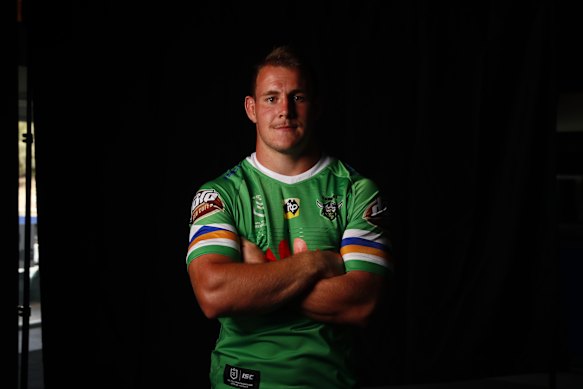
Bateman initially enjoyed Canberra. “Luke was pretty charismatic,” says friend and former teammate Sam Williams. “He had a way with words, and was good with people.” He started dating a local girl and bought a house back in Brisbane with the money he saved. He also loved his football, its physical and mental demands, and the opportunity to test himself. “I held myself to a high standard,” he tells me. By 2016, he’d become a core member of the team. But there were elements of the culture that troubled him. “The blokey-ness of it, and the ruthlessness,” he says. “It was just ripping each other all the time, putting one another down. The coaches, too. It was all very surface-level, and I struggled to make close friendships.”
Then there was the gambling. Not long after he arrived in Canberra, Bateman’s coach took the team to dinner, followed by a trip to the casino. “That was the bonding session,” says Bateman, who was then 18. “Playing blackjack.” Bateman was still an avid reader. He would take his fantasy books with him when he played an away game, “stuffing them at the bottom of my bag, where no one could see them”. If he was sharing a hotel room with a teammate, he would sit in the bathroom for half an hour with the door locked and read. But the gaming culture was impossible to ignore. After a while, most of his spare time became taken up, on his phone, betting on horses.
“It was so easy. You could be sitting having dinner, pull out your phone and put a $1000 bet on, and no one would know.” He also began drinking more and doing drugs: MDMA and cocaine. “It’s normalised in footy,” he explains. “If you don’t gamble, if you don’t do drugs, if you don’t drink, you’re not one of the boys.”
Bateman had a good season in 2017: he played almost every game for the Raiders and signed the first in a series of contracts with the club that would be worth $1 million over three years. He had money, a new Ford Ranger and a loving partner he planned to marry. But he felt increasingly out of place. “You have to carry on so much in that footy scene,” says Brad Prior, his flatmate at the time. “But Luke, when he was alone, was softer, just a totally different person.”
One day, Bateman was sitting on the couch, chatting to Prior, who was working as a window-washer. Out of the blue, Bateman suggested they start a window-washing business together. “It was so weird,” he says, “because I should have been really happy. I was living what I thought was my dream, playing NRL, getting paid hundreds of thousands of dollars. But at that moment, I would rather have started a window-washing business.” It dawned on him that he might, in fact, hate what he was doing.
His gambling worsened. “Luke would just sit on the couch all the time, dialled in to his phone, punting,” Prior says. When his friends placed bets, they would stop when they ran out of money. Bateman would keep on going, using money he didn’t have and pestering people for more. “Luke borrowed money from me,” his brother Sam says. “Just small amounts, and he always paid me back. But it was difficult to tell how much money he was spending.”
Desperate for cash, Bateman began pawning his personal belongings, including his laptop and stereo. Unable to place bets on his credit card, he would buy computers and TVs, immediately sell them at Cash Converters and gamble with the proceeds. “I took out $1000 payday loans at, like, 60 per cent interest.” He began buying drugs “on tick”, an informal, pay-later system. Despite the fact he was earning almost $400,000 a year, he couldn’t buy food. And so, in early 2018, he asked his mother, Leanne, who was living in Brisbane, to take control of his finances.
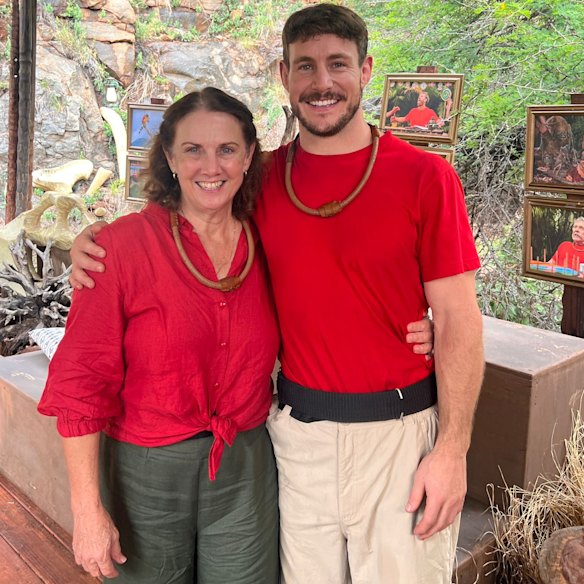
“I’d order groceries to be delivered to his door,” she tells me. “I paid his mortgage when he couldn’t. But it was futile. The accounts were still in his name, so when he wanted to take control back, he could, and he did.” Leanne worked with Prior and Bateman’s partner to keep an eye on her son. “It was pretty hard, though,” says Prior. “Luke was always bullshitting one of us about how bad things were.”
In early 2019, Bateman injured his knee and was sidelined. At the time, he was living with his girlfriend in a 12th-floor apartment in Belconnen. One night, at 1am, he called Leanne. “It was terrifying,” she tells me. “He said, ‘I’m standing on the balcony, thinking about jumping.’ ”
Professional sports teams have a duty of care to their players: clubs routinely employ welfare officers whose job is to support the players with their mental health and wellbeing. After her son threatened to kill himself, Leanne called the Raiders. “I told the welfare officer, ‘My son is suicidal, he needs help,’ ” she says. “They came back to me with, ‘We ask Luke every day how he is and he always says, “I’m fine.” ’ They just thought I was being hysterical.” (A spokesman for the Raiders declined to comment for this story.)
The club eventually organised for Bateman to see a psychologist. Leanne then demanded a meeting with senior management, “so we could come up with a treatment plan”, she says. “The welfare officer said he’d try to organise it. But then COVID hit and it never got off the ground.”
There is a point in every fantasy book, around midway, when the protagonist reaches what is often called, in writing parlance, The Ordeal; a battle, say, or a high-stakes showdown, the outcome of which will determine the rest of the story. The Ordeal for Bateman came in late 2019, when he woke up in Newcastle after a three-day bender having driven, drunk and high, from Canberra, stopping off along the way to party and gamble. His partner had left him – “quite deservedly so”, he says – and he was broke. “I thought, ‘Either I change or I’ll die.’ ” In 2020, at Leanne’s urging, he began taking antidepressants and regularly seeing a psychiatrist. Then, in 2021, he agreed to go to rehab, a 28-day program in a facility in Gympie. “I did the 12 steps, the whole thing,” he says. “It changed my life completely.”
When he got out, he made a deal with his mother and her partner, Donny. “They said to me, ‘OK, you tell us everyone you own money to: friends, bookies, drug dealers. We’ll pay them all back, but then you come out and work in the bush with Donny and work off that debt with us.’ And so I did.”
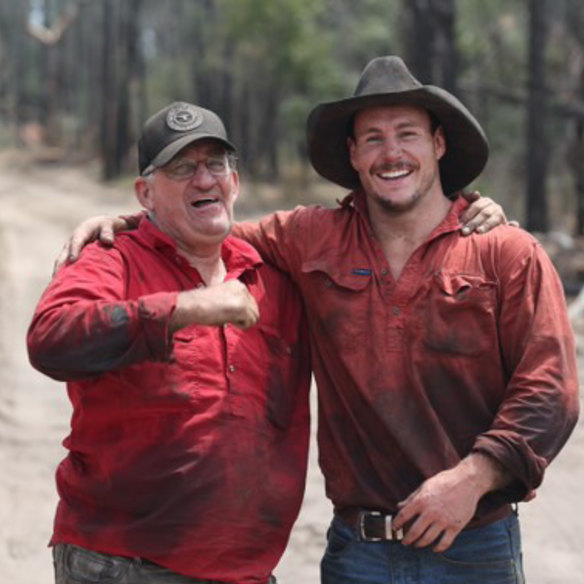
Bateman reckons that gambling cost him about $500,000 over four years. He has since said that books were a huge part of his recovery. “Along with the professional help I received, books gave me the map back to myself,” he wrote in a piece for SBS last year. “If I’d had a male role model who was into books when I was a kid,” he tells me, “and who didn’t make me feel that reading was weird or wrong, my life could have been very different.” He now often uses his social media to talk about self-development and modern masculinity, and has worked on government initiatives to counter domestic violence.
Bateman is a born performer, especially in his book posts, each of which is a 60-second aria to reading and writing. He will wince in ecstasy when discussing a plot twist or rub his hands in glee. His screen appeal hasn’t gone unnoticed: earlier this year, he appeared in I’m a Celebrity … Get Me out of Here!, and, in 2023, he popped up as a groom on The Bachelor. (“It was fun,” he says. “Living in a penthouse in Melbourne for five weeks, dating 24 women. And I got paid 70 grand!“) But telegenics alone don’t explain Bateman’s rise, which is more broadly cultural: in this moment of profound hetero-fatalism, he represents a flicker of hope, a reminder that articulate, attractive, emotionally available men still exist, even if they remain hidden in the bush somewhere, driving tractors.
A profile like Bateman’s is, of course, extremely helpful, until the moment that it isn’t. In May 2025, after about a month of posting on BookTok, Altria Books Australia, an imprint of Simon and Schuster, announced they had signed Bateman to write a two-book fantasy series. Many people saw the deal as unfair, and as a sign of the publishing industry’s institutional bias against minorities.
“It was frustrating,” says Jing Xuan Teo, co-founder of Amplify Bookstore, in Melbourne, which only stocks books by BIPOC authors (black, Indigenous, and people of colour.) “Here’s a hot white guy in a truck who joins BookTok, women flock to him, and despite not having any writing credentials that we know of, he immediately gets a publishing deal, when people of colour have been trying for years.” Teo doesn’t blame Bateman. “It’s not his fault: you and I would take that deal. It’s the fault of the publisher for going after virality and sales rather than quality.”
Teo says publishers have a responsibility, as cultural gatekeepers, to publish authors from more diverse backgrounds. But publishing is also a business. “In an increasingly competitive book market, generating interest in a new title is very challenging,” says veteran publisher and former chair of Adelaide Writers’ Week, Louise Adler. “Marketing books by celebrities is made easier because these celebrities have an existing devoted fan base which they cultivate across a range of platforms.” In the past, a publisher might spend tens of thousands of dollars on publicity, but someone like Bateman has essentially done it for them.
There were calls to boycott Bateman’s books, but some in the industry were more forgiving. “I think we should celebrate Luke’s deal,” says bestselling fantasy author Kate Forsyth. “All humans have stories to tell and a right to tell them.” Forsyth, who has been writing fantasy since the late 1990s, agrees that publishing has to do better when it comes to diversity. “But people perhaps don’t realise what a huge transformation there has already been in the industry over the past decade.” Fantasy, she says, has gone from being written almost exclusively by men to being written almost exclusively by women, with authors of colour, including Shelley Parker-Chan, Roanne Lau and Ambelin Kwaymullina, earning significant readerships.
Interestingly, the criticism that most stung Bateman was that he hadn’t written before. He tells me he has written since primary school and entered short-story competitions as a kid. He journalled while he was in rehab and writes poetry, some of which he posts to social media. He says he had been working on his own fantasy series for years before Simon and Schuster Australia came knocking. “I already had 10,000 words. I gave them a whole outline, chapter by chapter.” Most of it was written in his caravan, in the bush, at night. “I had the books’ magic system and the characters all worked out.” He concedes that he has a platform and that he’s lucky. “But people have projected their frustration onto me without knowing a thing about me.”
In late March, Bateman appeared on stage at the Melbourne International Comedy Festival alongside a number of other comedians, including David Hughes and Tommy Little. “I even wrote my own jokes, mostly about reformed gambling addicts and rehab stories,” he says. There were about 400 people in the audience, but Bateman says he wasn’t nervous. “I’m not a comedian, so if nobody found it funny, I wasn’t worried!”
Two days later, he jetted off to Los Angeles for a week. It was mainly a holiday but also to pursue a few professional opportunities, the exact nature of which he wouldn’t reveal. I mentioned to him that going to a place such as LA came with risks, namely gambling, drugs and booze. But he was confident he wouldn’t relapse.
Ultimately, he would like to live in the US full-time to pursue a career in writing. “But that’s a long way off,” he tells me. As for the near future, he is bound to be travelling a lot: the first of his two fantasy novels is to be released early next year, followed by what will no doubt be a bells ‘n’ whistles, international book tour.
It’s a long way from his caravan. But wherever he goes, he has something he uses to stay grounded. It’s a grainy photo he keeps as the screensaver on his phone, of himself as a little boy. He’s dressed as a cowboy, in a Stetson hat and a blue vest pinned to which is a sheriff’s badge. “I have it there so that every time I look at my phone I’m reminded of the 10-year-old boy inside me,” he says. “I want him to be proud. And I want to remember the power of magic, and why it’s worth holding on to.”
Lifeline: 13 11 14
Get the best of Good Weekend delivered to your inbox every Saturday morning. Sign up for our newsletter.
Read more from Good Weekend:
Inside the world of ABC chair Kim Williams
The Ipswich schoolboy turned $6 million man
Michelle Payne’s rise to the top was swift – then came stalkers, the agony and the heartbreak

















































