1 month ago
7
1 month ago
7
Opinion
October 14, 2025 — 7.30pm
October 14, 2025 — 7.30pm
Western Sydney is dead. Long live Sydney. The quest to map Sydney’s subregions is obscured by stereotypes. Take it from me, it’s not helping.
Carving up Australia’s largest metropolis entrenches economic, social and cultural prejudices. These labels are unrecognisable to the people they tag, and they are inaccurate.
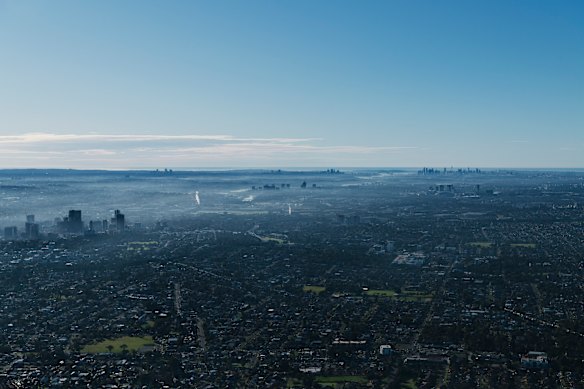
An aerial view towards the Sydney CBD, photographed from Western Sydney. Credit: James Brickwood
As someone who scraped his knees growing up on the mean streets of Toongabbie, it’s time to set the record straight.
I don’t recall, as a kid, the words western Sydney being uttered around the kitchen table. In state government corridors, the 1968 Sydney Region Outline Plan reigned.
For cartographers, the closest nomenclature was “the western suburbs”. For me, that area was neatly confined within Lidcombe Oval, the home of the Western Suburbs Magpies.
Loading
In the years since, the merger of the Magpies with the Balmain Tigers blurred any east-west distinction and blunted decades of sporting regionalism. Once mutually working class, both locales, and the resulting merged club, bear little resemblance to their gritty origins. Magpies great Tommy Raudonikis went on to play for the Newtown Jets. Hardly latte sippers.
As somebody who, until recently, led university-based advocacy for Sydney’s western reaches, I can confirm the region in question happily defies definition. Consultants, near and far, will argue otherwise for their own reasons.
The push for the fairer distribution of resources across all of Sydney was always my aim. That means disadvantage in Malabar matters just as much as it does in Miller.
Mapping the Red Rooster, latte, or other arbitrary lines won’t bring equity. Nor can these demarcations clarify Sydney’s constantly changing economic and social geography.
Loading
Take Kirkham, near Campbelltown. This leafy suburb is never more than 10 minutes from multiple roast-chicken outlets. Yet barely a whiff of poverty troubles its residents. Property prices in these climbs regularly pip $2.5 million.
Just a short drive away, in Airds, median property prices have nearly doubled in five years, yet still only nudge $810,000. Airds is aspirational, but from a low equity base.
Comparable gulfs persist elsewhere. Malabar is 15 minutes from Coogee, where income levels are nearly double the former. The data tells us exactly where the problems are, and what help – education, employment, health and housing – is required.
Language is another commonly deployed mapping trope. Some Sydney suburbs do have an unfair advantage on that count. Bilingualism resonates in Girraween, Harris Park, Haberfield and Haymarket.
Elsewhere, English holds sway in Paddington, Penrith, Randwick and Richmond-Windsor. In some instances, multilingualism correlates with high education levels, but sometimes it doesn’t. Again, it is not always where you live, but rather how you live.
Since ancient Athens, the idea of life outside the confines of the polis has become a way to define a city’s virtues. The worse the perceived behaviour beyond city gates, the more connected those within feel.
The headline “a fatal shooting in western Sydney” appears with disturbing regularity across commercial and public media. These generalisations render massive areas beyond inner Sydney as lawless.
But the barbarians-at-the-gates mantra works only as long as the barbarians still want to break in.
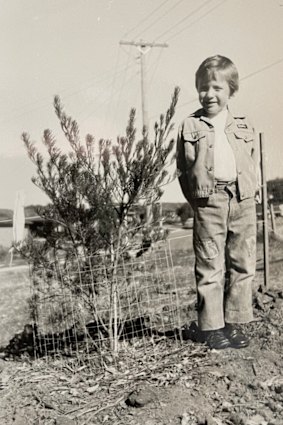
Andy Marks photographed in double denim in Toongabbie, 1979.
Like the move west of ABC Sydney’s newsroom and this masthead’s launch of a Parramatta bureau, regionally embedded news is vital in giving a voice to all of Sydney. The depth and resonance of coverage emanating from these new media digs vindicate the decision. The alternative is Sydney’s “barbarians” tune out.
Media is on the move, still, politicians won’t easily drop stereotypes. “For three years, we’ve been working… to build western Sydney’s future”, said Prime Minister Anthony Albanese ahead of the last election. The constant future-casting has the effect of depicting a large swathe of Sydney as undercooked, forever a work-in-progress.
The Coalition, too, sought to cultivate regional restlessness at its campaign launch in Liverpool. Then opposition leader, Peter Dutton, declared the amorphous west was “one of the most important battlegrounds of our election”. In that scenario, the politicians are the barbarians and the voters mere blood-sport spectators.
Both depictions deny Sydneysiders agency. Neither offers the city, in its entirety, a unifying set of principles.
In the US, partisan narratives targeting particular cities are ending with the imposition of National Guard troops. We’re far from that scenario in Australia, but we should never underestimate the willingness of some political actors to emulate those tactics.
Sydney is Sydney. East, west and everywhere in between must work to address inequity and celebrate unity, wherever the opportunity arises.
For millennia, this city has been the Eora nation, home to the Gadigal, Dharug and many other clans that defy new divides.
A greater Sydney can only become so if it embraces all of its parts. The only stumbling block will be deciding who will break it to the Shire. Those guys are great. But that’s another story.
Andy Marks is a reformed western Sydney advocate, political analyst and cultural commentator.
Most Viewed in National
Loading