3 months ago
8
3 months ago
8
She was a stunning former model and television hostess. He was a successful businessman. They owned a mansion in South Yarra, a weekender in Woodend, and had three beautiful children. So why did Jacqui Ramchen vanish without a trace? John Silvester reports.
Veteran homicide investigator Charlie Bezzina was on leave and driving towards Gippsland when his mobile rang. The man at the other end didn’t need to introduce himself. They had known each other for nearly 10 years, although they would never be friends.
The caller was Vic Ramchen. He had phoned to say that one of his three gifted children had just won a prestigious international maths prize in the United States.
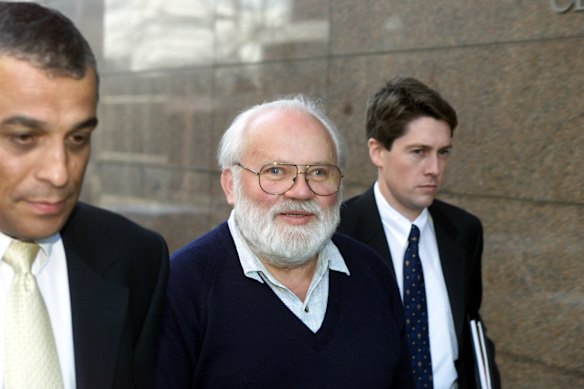
Vic Ramchen pictured in 2001 on his way to his bail application hearing.Credit: Joe Armao
Bezzina congratulated the proud father and wished his children well. But as he drove on, he wondered why Vic felt compelled to share the news with him.
The detective knew he would soon charge Vic with the murder of his missing wife – a crime the suspect would always deny. He believed he was giving him a message – but what?
Could it be that he was saying that whatever had happened in April 1992 when Jacqui Ramchen disappeared from her South Yarra mansion, the children had not been harmed?
Did he want the detective to know that, despite the suggestion he was a murderer, he was still a good father?
Or was he saying that his children were better off without a mother who could have destroyed his family and their financial security?
It is one small mystery in a murder investigation that remains suspended in time.
When Jacqueline Mertens returned to Melbourne in 1980 after eight years overseas, she was flat broke, but the flighty former model had a plan to make sure she would always enjoy the lavish lifestyle she had pursued around the world.
The former hostess on the successful 1970s quiz show, The Price is Right, wanted a husband, children, a mansion and money – lots of it.
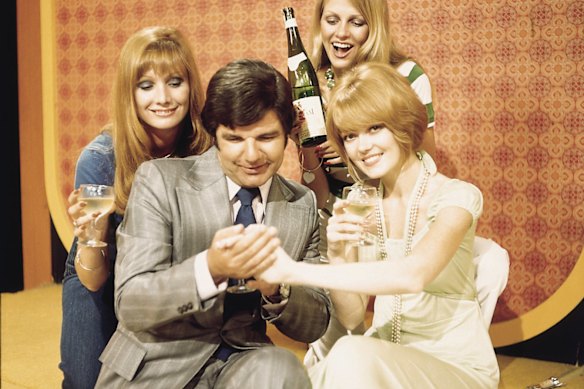
Jacqui Ramchen (right front) with other The Price is Right members.Credit: TV Week
To win her version of the dream jackpot, the 32-year-old was to use what she knew were her bankable assets – stunning good looks and smouldering sexuality.
Jacqui may have no longer strutted the catwalk, but she still turned heads in the street – and she knew it.
After her modest television career she flew to Hong Kong and married. When that relationship failed she moved on to London to work in fashion and modelling before returning to Australia.
Her plan to find a rich husband was not an original one, but what made Jacqui different was her honesty about her intentions and her ruthless determination in her application.
She told a group of friends, “she was going to marry for money, and that love would come later”.
Jacqui remembered a stern-faced civil engineer with a business brain she met by chance at a Melbourne restaurant before she left to go overseas. They had gone out once but she was about to leave to get married in Hong Kong. Now she wondered whether he was still available.
Within weeks of returning to Melbourne she found out. His name was Slavik Ramchen, a hard-working, hard-drinking divorcee, known as Vic.
Vic’s younger sister, Erika, remembers when Jacqui first came calling. She was working as his secretary at his Richmond office when an attractive and confident woman walked in. “I thought she was someone wanting to sell carbon paper or something and I asked her why she wanted to see Vic and she stated she was a friend.
“I don’t think Vic recognised her. Jacqui jogged Vic’s memory and then we all had a drink in the office.” The two not-so-old friends went out to dinner that night. The next morning I learnt that Jacqui had stayed with Vic that night. I thought that it would be a one-night stand,” Erika said.
She was wrong.
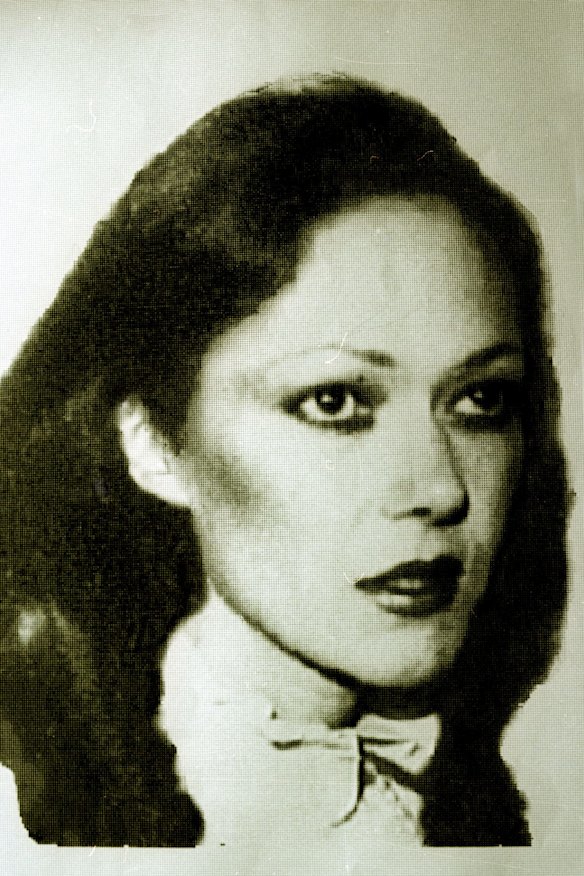
Jacqueline Ramchen.
The couple began to date and about a month later Erika arrived at the home she shared with Vic in Erin Street, Richmond, to find “Jacqui sitting out the front of his house on a suitcase”. The next day she moved in.
Erika did not trust the younger woman. “During this time I saw a great deal of Jacqui as we were living in the same house, and it was apparent that Jacqui was persistently asking Vic to marry her. She was constantly trying to project herself as being a potential model wife.”
In June 1980, they married at a registry office. It was no society wedding but the model and the businessman appeared happy. She was a classic beauty, but it would be many years before police would allege he was the classic beast.
Vic had built up a strong civil engineering firm and was expanding into property development with projects in Gisborne and Northcote. His work was professional and thorough.
In 1979, he bought a weekender – Macedon Grange, a beautiful 100-hectare bush and rural property at Woodend. In the early 1980s, he built a large, bluestone home on the property, which was valued at $1.4 million in the late 1980s.
Property prices were buoyant and life was good. Business associates say he was confident to the point of arrogance and bristled with self-belief. Jacqui wanted to be the model mother as well as a socialite wife but Vic, eight years older, had doubts. “I did not really want children ... I considered myself too old to be kicking footballs around and other such fatherly activities, but she was young and wanted children,” he said later.
Vic warmed to the idea and the couple had two boys and a girl. All became gifted students, despite the trauma they had to endure.
Friends said that Jacqui was a good mother. “She and Lev [her eldest] were particularly close. He was very much a mummy’s boy. She was protective of him and the other children,” a former neighbour, Christine Mills, told police.
After the birth of their last child in 1989, the Ramchens bought the 100-year-old mansion, Fairbain, in Domain Road for nearly $3 million.
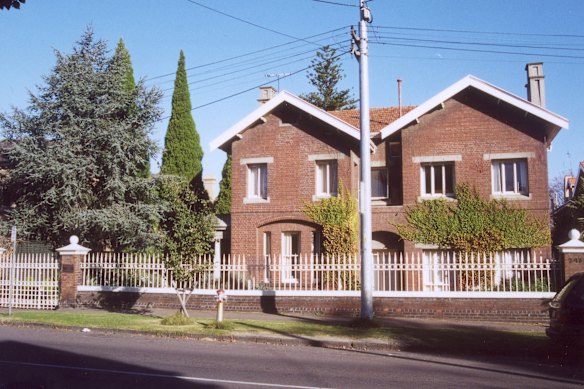
The Ramchen family home in Domain Road, South Yarra.
The once-beautiful two-storey home was renovated in the 1920s but had been in decline for years. The builder and the model were determined to return it to its prime. It would be the perfect stage for their showcase marriage.
Then came the crash – financial, emotional and physical.
The beginning of the end
Some relationships slowly disintegrate, others explode, but few turn into the running, public battle of Vic and Jacqui Ramchen. Even Vic would later say to police that his marriage would, “make a bloody good soapie”.
The Ramchens may have lived in a sprawling mansion but the large front gates and two-metre white spiked fence could not conceal the continuing war inside the grounds.
Marlene Gould lived next door in Domain Road with her husband, Noel, and three adult children. On December 21, 1991, she was cleaning up after her son’s 21st birthday when she heard the two neighbours abusing each other. “He was putting his hands on her and she was saying, ‘Leave me alone’.”
Loading
Five days later there was another argument. “She was saying things like, ‘I’m sick of you calling me a whore and a prostitute. If I as much as look sideways you think I’m having an affair with everybody. I may as well be dead as living the way you treat me’,” Gould said.
“I heard Vic say, ‘Why don’t you kill me?’ She said, ‘Stand in front of the car and I’ll run you over’. Vic stood in front of the car, the BMW. Jacqui got in, turned on the motor, opened the door, yelled out, ‘Get down the driveway further so that I can run at you’. Vic did this, and then Jacqui drove at him quite quickly. When the car got near him Vic jumped out the way and Jacqui put the brakes on. I couldn’t say if the car would have hit Vic if he didn’t move. I didn’t know if Jacqui would have been able to stop. Jacqui screamed out he was a coward. She said, ‘You won’t even stand there and let me kill you, but you’ll be happy when you kill me’.”
Gould heard more arguments and saw Vic’s mother yelling. “This wouldn’t happen if you were a good wife. You should be a good wife, you must have sex with your husband.
“Later that night I heard them out the back, I heard laughing and I think they were playing with the kids, so everything appeared OK to me.”
It was a pattern that was repeated regularly. Moments of insane anger punctuated by apparent calm family life.
In March 1992, Jacqui’s brother, Jack, went to the Domain Road house to visit his sister. What followed left the quiet farmer stunned. He later told police that Vic “started saying that Jacqui was a whore and he was making accusations about her. At one stage Jacqui started slapping Vic across the face and on the chest.”
Vic asked to see Jack Mertens inside and, according to him, said, “Look Jack, I don’t know what to do, whether to shoot myself or her.”
Their arguments did not stay within the walls of Fairbain. Soon they were the talk of their children’s exclusive school.
In 1992, a group of mothers and a teacher were standing together at pick-up time at Christ Church Grammar School in South Yarra when Vic walked past. According to one of the mothers, Maree Turner, he said, “How do you do? I’m Vic Ramchen and my wife is a harlot.”
Jacqui was not interested in keeping matters private either; she once told Turner that Vic “wanted sex eight times a day”.
Jacqui and Vic yelled in the streets, fought at parties and involved friends, relatives and strangers in their fights. Some were bemused, others horrified, while some were riveted to this real-life soap opera.
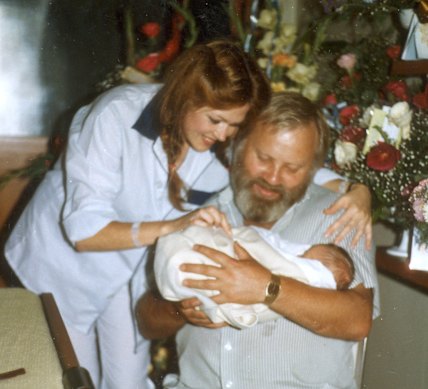
Jacqui and Vic Ramchen with their baby son Lev.
On March 20, 1992, police were called to the house for a routine domestic disturbance. Jacqui told Constable Peter Easton she was in the “process of filing for divorce” and had moved to the rear of the house.
She also told the police she would leave when she was financially stable. “She indicated strongly that at this time she would also take the children when she left.”
As police were talking to Jacqui, her husband interjected, “You’re nothing but a slut. You’re a whore.”
Jacqui’s mother, Hennie Mertens, believes her daughter was beaten by Vic. Jacqui’s father, Josephus, didn’t like Vic from their first meeting. His feelings turned to hatred and eventually he refused to visit the Domain Road home.
Josephus also remembers his daughter coming to their home with bruises on her back and legs, scratches on her face and a “big bald patch on her head were her hair had been pulled out”. She finally told her father she had been beaten by her husband. “We tried to get Jacqui to leave Victor and to come and live at home, but she would not leave,” Josephus said.
Vic later admitted to police that eight months before Jacqui disappeared, “I grabbed her by the hair ... yes, there could have had [sic] some scratches.”
For months, Vic believed his wife was having affairs and it seems she sometimes baited her husband suggesting, then denying, she had a string of mystery lovers.
His fears and anger increased when she had breast enlargement surgery. “I mean, who are you doing this for?” he asked. “Who you going to show your bloody boobs to?”
He told police his suspicions grew when “she started buying lacy lingerie … I could not believe she was buying it for my benefit.”
He said later: “She had the morals of an alley cat.”
Vic’s concerns over his wife’s fidelity were justified. She had a fling with a father from her children’s school, a barrister from St Kilda whom, she admitted, she actively pursued.
His name was Gary Forrester. He was separated from his wife and would arrive at school about 3pm to pick up his children. “Jacqui approached me and asked if I wanted to have a coffee. Jacqui then asked if I was living by myself and asked if I wanted her to visit me sometimes,” he said.
They had a brief affair but it was never going to last.
Forrester says he started to get anonymous threatening phone calls in August 1991. “I remember on one occasion he [Vic] stated to me, ‘You’ve heard the expression dead meat, well that’s what you’re going to be’.”
On one occasion, Vic drove to Forrester’s St Kilda house with his nine-year-old son, Lev, who was being dragged into the black-hole of his parents’ dying marriage.
According to Forrester, Vic said in front of Lev: “What am I going to tell this kid? You’ve been out f-----g his mother?”
Three months after Jacqui went missing, Forrester says he was confronted by Lev in the school. He “came up to me and said, ‘Just you wait till I get bigger and I’ll fix you up’.”
‘I don’t care if he kills me’
IT WAS a wet night on April 8, 1992, and only half the women in the adult education class turned up at the Prahran TAFE for the three-hour millinery course.
This was the night that Jacqui decided to “hold court”. About six women crowded around in a semi-circle while Jacqui sat in the middle, legs crossed. “She basically announced that she was going to tell us her life story,” one recalled.
The story was one of show-business, fame, glamour, sex, violence, betrayal, adultery, greed and intrigue. They were enthralled.
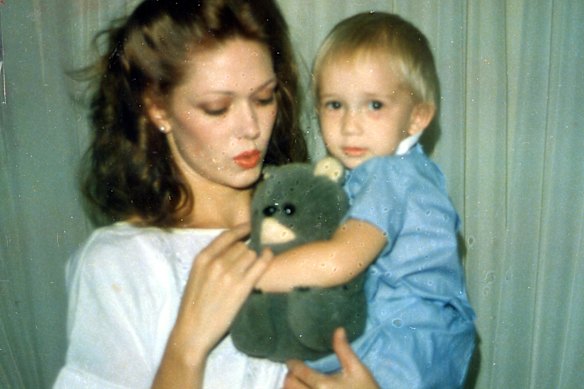
Jacqui Ramchen with son Lev.
One of the students, Debra Elliott, told police, “We all suggested to her that if her husband was that bad she should leave him, but she said no because if she did that she would never see her kids again.”
Another member of the class, Julie Costello, remembers the rambling monologue. “We were all shocked. She said, ‘I don’t care what happens to me now … I don’t care if he kills me’.”
Two days later, she disappeared.
At 8.30am on April 10, 1992, Jacqui drove her children to Christ Church Grammar in her blue BMW. The school insists a parent or carer sign the attendance book when dropping off and picking up children.
Jacqui signed the book when she dropped them off and was designated to pick them up. Yet it was Vic who collected them at 2.50pm, 10 minutes early. There was no sign of Jacqui. The school had not been notified of the change of arrangements but it was a minor breach of the rules and no one worried, at the time.
Jacqui’s tiny circle of friends revolved around the school. She had become the subject of real concern and idle gossip among many of the mothers in the school yard.
But it was the last day of term one, and it was two weeks before anyone at school noticed she was gone – and five weeks before she was reported missing.
Jacqui’s mother, Hennie, said she received a phone call at her Phillip Island home on April 5 and could hear Vic in the background being typically abusive.
Jacqui said she would ring back on her mother’s birthday on April 12 and would come down to the island with the children during the second week of the holidays.
She didn’t hear from her daughter again.
Hennie repeatedly tried to ring Jacqui but the phone was constantly engaged. She knew that Vic often took the phone from the hook when he didn’t want to be disturbed.
Mothers at the school started to talk when Vic brought the children to school. Finally, two weeks into the second term, one asked about Jacqui, and Vic responded; “She’s gone and I don’t care if I never see her again.”
Another mother, Anne Dutton, still remembers her response: “My words were, ‘Oh my God, I hope he hasn’t done away with her’.”
On May 11 or 12, Hennie rang Vic’s mother, Anna Ramchen, who told her to go to the house. When she got to Fairbain, Vic’s explanation was simple: “Well, she left me.”
Hennie confided in a nun, Sister Michele Kennan, who reported Jacqui missing to the Prahran police. When the investigation began, the mother of three had been missing 38 days and the trail was already cold.
On May 18, 1992, Sergeant Elizabeth Batten and Constable Wayne Treloar went to the mansion to make inquiries about Jacqui. They found the front gates were chained and padlocked and they had to scale the two-metre fence. They told Vic his wife had been reported missing. He responded she had left him and “was really just a slut”.
When he was asked why he hadn’t bothered to report her disappearance, he said, “I wasn’t too concerned because I believe that she has run off with whoever, like some little tramp. I did not even consider that there was any need to be worried about her safety.”
Loading
Police took a statement from Lev Ramchen. It was an extraordinary and tragic document from a gifted boy who lost his childhood due to his parents’ obsessions.
“Jacqui is my natural mother. I do not love my mother because I cannot love someone who was destroying the family. According to her, she started the affair in September 1991 [when Lev was in grade three]. We believe the affair started earlier. When I say we, I mean my father and I.
“My father said he would not forget what Gary Forrester had done to the family.
“When we realised she was gone, my father was not really upset. He did not really care. He had started not to care whether she stayed or left about two weeks before she left.”
Ten years later, Lev, who graduated as one of the top HSC students in the state and was enrolled in law at Melbourne University, was called by the defence at his father’s murder committal. “It’s not entirely clear, then or now, where she is or what happened to her,” he told the court.
Just before Jacqui went missing, Vic’s property empire started to crumble. He was pouring money into his home which, like his marriage was just a shell.
His Woodend property with its superb bluestone homestead, was put on the market in 1988, but no one would pay the asking price of $1.4 million.
The property crash, coupled with high interest rates, left Vic dangerously exposed.
According to a police financial profile, his gross rental income was around $382,000 from shops in Northcote and Gisborne, but his interest bill from the Commonwealth Bank was $416,000.
He bought the Domain Road house in late 1988 at the height of the property boom for about $2.8 million, but within four years, values in South Yarra and Toorak had been slashed. According to a police analysis, the value of the house had dropped by at least $1 million by 1992. But interest rates were still crippling.
Five weeks before Jacqui disappeared, the Commonwealth Bank sent a letter to Vic demanding repayment of a $3.1 million loan. If his wife had divorced him and demanded $1.5 million he may have been forced to sell all of his property at the bottom of the cycle.
A family law court lawyer said if the Ramchens had become involved in a bitter divorce battle, legal fees could have been up to $300,000.
Two months before she disappeared, she told her mother she had started divorce proceedings and would be free in eight months. She had moved into the back of the mansion and, while they lived under the one roof, they were technically separated.
Vic later told police his wife had asked for a divorce and he responded: “It’s not that bloody simple, we’ve got three kids you know. We’ve got a bad economy, you know, there’s properties.”
Vic didn’t trust his wife and yet when she disappeared, he made no effort to find her. Jacqui married for money, a house and for children, yet she walked out on all three.
According to police, she had access to five family and business accounts and up to $350,000, yet there is no record of her trying to access the funds.
Vic made no efforts to alter access or even inquire if any of the money was missing. He either knew she wouldn’t move on the cash or was beyond caring.
Now, Vic’s financial situation appears to have recovered. Fairbain is now estimated to be worth around $4 million. Real estate experts say the Woodend homestead now has a market value of around $1 million, and four small lots from the property have been sold for about $320,000.
The arrest Vic never saw coming
POLICE spent years trying to find out what happened to Jacqui Ramchen. They searched Fairbain, the Woodend property, a bird-watching area near Werribee frequented by the family and found nothing. They even used ground-penetrating radar to check under a concrete floor in Fairbain.
Few people, no matter how desperate or cunning, can disappear without leaving electronic footprints through interlinked computers. Police checked credit cards, Medicare, immigration, change of name records, taxation, social security, births, deaths and marriages, and road traffic authorities. They found her licence had lapsed and she had not tried to get money from any of the family bank accounts.
Police had motive and opportunity. What they lacked was a body. They would have to prove not only who did it, but that it was done at all.
Homicide squad detectives prepared a brief of evidence and lawyers from the Office of Public Prosecutions agreed there was sufficient evidence to justify charging Vic Ramchen with murder. The OPP’s established standard is that the evidence to be presented before a jury would support a “reasonable prospect of conviction”.
On July 27, 2001, Detective Sergeant Charlie Bezzina arrested Vic. The suspect didn’t see it coming. “I’m shocked, I mean I can’t see the basis for these charges,” he said at the time.
Asked if he wanted to say anything he responded: “Not at this stage, there will be plenty said later, obviously.”
And there was.
The committal hearing took eight expensive days. Vic had a top legal team led by Robert Richter, KC.
Witnesses swore that Jacqui would never leave her children and always contacted her family on birthdays. They said they believed she was dead. Others said she discussed “vanishing without trace” to Asia.
One witness, Doctor Elizabeth Farrell, said, “She told me that she was leaving. When she told me that I had the feeling that she was leaving without the children.” Another said Jacqui said, “If I had to disappear I could.”
Richter argued in court that the Crown could not prove that Jacqui had not deliberately disappeared or had fled and met her death at the hands of someone else other than her husband.
On March 14, magistrate Kim Parkinson found there was insufficient evidence to present Vic before a Supreme Court jury on the charge of murder.
He was released. Police will have to pay his legal costs, likely to be nearly $200,000.
Vic, 61, is a less imposing figure these days. He has been diagnosed with a serious illness and spends most of his time at home.
Hennie Mertens knows her daughter is dead and suspects the murderer will never appear before a jury.
She went to the Melbourne Magistrates’ Court to listen to the evidence gathered against Vic. She felt sadness, anger and a strange sense of relief.
The anger was overhearing lies about her daughter and the sadness was finding the case would remain unsolved. But the feeling of relief came when she saw her three grandchildren outside the court – all seemingly healthy and content.
“I was happy to see that Vic had looked after them. They all look well. He is a good father.”
She was bitter, though, that Vic has stopped her seeing her grandchildren. “I hope one day when they are old enough, they will come here. They will always be welcome.”
She was shocked to see Lev had inherited his mother’s fine-boned looks. “He is just like her.”
This piece was first published on March 29, 2004.