3 months ago
22
3 months ago
22
A career tunnel worker diagnosed with silicosis has been awarded $2.4 million in an Australian first, with a judge offering a scathing assessment of contracting companies’ “egregious breaches of duty” to protect employees from deadly airborne hazards.
In a judgment handed down in the Dust Diseases Tribunal on Tuesday, 53-year-old Craig Bennett was awarded $860,000 in general damages, the highest ever awarded in Australia for a dust-related injury. The remaining $1.54 million was for the loss of earning capacity.
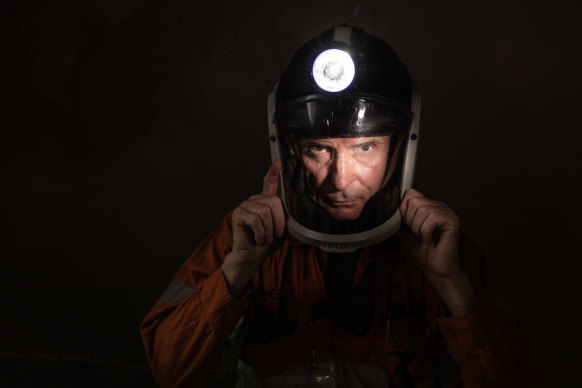
Tunneller Craig Bennett has been awarded $2.4 million in damages by the Dust Disease Tribunal.Credit: Paul Harris
It is the first case brought by a road tunnel worker diagnosed with silicosis. The judgment could have major consequences for the thousands of workers employed across Australia’s multibillion-dollar tunnelling projects. One in 10 is predicted to develop the incurable lung disease.
In his judgment, Judge Andrew Scotting concluded that Bennett, who suffers from silicosis and progressive massive fibrosis, would be incapacitated for work by 65, and reach respiratory failure by 70 without a lung transplant.
Bennett was diagnosed with the deadly lung disease in 2020 after working for 27 years in the tunnelling industry.
He worked on some of the nation’s biggest infrastructure projects: Sydney’s NorthConnex twin tunnel, WestConnex and the Eastern Distributor, and Melbourne’s EastLink project.
The defendants to the case were some of the nation’s largest contracting companies, including CPB Contractors, Lendlease, John Holland and Thiess.
Scotting castigated the companies’ failure to protect workers from the dangers of airborne disease, rejecting the proposition that Bennett’s disease was caused by negligence on his behalf.
Loading
“The defendants knew or ought to have known that, by exposing the plaintiff to large quantities of RCS [respirable crystalline silicosis], that he was at risk of serious illness and death,” wrote Scotting, adding the companies could have implemented a number of “high order” safety measures.
“The overwhelming cause of the plaintiff’s condition was the egregious breaches of duty committed by each of the plaintiff’s employers.”
A 2023 investigation by the Herald, The Age and 60 Minutes exposed serious health risks for tradespeople working with engineered stone, prompting bans on manufactured stone benchtops, panels and slabs containing at least 1 per cent silica.
Curtin University research published in 2022 has forecast up to 103,000 Australians will develop silicosis after being exposed to the deadly dust at work.
Loading
Bennett declined to comment. But he told the Herald in early 2023 about being advised by his doctor that he had advanced silicosis, and was told the diagnosis meant he needed to quit the highly remunerated tunnelling work immediately.
“I broke down in tears in that doctor’s office,” he said. “I was at a crossroads. I didn’t know what to do. It was just too much to take in.”
Bennett told the court he was yet to tell his 12-year-old daughter because she was too young to understand, and he was concerned how she might react.
“I don’t know how to tell her. I will one day, but yeah … ,” he said in 2023.
Loading
Bennett, who continues to work in Brisbane on the Cross River Rail Project, described how, for most of his career, he was provided minimal protective equipment and little information about the dangers posed by drilling through rock with high silica content.
“For most of the exposure period the plaintiff was provided with a paper face mask, which for the reasons given, provided little, if any, protection,” the judgment stated.
Maurice Blackburn principal lawyer Jonathan Walsh, who represented Bennett, said the judgment was precedent setting and a “bellwether case to demonstrate to workers that courts will reasonably compensate you”.
Scotting’s judgment swiftly dismissed the argument proffered by tunnelling companies that the best available respiratory equipment was a “panacea” for dealing with dust diseases, Walsh said. It would put companies and governments on notice that significant safety improvements were required.
“It’s not that this technology needs to be invented. It already exists. It’s about will and whether these companies are willing to adopt these changes. Or the law needs to be vastly improved to force these companies to adopt these technologies,” he said.
Also representing 30 tunnelling workers diagnosed with silicosis, Walsh said the case was likely to be just the beginning of what could be hundreds of cases in the tribunal.
Australian Workers’ Union assistant national secretary Chris Donovan said Bennett’s diagnosis was a failure of responsibility across industry, accusing his employers of treating “his life as collateral damage in the race to get the job done”.
“Craig’s legacy must not be a gravestone, it must be a turning point. His case demands real change, real accountability, and real protections so that no worker ever breathes in death on the job again,” he said.
The contractors have been contacted for comment.
Most Viewed in Politics
Loading