3 months ago
47
3 months ago
47
Jeremy BowenInternational Editor

 BBC
BBC
It is only day three of the new war between the United States, Israel and Iran.
It is already a regional war, after Iran's decision to attack Arab states who are US allies as well as Iran's neighbours across the Gulf. The United Kingdom has dropped its refusal to allow the US to use its bases.
The war is still escalating, and news alerts are pouring in on my phone. I've just read a press release from US Central Command saying that three US F-15E Strike Eagles have been shot down by Kuwaiti air defences in "an apparent friendly fire incident". By the time I finish writing this piece more missiles will have been fired and more than likely people who are alive now will have been killed.
It is way too soon to have any idea of when or how the war will finish. Once wars start, they are hard to control. But here are some of the ways that the belligerents would like it to end.
Trump's definition of victory
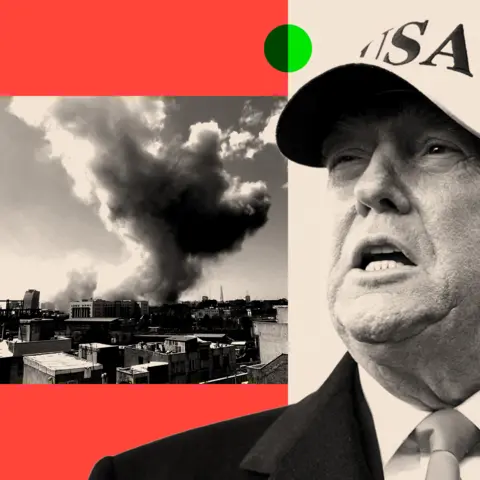
President Trump, as ever, has radiated confidence in American power since he announced the war had started in a video message filmed at his Mar-a-Lago residence in Florida. Other presidents might have chosen a solemn address from behind the Resolute desk in the Oval Office.
Trump wore an open-neck shirt and a white baseball cap pulled low over his eyes. He ran through a long charge sheet, arguing that Iran had been an imminent threat to the US since the Islamic Revolution in 1979.
 US Navy via Getty Images
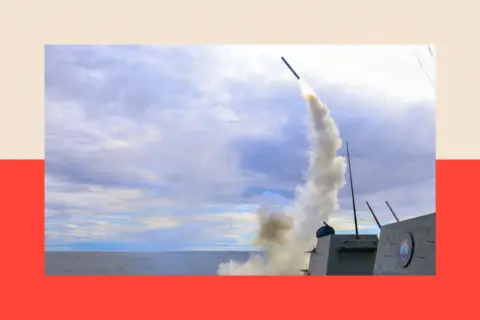
Military action by the US and Israel is pulverising Iran's military capacities
Trump can always change his mind, but in that speech, he provides a definition of his conception of victory. It amounts to a check list:
"We are going to destroy their missiles and raze their missile industry to the ground. It will be totally, again, obliterated. We're going to annihilate their navy. We're going to ensure that the region's terrorist proxies can no longer destabilize the region or the world, and attack our forces, and no longer use their IEDs or roadside bombs, as they are sometimes called to, so gravely wound and kill thousands and thousands of people, including many Americans."
Trump claimed Iran was developing missiles that could reach the US, a statement that is not backed up by US intelligence assessments. He also claimed it was close to developing a nuclear weapon, contradicting his own statement last summer that the US had "obliterated" Iran's nuclear sites.
 Getty Images
Trump claimed Iran was developing missiles that could reach the US, a statement that is not backed up by US intelligence assessments
Trump believes that the US, with Israel, can cripple the regime in Tehran. If it does not capitulate, he sees it as being so smashed that the Iranian people will have their best chance in generations to take to the streets to seize power:
"When we are finished, take over your government. It will be yours to take. This will be probably your only chance for generations. For many years, you have asked for America's help, but you never got it. No president was willing to do what I am willing to do tonight. Now you have a president who is giving you what you want. So let's see how you respond."
Transferring responsibility for regime change to the Iranian people, even when he is directly encouraging them to act, gives him a potential get out at a later date if the regime survives. But it can also be viewed as a moral responsibility for the US to see it through, though it's an open question as to how much that would sway a president who believes there is always a deal to be done.
There is no precedent for changing a regime or winning a war against a well-armed adversary simply by using air power. In 2003 the US and its allies including the UK sent major ground forces into Iraq to remove Saddam Hussein. In 2011, Libya's Col Muammar Gaddafi was removed by rebel forces armed by Nato and Gulf countries and protected by their air forces. Trump is hoping that the Iranian people can do the job themselves.
 Anadolu via Getty Images
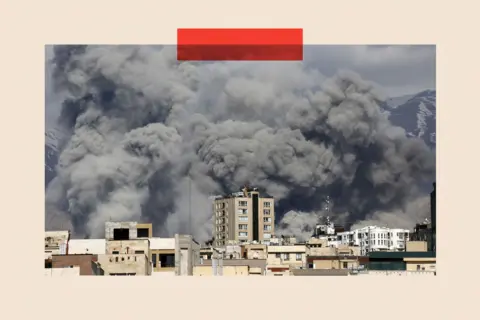
The US and Israel struck Iran on Saturday, killing the country's Supreme Leader Ayatollah Ali Khamenei
Trump's plan is a huge gamble. The odds are stacked against bombing alone causing regime change.
Could there be an internal pro-western coup? Not impossible, but highly unlikely viewed from day three of the war.
It is more likely that the men now running the regime will hunker down, fire more missiles, fuelled by ideology and the conviction that they can take more pain than the US, Israel or the Arab Gulf states. Most of the pain will be felt by the long-suffering Iranian people. But they do not have a say in the matter.
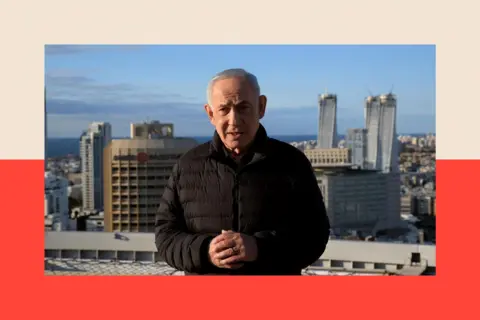
Like Donald Trump, Benjamin Netanyahu has also made statements encouraging Iranians to take matters into their own hands. But if they cannot overcome the regime's ruthless security forces, Netanyahu's priority is smashing Iran's military capacity and its ability to rebuild militias around the region that could threaten Israel.
For decades, Benjamin Netanyahu has seen Iran as Israel's most dangerous enemy. He believes that the Islamic Republic's rulers want to build a nuclear weapon to destroy the Jewish state.
 GPO HANDOUT/EPA/Shutterstock
Benjamin Netanyahu has made statements encouraging Iranians to take matters into their own hands
On Sunday, day two of the war, he stood on a roof in Tel Aviv, perhaps the defence ministry building in the heart of the city, and stated how he saw the war ending.
He said that Israel and America together would be able "to do what I've hoped to achieve for 40 years – to crush the regime of terror completely".
He said it was a promise that he would make sure became a reality.
Wars always have a domestic political dimension. Like Trump, Netanyahu faces elections later this year. Unlike Trump, his own job is on the line. Many Israelis blame Netanyahu for the security blunders that gave Hamas an opportunity to attack on 7 October 2023. He will take a giant step towards electoral forgiveness if he can say he has led Israel to a decisive victory over Iran. He might even be unbeatable.
The killing of the supreme leader and his top military advisers was a hammer blow to the regime. But it does not necessarily mean that it will collapse.
Ayatollah Ruhollah Khomeini and its other founders nearly 50 years ago designed its institutions to survive wars and assassinations. It is not a one-man show. The Syrian and Libyan states under Assad and Gaddafi were built around ruling families. When the families were removed – Gaddafi was killed and Bashar al-Assad fled – the regimes collapsed.
Iran's regime is a state system, resting on a complex and dense network of political and religious institutions with overlapping responsibilities. It is engineered to survive wars and assassinations.
That does not mean it will. The Islamic Republic's system faces its sternest test. But it has planned for this moment.
 Reuters
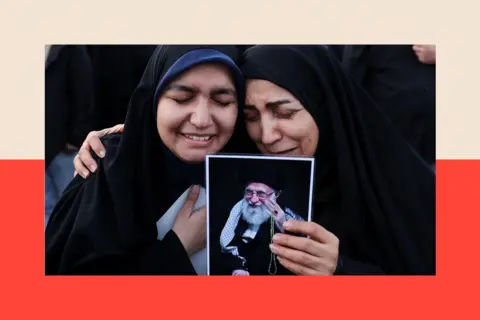
Thousands went onto the streets of Tehran after the killing of the Supreme Leader
The regime's definition of victory is survival. To achieve that it surrounds itself with a formidable level of protection.
It has a powerful and ruthless apparatus of security, repression and coercion. In January its men went on to the streets, following orders to kill thousands of protestors. So far - and as I have said repeatedly, it's only day three of the war as I write this - there is no sign that the regime's armed forces are melting away, as Assad's did after he fled to Moscow in December 2024.
As well as conventional armed forces and well-armed police, there is the Islamic Revolutionary Guards Corps, with an explicit mandate to protect the regime at home and abroad. It exists to be the muscle behind the velayat-e faqih, the guardianship of the jurist. That is the key doctrine of the Islamic revolution in Iran, which justifies the rule of Shia religious leaders.
The IRGC is believed to have 190,000 on active duty and as many as 600,000 reservists. Religious doctrine apart, it also runs much of the economy. Its leaders have financial as well as ideological reasons to stay loyal.
The IRGC is backed by the Basij, a volunteer paramilitary force. Its estimated 450,000 members have a reputation for loyalty to the regime and for thuggery.
I saw them in action in Tehran as the regime's first line of defence during the protests that followed the disputed 2009 election, threatening and beating protestors on the streets with clubs and rubber truncheons. Behind them were heavily armed police and IRGC men. The Basij also had flying squads on motorcycles that raced around the city dealing with outbreaks of dissent.
Donald Trump has threatened the IRGC and the Basij with certain death - he said "it won't be pretty" - unless they lay down their arms. His threats are unlikely to change many minds among the regime's armed men.
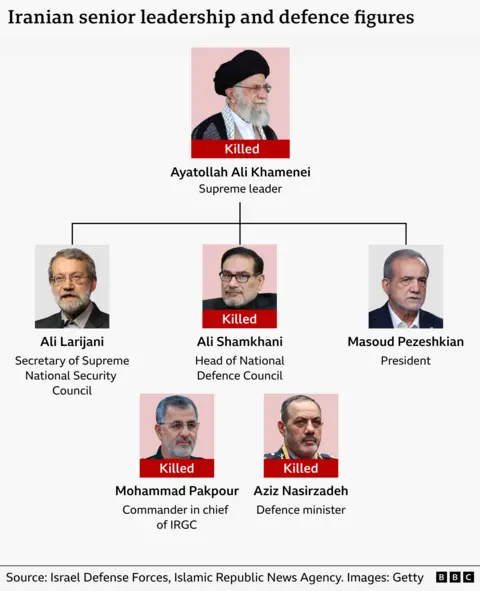
The Islamic Republic and Shia Islam are imbued with the idea of martyrdom. When after hours of official claims on Sunday that the supreme leader was safe and well, the weeping newsreader on state TV announced Khamanei's death by saying that he had drunk the sweet pure draft of martyrdom.
Some serious analysts of Iran suspect the Ayatollah went ahead with a meeting at his compound in Tehran with his senior advisors when much of the rest of the world believed an attack was imminent because he sought martyrdom.
The regime has a core of civilian loyalists. Thousands went onto the streets of Tehran after the killing of the supreme leader, on the first of 40 days of mourning. They gathered in public squares lighting candles and the torches of their mobile phones, despite the plumes of smoke rising from US and Israeli airstrikes.
The Americans believe that this time, their raw power - along with Israel's - can impose regime change on an enemy without creating a disaster.
The precedents are not good. The removal of Iraq's Saddam Hussein in 2003 led to a catastrophe - long years of war that incubated jihadist extremist movements that still exist.
Libya, a country with enough oil to give its small population western standards of living, is broken and impoverished, a failed state 15 years after Gaddafi was removed from power and killed. Western countries who celebrated his fall and made it happen essentially washed their hands of responsibility after the country broke up.
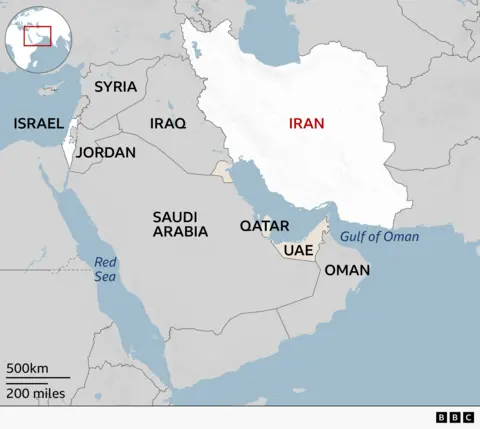
Iran is a big country, almost three times the size of Iraq with a multi-ethnic population of more than 90 million. If the regime in Iran does fall, the nightmare scenario is that the confusion, chaos and bloodshed that might follow could rival the civil wars that killed hundreds of thousands in Syria and Iraq.
Military action by the US and Israel is pulverising Iran's military capacities. That changes the equation in the Middle East, even if the regime survives.
Many, most likely most Iranians, would rejoice if it fell. But it would be an immense challenge to replace a regime removed by force with a peaceful, coherent alternative.
Trump's gamble is that it will be possible, that this war will make the Middle East a better and safer place. The odds against that happening are challenging.
Top picture credits: AFP via Getty Images

BBC InDepth is the home on the website and app for the best analysis, with fresh perspectives that challenge assumptions and deep reporting on the biggest issues of the day. Emma Barnett and John Simpson bring their pick of the most thought-provoking deep reads and analysis, every Saturday. Sign up for the newsletter here