3 months ago
25
3 months ago
25
The history of fashion, like the history of the world itself, belongs to the disruptors. Just as revolutionaries rewrite the political landscape and artists transcend our everyday worlds, the people who change the way we dress reshape much more than our wardrobes. Written in fabric, theirs is a language of provocation, empowerment and liberation. Clothes, as Virginia Woolf wrote in her 1928 novel Orlando, “change our view of the world and the world’s view of us”.
Two of fashion’s greatest change agents were born 18 months apart, on separate sides of the globe, into worlds that weren’t quite ready for them. Vivienne Westwood spent much of her childhood roaming the woods near her quaintly named village of Tintwistle, dressed in clothes sewn by her mother, a champion of wartime Britain’s make-do mantra. Years later in London, she was at the forefront of punk, the youthful rebellion whose impact still echoes around the world.
Growing up in conservative post-war Japan, Rei Kawakubo chafed against gender limitations to forge a career – and a fashion empire – that rewrote the rules on beauty and challenged what we mean when we talk about clothing. At 83, the founder of Comme des Garçons is as bold and innovative as she was back in 1981, when she threw a metaphorical hand grenade onto the catwalks of Europe with her debut showing at Paris Fashion Week. In an era of figure-hugging, shoulder-padded excess, her baggy, deconstructed clothing, in various shades of black, was dubbed “apocalyptic” by one shocked observer. Her most recent collection, unveiled in October, was a lot more colourful, but no less boundary-busting.
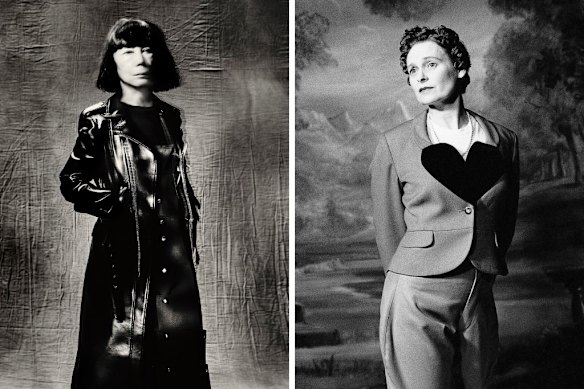
From left, Paolo Roversi portrait of Rei Kawakubo, 2016. Vivienne Westwood, London, 1987.Credit: Comme des Garçons, John Stoddart/Popperfoto via Getty Images
This month, the work of these two groundbreakers comes together in an exhibition of almost 150 works at the National Gallery of Victoria. Westwood/Kawakubo is the brainchild of NGV fashion curators Katie Somerville and Danielle Whitfield and follows the gallery’s previous pairings of Andy Warhol and Ai Weiwei in 2015 and Keith Haring and Jean-Michel Basquiat in 2019. This is the first time two women have shared the spotlight.
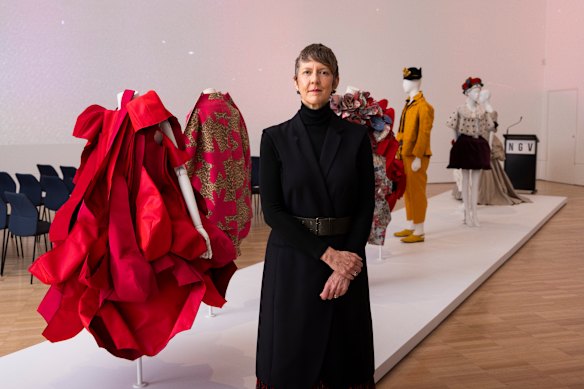
Katie Somerville with clothes designed by Rei Kawakubo and Vivienne Westwood.Credit: Paul Jeffers
Somerville recalls the moment three years ago when she and Whitfield started thinking about the summer of 2025-26, and how best to draw on what is fast becoming one of the world’s great fashion collections. “It was as innocent as that really, two curators seeing this opportunity in the context of what the NGV does, but also what our collection could do,” she says.
Showing Westwood and Kawakubo side by side makes sense in so many ways that it’s surprising they’ve not been paired before. “There’s lots of reasons why they seem like a good fit,” says Somerville. “They’re of the same generation and their career trajectory kind of runs in parallel … they’re also both self-taught … [and therefore] not constrained by a sense of how one should do something. You’d be hard-pressed to think of two more impactful or influential designers, of any gender, in terms of all of those new ways of doing things, making things, selling things, presenting things. Both designers have been propelled by the idea of newness.”
The exhibition bears witness to the pair’s restless innovation across themes including Punk and Provocation, Rupture, and Reinvention. A section exploring The Body: Freedom and Constraint reminds us that even the human form was ripe for reimagining in their hands. Westwood ignored the contemporary ideal of slim-hipped womanhood by fashioning oversized, 18th-century-style derrieres and curve-enhancing corsetry. Kawakubo swapped womanly shapes for lumpy silhouettes or inserted models into flat, two-dimensional creations that evoke the cutout dolls of childhood. “The rule,” she said of 2012’s Two Dimensions collection, “was to ignore the human body.”
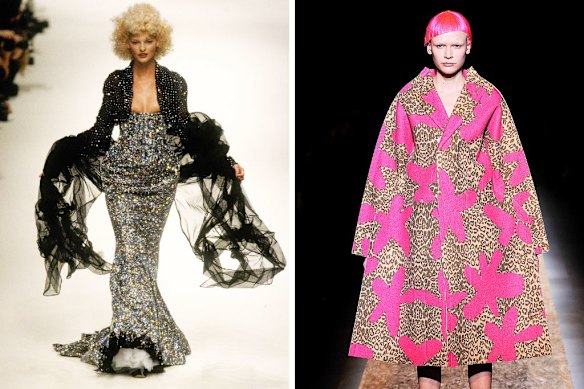
From left, Linda Evangelista wears Vivienne Westwood evening bolero and dress, from the Erotic Zones collection, spring-summer 1995; Henna Lintukangas wears Comme des Garçons Look 9, from the 2 Dimensions collection, autumn-winter 2012–13.Credit: Photos: PL Gould/Getty Images, Comme des Garçons
In the exhibition’s opening section, we are transported back to the 1970s and early ’80s, reminding us, says Somerville, “of what the world looked like when these two women started doing their radical changes”.
Acclaimed British milliner Stephen Jones, who has worked with both designers over the years and contributes original and new works to the NGV show, was there when punk upended everything.
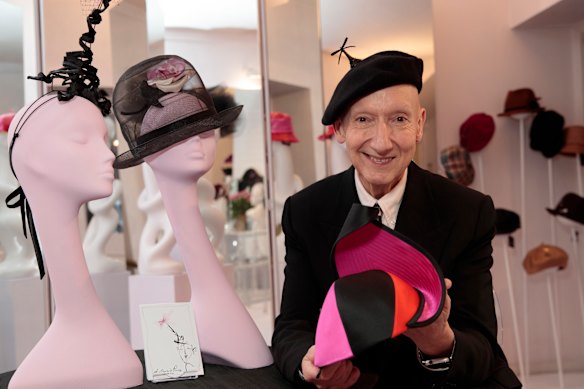
Milliner Stephen Jones: “Whether you’re a Vivienne Westwood person or a Comme des Garçons person ... it’s like if you’re following a football club.”Credit: Getty Images
“Punk was really important in Britain because a generation was growing up thinking that previous generations, previous societies, had nothing to do with us,” he says of those heady days in London. “Punk was about destroying the past to try to build a new future.”
It was an attitude that was stitched into one of Jones’ best-known creations, the Harris Tweed crown, which features in the NGV show. Part of Westwood’s autumn-winter collection of 1987, this spoof of the Queen’s gold and gem-encrusted version became famous when model and Westwood muse Sarah Stockbridge wore it on the cover of i-D magazine. Jones made a version out of black tweed and velvet for Westwood’s memorial service in 2022, but in the end wore one of his originals. “It was falling apart, but it was from the time,” he says.
Loading
Jones is intrigued by the paired NGV exhibition, and says Kawakubo’s support for the show (including a surprise donation of more than 40 Comme des Garçons items in the lead-up to the opening) illustrates her admiration for Westwood.
“No designer likes to be compared with another designer, but I think Rei would have agreed to it because she respected Vivienne,” he says.
I meet up with Jones in Paris the day after the launch of Comme des Garçons’ spring-summer 2026 women’s collection, an ode to creativity that left both of us smiling. “There was something so joyous about it,” he says. “I was intrigued by the making of the clothes, how beautiful they were. How far Rei can push it. She does inhabit her own world.”
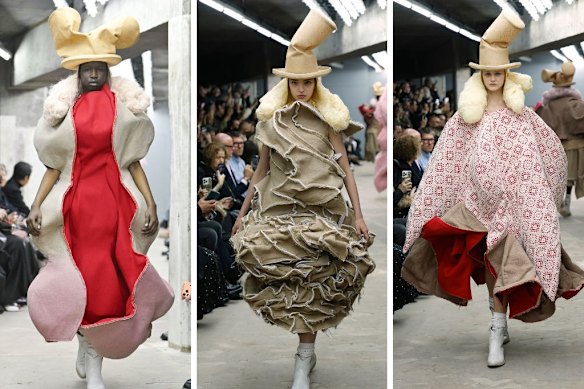
Three looks from After the Dust, Comme des Garçons’ spring-summer 2026 collection. Credit: Getty Images
Kawakubo’s singular vision extends to the minimalist backdrops in which she presents her designs, a world away from the glamorous Paris settings chosen by other designers at Fashion Week. Inside a bunker-like room with pockmarked concrete walls and unflattering fluorescent lighting, her creations conjured a spring-like sense of renewal: models in pale pink and yellow wigs floated by, encased in sculptural folds of pink lace or fluffy balloons of white fabric, their oversized, candy-coloured collars sitting beneath weird, wonky top hats.
Simple, earthy fabrics, including the kind used for potato sacks, were shaped into sculptural marvels: a wavy assemblage of red and pink, multi-layered gowns of tied cloth, and a weird, arm-like appendage jutting from the shoulder of one totem-like dress. Towering curved hoods, shredded folds of overlapping fabrics and weird, bulging forms defied any pedestrian notion of wearability. A haunting soundtrack by Spanish singer Fatima Miranda added to the sense that we had slipped through Alice’s looking glass.
Dubbed After the Dust, the collection is a testament to hope and the creative conjuring of beauty out of desolation. If works of poetry written in fabric could transform a gloomy interior of concrete and fluorescent, then something good might yet come of this bleak period of history.
Loading
“Someone said to me beforehand, do you think she’s going to reflect the world and all the problems that are going on,” says Jones. “I thought, ‘no, I think she’s going to do the complete opposite’, which she did; it was really joyous, like, hey, let’s celebrate our culture, let’s celebrate creativity. What else can we do?
“Afterwards I said to Rei, ‘that show made me really happy’. And you know, if fashion has a purpose, to make you happy is the most wonderful thing it could do.”
For members of the Comme des Garçons tribe, the arrival of a new collection is indeed a happy event. You see them at the Fashion Week show, dressed head to toe in Kawakubo. One woman wears an oversized, bonneted jacket from the 2022 Lamentation collection that envelops her head; it is only when she looks my way that I see her smiling face. A tall, blond man, wrapped in ballooning curves of black polyester, poses for photographers before folding himself into one of the tiny chairs that line the catwalk.
“It’s wonderful to see everybody looking great and being respected for their look, whatever they’re wearing and how they’ve put it together,” says Jones. “And it’s completely tribal. It’s that sense of belonging, whether you’re a Vivienne Westwood person or a Comme des Garçons person. It’s like if you’re following a football club. That’s the way you live your life.”
During his 40-plus years working with Westwood and Kawakubo, Jones has collected countless tales of the backstage reality behind all that beauty. He recalls being put to work an hour before the launch of Westwood’s celebrated 1985 Mini-Crini collection, in which skirts shaped like Victorian-era crinolines were trimmed to the length of 1960s minis.
“I went backstage and Vivienne said, ‘you can sew, can’t you? Here’s the pattern, there’s the fabric’. I made two skirts, and the show was about three hours late.”
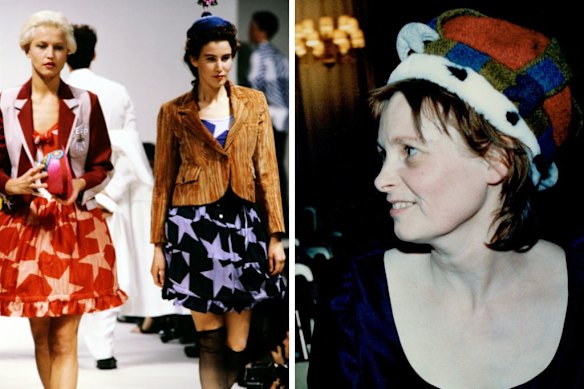
From left, two looks from Vivienne Westwood’s Mini-Crini collection of 1985; the designer wearing Stephen Jones’ Harris Tweed crown in 1987.Credit: Getty Images
On another occasion, unimpressed by the hats he’d made to accompany one Comme des Garçons collection, Kawakubo sent him away for a coffee while she and his assistant “sorted” things out. By the time he returned, his hats had been turned inside out and back to front.
“It looked fantastic,” he admits. “It was challenging in a way, but my god, I learnt a lot. In that particular act, I understood a lot about making something perfect as opposed to making something expressive. What Rei wanted from me was something expressive, not a neat little hat.”
I ask Jones what the world might have looked like without Westwood and Kawakubo. “Duller, certainly. And I think everything would have finished hems,” he quips.
More importantly, he says, “young people might not have the heroes to look up to that they have. Because Rei’s a creative hero. Vivienne was a creative hero. So many people out there think, one day I’d like to be like Vivienne Westwood. Maybe they can be their own Vivienne Westwood, maybe they can be their own Rei Kawakubo. It’s wonderful to have people like that to inspire.”
10 exhibition highlights
VIVIENNE WESTWOOD
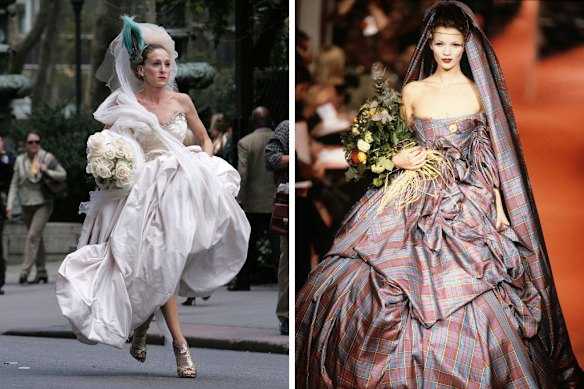
From left: Sarah Jessica Parker wears a Vivienne Westwood wedding gown on the set of Sex and the City: The Movie, New York City, 2007; Kate Moss wears Vivienne Westwood Look 49, from the Anglomania collection, autumn-winter 1993-94. Credit: James Devaney/WireImage via Getty Images; firstVIEW
Wedding dresses: Budding bridezillas can imagine themselves dressed in the sumptuously ruched taffeta tartan gown worn by Kate Moss for the 1993 Anglomania collection, one of several in which Westwood both celebrated and parodied her British roots. Others might prefer the voluminous dress from 2007’s Wake Up Cave Girl collection, a version of which was worn by Sarah Jessica Parker in Sex and the City: The Movie.
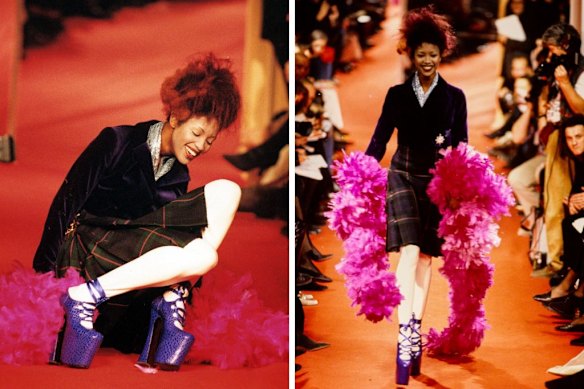
Naomi Campbell takes a tumble during the launch of Vivienne Westwood’s Anglomania collection in 1993.Credit: Getty Images
Those shoes: Even non-fashionistas might recall the moment when Naomi Campbell, wearing Westwood’s iconic oversized heels, took a tumble on the catwalk during the Anglomania launch. Later she told biographer Ian Kelly: “I thought to myself, ‘So what, girl, I’m down. What do you do? You pick yourself up… You keep going’.” Towering shoes were part of Westwood’s drive to, quite literally, elevate women, who, she once said, “should be on pedestals. Like art”.
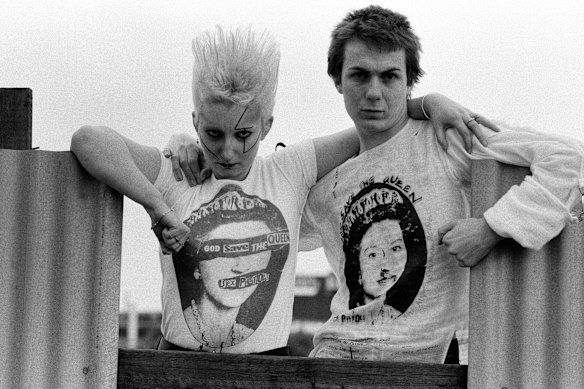
Pamela Rooke, aka Jordan, and Simon Barker, aka Six, model God Save The Queen T-shirts from the Seditionaries boutique, May 1977. Credit: Mirrorpix via Getty Images
Punk originals: When the Sex Pistols came snarling onto the world’s television screens, they did so wearing Westwood. Slogans such as “Destroy” and “God Save the Queen (she ain’t no human being)” were blazoned across shirts and paired with bondage trousers from Westwood’s Seditionaries boutique in London – store of choice for Britain’s best-dressed anarchists. The exhibition’s Punk and Provocation section includes originals that somehow survived all that agitation.
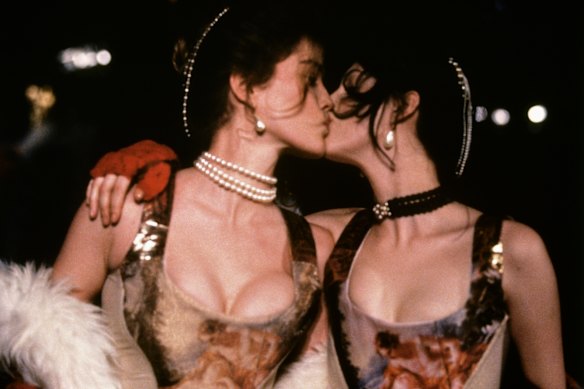
Susie Bick and Denice D. Lewis wear outfits from Vivienne Westwood’s Portrait collection, autumn-winter 1990-91. Credit: John van Hasselt/Sygma via Getty Images.
Corsetry: As anarchic as her designs were, Westwood had a deep interest in history, fed by hours spent in libraries and museums researching historical costume. A one-time primary school teacher who went on to teach fashion design in Vienna and Berlin, she treated clothing as another form of instruction; her signature bustle pads, corsets and derriere cages tell us as much about 18th-century fashions as they do her willingness to subvert what came before.
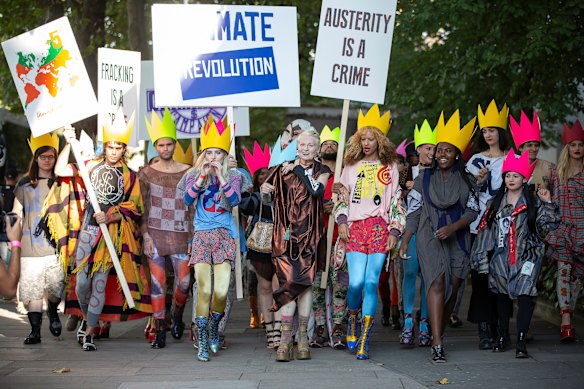
Vivienne Westwood (centre) and her ‘Fash Mob’ prior to her spring-summer show at London Fashion Week, 2015. Credit: © Ki Price
Messages: In the exhibition’s final section, Westwood’s environmental and human rights activism is evidenced in items from collections such as Propaganda (2005) and Chaos Point (2008), in which she returned to the bold graphics and text seen in those early punk years. In his 2014 biography, co-written with Westwood, Ian Kelly writes: “Vivienne’s overriding gift to fashion and the real argument for her as an important cultural figure is her conviction that clothing can change how people think.” Her old pal Stephen Jones says she was always a step ahead. “She was going on about eco stuff years ago, and we all thought she was a complete crackpot. Hello!”
REI KAWAKUBO
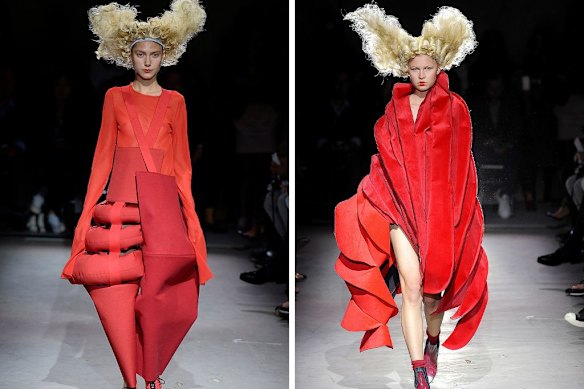
Two looks from Comme des Garçons’ Blood and Roses collection, spring-summer 2015. Credit: Getty Images
Blood and Roses: In 2014, Kawakubo, once the queen of monochrome clothing, unleashed this pivotal collection in which various fabrics, from cashmere to PVC, were dyed in a single shade of red. “The Blood and Roses collection is a little bit about the Tudor wars … the idea of passion and violence and all the blood, and all the associations with red, but it is much more an emotional idea rather than a literal one,” says the NGV’s Katie Somerville. Kawakubo has said that she wanted the 23 looks in Blood and Roses (seven of them are included in the show) to “become symbols of Comme des Garçons”.
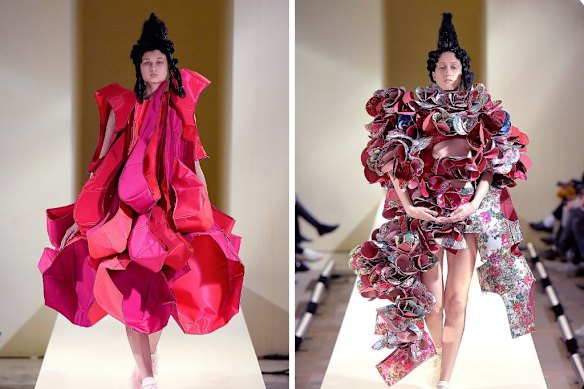
Two looks from Comme des Garçons’ 18th Century Punk collection, autumn-winter 2016-17.Credit: Getty Images
18th Century Punk: With this collection from 2016, Kawakubo imagines a breed of women unshackled from the niceties of 18th-century ladies’ wear and encased instead in impenetrable red peaks and heavily patterned armour. “I was thinking that there had to be women in the 18th century who wanted to live strongly,” she has said. “So I designed what I imagined this type of woman would have worn.”
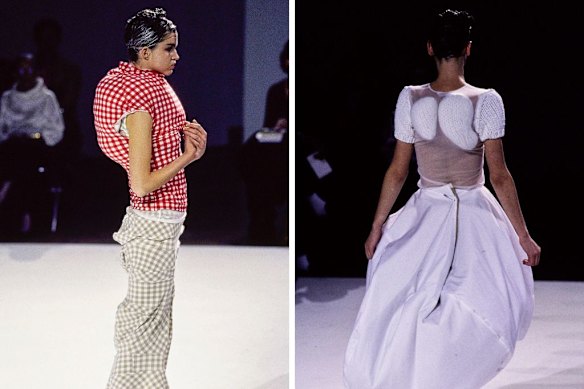
Tops and skirts from Comme des Garçons’ Body Meets Dress - Dress Meets Body collection, spring-summer 1997. Credit: Getty Images
Body Meets Dress, Dress Meets Body: This 1996 collection, with its offbeat protuberances and unflattering blobs, distorts beauty ideals by wrapping the body in stretch fabrics from which asymmetrical lumps bulge from stomach, upper back or side. “It’s one of the first times she’s really exploring this idea of creating a different outline for the body and sculpting a completely different form,” says Somerville. Kawakubo later described it as her “least dissatisfying” collection.
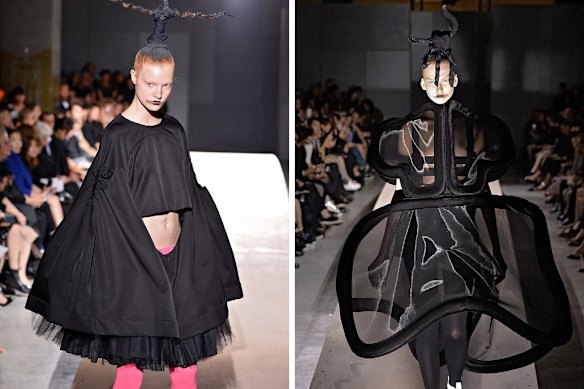
From left, playsuit and dress from Comme des Garçons’ Not Making Clothing collection, spring-summer 2014.Credit: Getty Images
Not Making Clothing: In 2013, Kawakubo ventured further into abstraction, creating stiff sculptural garments that pay little heed to the human form. “She’s wanting to cast off everything she’s done up to that point and be really childlike in terms of ... creating something that is not necessarily presenting a garment as we know it,” says Somerville. “It’s much more into that sculptural play.”
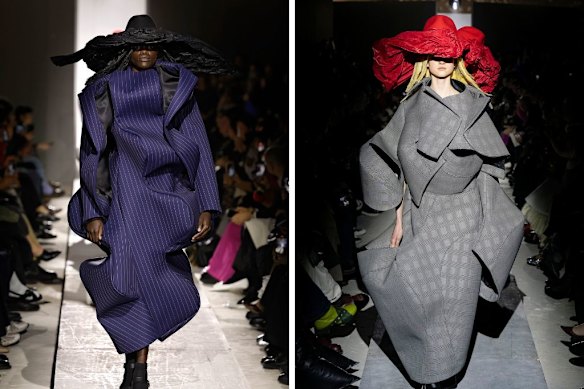
Two looks from Comme des Garçons’ Smaller is Stronger collection, autumn-winter 2025-26. Credit: Getty Images
Smaller is Stronger: The most recent items in the exhibition, from this year’s autumn-winter collection, take traditional tailoring to places previously unseen, subverting the language of pinstripes and checks to concoct clothing whose bulges and angles defy definition. “When you’re cataloguing objects, it’s usually quite obvious what you’re describing,” says Somerville. “But with a lot of these pieces, it’s ‘Is this a dress? Is it a coat dress?’ The rules don’t apply with her.”
Westwood/Kawakubo is at NGV International, December 7 to April 19. Lindy Percival travelled to Paris courtesy of the NGV.