3 months ago
6
3 months ago
6
Examine, a free weekly newsletter covering science with a sceptical, evidence-based eye, is sent every Tuesday. You’re reading an excerpt – sign up to get the whole newsletter in your inbox.
A few months ago, the last edition of The Skeptic rolled off the presses. After 44 years of keeping the psychics, astrologers and homeopaths honest, Australia’s leading magazine of critical thought has closed.
When the Australian Skeptics launched their magazine in 1981, it made Australia a world leader in debunking misinformation.
That first edition carried news of the Australian tour of a paranormal investigator who debunked water divining and spoon bending, an investigation of “psychic surgery”, and lab tests of an alien exo-material (revealed, sadly, to be fibreglass).
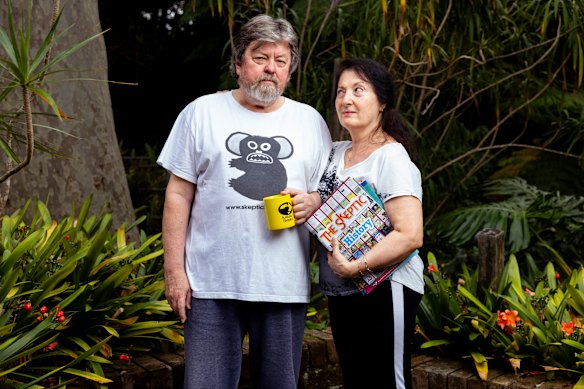
Tim Mendham, editor in chief of The Skeptic magazine, with his wife, Hilda, the magazine’s designer.Credit: Dominic Lorrimer
“As a sceptic, you’re supposed to give people a fair go,” editor Tim Mendham tells me with a long sigh (his wife, Hilda, is the magazine’s designer). “At times you feel like saying, ‘You’re a f---ing idiot.’
“The amount of people who have come to me and said, ‘I can move the sun.’ You’d think people would notice.”
Times are changing. As The Skeptic’s print run ends, Mendham tells me he is worried that we are entering a less sceptical age.
“People have always lied. But the lying now is with impunity,” says Mendham. “You are playing whack-a-mole, and that’s where it becomes depressing.”
Misinformation used to be more fun, he says, or at least less harmful. Bigfoot, UFOs (enjoying a resurgence), the Loch Ness Monster.
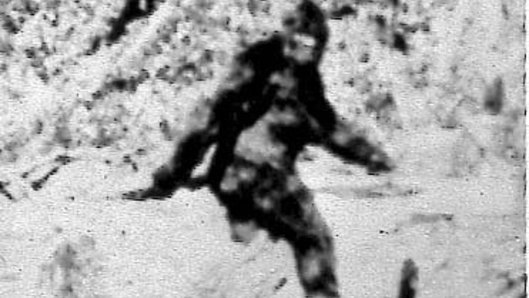
Photographers Roger Patterson and Bob Gimlin made this image in October 1967, purportedly showing a female Bigfoot.Credit: AP
Now it’s quacks, anti-vaxxers and psychics who prey on people’s vulnerabilities. “It becomes quite dark,” Mendham says. “The anti-science attitude that’s around now, we haven’t seen it for a long time.”
The end of the age of scepticism?
Is Mendham right? Are we entering a less sceptical age?
People have always believed things that weren’t true. True believers and charlatans alike have always spread misinformation. What has changed, says Jeremy Brownlie, is our ability to create and spread mistruths.
Brownlie, an associate professor of genetics and evolution at Griffith University, has just completed a series of reports on misinformation, commissioned by the federal government (the reports remain under consideration and have not yet been publicly released).
Brownlie argues that it is our cognitive biases that enable misinformation.
First, we have a natural bias towards believing what people we know tell us. Maybe this served us well around the campfire, when we would listen to the stories of successful hunters. Maybe it is linked to our natural attraction to stories and narratives. But it manifests as an attraction to the storytellers of the digital age – influencers – and as a willingness to give similar weightings to the opinions of uncle Roy on Facebook and the nation’s chief health officer.
Second, even if we know something is untrue, we remain vulnerable to repetition. Hearing a mistruth again and again makes us less confident in our belief in its falsehood. This is known as the “illusionary truth effect”.
“Misinformation hacks that architecture of our brain and the way we think,” Brownlie says.
Let’s return to Mendham’s concern that misinformation is getting worse.
Here, Brownlie makes a key point: we’re not just seeing a swell of misinformation; we’re also seeing an interlinked decline in trust in institutions.
The Skeptic’s greatest hits
- In the magazine’s inaugural issue, it investigated “psychic surgery”, purportedly being performed by deceased surgeons via a medium. This included the use of an “invisible psychic microscope” and the threading of “invisible psychic tubes” to drain the patient of their “bad fluids”. The patient was diagnosed with partial deafness, a “hot brain”, and displaced bones caused by the birth of a child, despite never having given birth to a child. The Skeptic’s investigators were unimpressed.
- In the same issue, the magazine sent investigators to check if Perth still existed, after a clairvoyant predicted the city’s destruction (via tsunami) on February 9, 1981. “PERTH STILL THERE!” read the headline.
Distrust is a central problem for many advanced economies, but let us consider the United States. Trust in government has dipped to near-record lows since pollster Pew started tracking it in the ’60s; meta-analyses come to the same view. Trust in the Supreme Court and the major political parties is also at record lows.
“Misinformation erodes trust in institutions,” says Brownlie, “so people then seek out information from other sources, which erodes trust in institutes. You’ve got this downward spiral of trust.”
Medical and scientific bodies are picking up on this, and they are worried. I’ve been asked to speak at several academic conferences in the past few months on the same topic: are people losing trust in science?
I’ve come to think the problem is more complex. Trust in science per se seems robust in America and Australia (many misinformation-peddlers claim that science supports them, so clearly it’s still got something going for it). Instead, we’re seeing a decline in the trust of institutions we rely on to tell us what the science says.
Brownlie argues the cause is also more complex than just “the internet”. He points to evidence suggesting we are more susceptible to misinformation when we are sicker, more exhausted, more sleep-deprived. Tired people think more emotionally and less rationally. “A modern lifestyle is not one that sets us up for deep critical thinking,” he says.
His argument reminds me of Pat McGorry’s warning that the youth mental health crisis isn’t about social media or phones but about general social collapse. It also reminds me of the trust-in-institutions data I find most intriguing: countries with higher levels of inequality have lower levels of trust in governments.
Are people simply starting to lose faith in the ability of governments to make their lives better? Are they seeking alternative facts because the real ones don’t help any more?
Brownlie’s solutions focus on building critical thinking skills and scientific literacy into the school curriculum. For older Australians, he sees a role for campaigns – like the Australian Competition and Consumer Commission’s Scamwatch – that teach people to identify and be wary of misinformation.
I think there’s also a message for institutions. If they want to retain our trust, they need to ask: how are they helping us make our lives better?
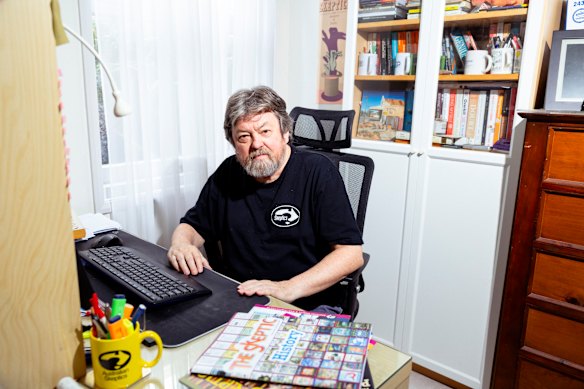
Tim Mendham in his study with copies of The Skeptic.Credit: Dominic Lorrimer
Luckily for us, The Skeptic will endure as an online publication.
“It is a cause. The cause is truth, reason, critical thinking,” says Mendham. “There has never been a greater time for scepticism.”
Tim Mendham on:
The sceptical mindset:
“You say you can fly; I say show me. I’m not saying you can’t – that’s a cynic. A sceptic will look for the truth.”
On homeopathy:
“Some things the sceptics say, ‘Keep an open mind.’ Not homeopathy. It’s absolute rubbish.”
On psychics: “The people who are serious about contacting the dead, the big performers, I would suggest … [they are] grief vampires. They know what they are doing.”
On trusting science: “‘I trust the science’ is dangerous. That’s scientism. We know lots of scientists who aren’t right, who are crooks. There are scientists who are misled. You have to trust the process, not the people.”
On ghosts: “There is not a pub in England that is not haunted. Most museums are haunted.”
The Examine newsletter explains and analyses science with a rigorous focus on the evidence. Sign up to get it each week.
Most Viewed in National
Loading