3 months ago
18
3 months ago
18
A “timber potato chip” covering Anzac station, a crypt beneath City Square and a whispering wall at Arden are just some of the architectural features of the Metro Tunnel.
The $15 billion project is designed to make commuters stop and look, lead architect Ivan Harbour says.
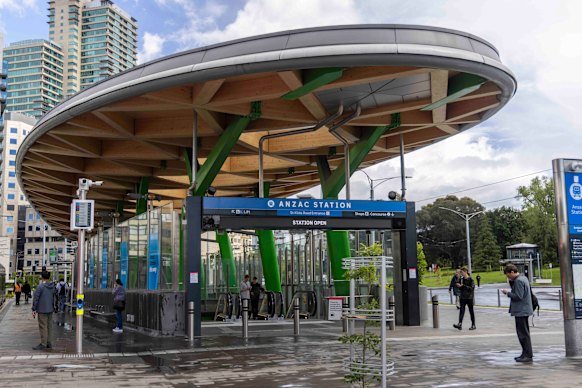
The “timber potato chip” at the entrance to Anzac station on St Kilda Road.Credit: Wayne Taylor
The stations were designed in a collaboration between Australian architects Hassell and UK firms Weston Williamson + Partners and Rogers Stirk Harbour + Partners.
Harbour said the architecture was designed to “hero the engineering” and “hero the concrete”, which is left exposed alongside bright pops of orange and yellow in fittings, representing Melbourne’s sunrise.
Loading
Since its opening on Sunday, Metro Tunnel passengers have stopped to take selfies and snap photographs of the vast underground spaces, while outside they stop to admire the new landscaping.
The Metro Tunnel adds 16,500 square metres of landscaping and green space that was formerly asphalt – the equivalent of 63 tennis courts.
Lord Mayor Nick Reece said he was blown away by the architecture of the stations, which have common features such as the exposed concrete, along with unique design elements for each station.
“People will visit Melbourne to visit the stations – they are that good,” Reece said. “The Moscow underground with its famous gilded stations with chandeliers has got nothing on these fabulous stations we have in Melbourne.”
Rory Hyde, an associate professor in architecture at the University of Melbourne, said the station design was in a style known as “British high tech”, a design movement from the 1960s which features concrete, steel and glass.
Hyde said the stations were well designed, but questioned whether a more contemporary or innovative style could have been used, saying he had hoped for more ambitious public architecture like the Pompidou Centre in Paris, which Rogers Stirk Harbour + Partners also designed.
Hyde said he was not impressed by the roller doors at the entrance to each station.
“The garage doors that they’ve strapped onto the front of them just look like something you ordered from Bunnings,” he said.
Arden
The entrance to Arden station in North Melbourne is a large building featuring 100,000 Victorian hand-laid bricks and huge arches.
The station is designed to reflect North Melbourne’s rich industrial history.
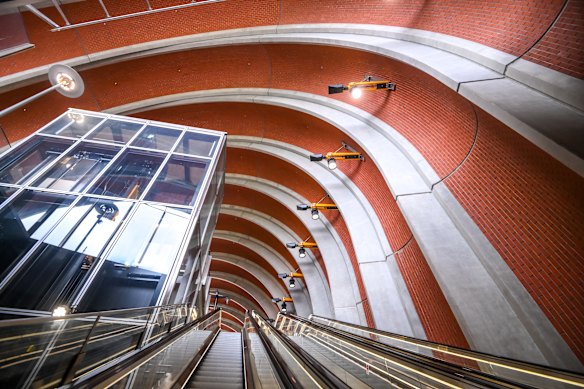
The Arden station entrance features massive concrete arches lined with more than 100,000 hand-laid bricks, reflecting North Melbourne’s rich industrial history. Credit: Justin McManus
One unusual architectural quirk is if two people each stand at a side of the first arch, they can face the bricks and talk to each other with a “whisper wall” effect whereby the sound travels along the arch.
Parkville
Covered by a glass canopy, the Parkville station is airy and bright. Light spills all the way down from the station entrance to the platforms 25 metres underground.
The station features tall concrete columns, one of which is 21 metres high – the height of a seven-storey building.
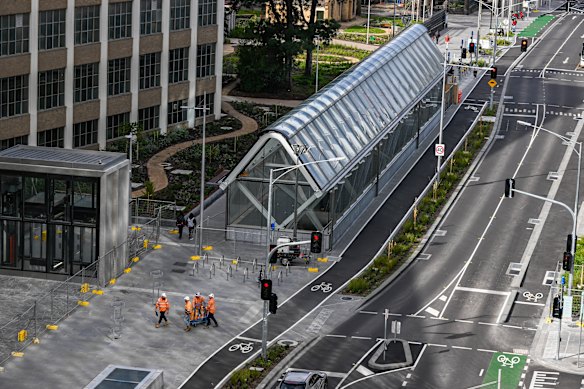
A glass canopy at one of the entrances to Parkville station.Credit: Joe Armao
Bright orange steel drums provide lighting along with “cockatoo-style” lights.
State Library
The design of the station, which sits 42 metres underground and is deeper than Marvel Stadium, is “trinocular”, with a central cavern and a rail tunnel on either side.
This creates a wide open space with the concourse and platforms on a single level, and huge orange steel arches framing the barrel-vaulted ceiling to create a mesmerising effect.
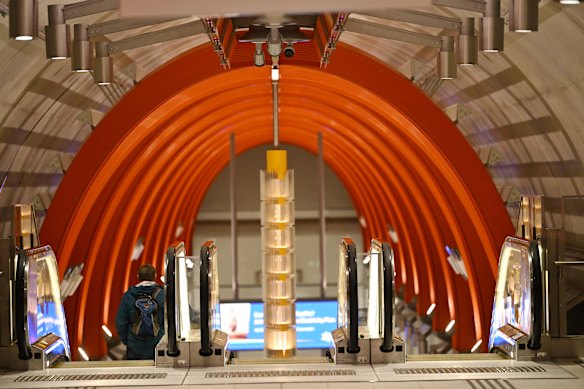
Steel arches at State Library station.Credit: Justin McManus
Town Hall
The revamped City Square sits above Town Hall station, but below it is another huge space – a square beneath a square – known as the “underground crypt”.
“It’s a vast, great space full of activity, and the thoughts are that it can take on all sorts of extracurricular activities and really become a real city space,” Harbour said.
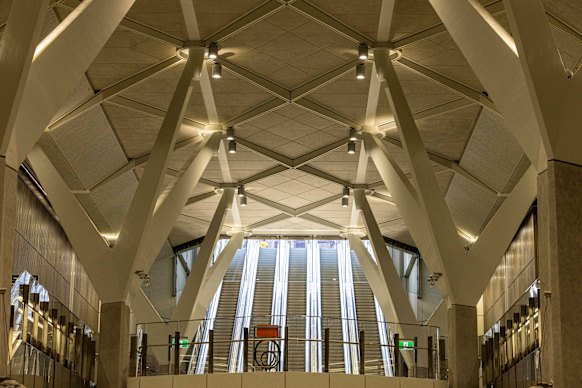
The “crypt” inside Town Hall station.Credit: Wayne Taylor
Anzac
Anzac station, opposite the Shrine of Remembrance, is closer to the surface than many of the other stations. Its bright-green features are a nod to the nearby gardens.
Loading
The station is topped with a large wooden roof, which Harbour describes as a “toroidal form” and Hassell as a “pavilion in the park”. But Hyde has dubbed it the “timber potato chip”.
Hyde said it was good to see timber featured in one of the Metro Tunnel stations.
“This is at least a nod to something new and what we’re talking about, which is the use of mass timber and getting away from concrete,” he said.
Landscaping around Anzac station has created what Hassell architect Craig Guthrie describes as “a new neighbourhood park” linking Albert Park to the Botanic Gardens through a terraced design.
“Albert Park was formerly a swamp, and as the land rises up to Domain that was more woodland,” he said. “In the design, we’ve tried to express the former landscape that was there with the woodland moving to lagoon.”
Start the day with a summary of the day’s most important and interesting stories, analysis and insights. Sign up for our Morning Edition newsletter.
Most Viewed in National
Loading