3 months ago
18
3 months ago
18
The world has changed, Barnaby Joyce declared this week, minutes after he quit the Nationals after 30 years. “Politics has changed, the way people get media has changed,” Joyce said. “You can either change with it, or get run over by it.”
As Parliament came to a close for the year, he wasn’t the only person making that assessment.
The Australian Electoral Study – an analytical deep-dive conducted after every election since 1987 – was published this week. It’s an independent examination that tracks voters’ thoughts and long-term changes in the Australian public.
As part of this work, it’s identified voting patterns becoming more volatile as people ditch major parties, and a drift away from traditional media consumption.
But this year’s study was particularly devastating for Opposition Leader Sussan Ley and the Coalition.
It found that Peter Dutton was the least popular opposition leader in the study’s history and the Coalition’s policy offerings were brutally shunned. More than that, though, it said the demographic threats to the Liberal and National parties – in terms of age and gender – appear existential.
“Unchecked, the current levels and trajectories of party support revealed here point to Labor dominating federal politics for the foreseeable future,” it noted.
Labor’s 94 seats is the largest number held by a single party in the House of Representatives. In its second-term, the government not only increased its share of seats in the House, it also increased its share of the national vote. The last time that occurred was when John Curtin led Labor in 1943.
Meanwhile, the Liberal Party’s primary vote is at its lowest level since Menzies took the party to its first election in 1946. If opinion polls are correct, that’s got even worse.
The electoral study provides much insight into how the Coalition has got to this point.
Women, who once were more likely to vote for the Coalition than Labor, are now firmly backing left-of-centre parties and candidates. Just 28 per cent of women – the single largest voting bloc in the country – backed the Coalition, compared to 37 per cent of men.
“The shift from the traditional to the modern gender gap can be understood in part through changes in society, including the role of secularisation, higher education and higher workforce participation among women,” the survey said.
“Australia’s political parties have also transformed over the past few decades in the degree to which their representatives reflect the broader community.”
Loading
As noted in this masthead last week, the 50 Labor women MPs outnumber the Coalition in the lower house. Ley promises there are new policies coming to woo back women.
There’s another, growing, problem for the Coalition. Support along generational lines is swing sharply towards Labor. Millennials (born between 1981 and 1996) and Gen Z (post-1996) accounted for 42 per cent of voters at this year’s election.
Among millennials, Coalition support has fallen from 38 per cent in 2016 to 21 per cent. Labor’s support among this cohort has climbed from 33 per cent to 37 per cent, giving Albanese a 64-32 lead over Peter Dutton.
Among people in their 30s and 40s, support for the Coalition has fallen almost half.
“This is no longer a cohort of fickle young voters, but a generation at a ‘steep’ part of the life course with respect to earning power, family responsibilities and wealth accumulation,” the study noted.
By the time of the next election, Millennials, Gen Z and Gen Alpha will account for more than half of all voters. The only generations backing the Coalition – Boomers and those born before 1945 – are dying away.
Not only is the Coalition support base disappearing, the proportion of rusted-on voters is diminishing. In the late 1960s more than a third of Coalition voters stuck with the party no matter what. That proportion is now just 13 per cent.
That fracturing was part of the problem for Joyce. “All the time we said, ‘Hey, you’ve got to win back teal seats’,” he said.
Loading
“And what was happening, is people, especially in regional seats, they say: if that’s what you want to focus on, we’re gone. There are more One Nation members now in Tamworth than there are Nationals members.”
The maverick MPs’ defection has whittled Ley’s lower house team down to just 42 members of 150.
Joyce announced his long-signalled shift out of the Nationals the same day as Malcolm Turnbull – who he served as deputy PM – was in Canberra to unveil his formal portrait.
Turnbull weighed in on the problems plaguing the Liberal party a decade after he became prime minister. “It’s interesting now that we’re still having the same insane conversations on the right of politics about energy. I mean, it’s really ludicrous,” he said.
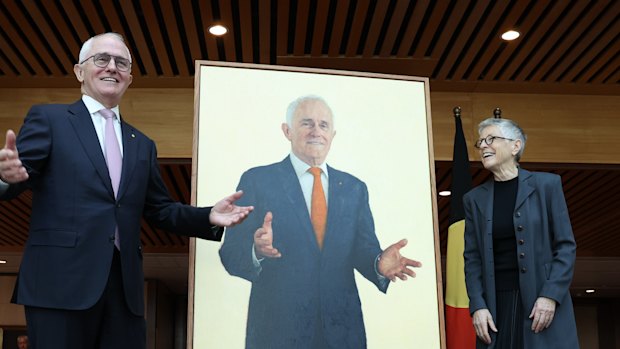
At the unveiling of his official portrait this week, Malcolm Turnbull noted: “It’s interesting now that we’re still having the same insane conversations on the right of politics ...”Credit: Alex Ellinghausen
“When I was Prime Minister, I used to say tediously … Energy policy should be determined by engineering and economics, not ideology and idiocy. It’s kind of common sense, isn’t it?
“But nothing’s changed. Here we are.”
It was a pointed remark in front of the handful Coalition colleagues, including Ley, in the audience. More telling was the turnout from five teal independent MPs who also came to hear him speak, each representing electorates that were once Liberal strongholds, including Turnbull’s former seat.
Ley is expecting a review, by Pru Goward and Nick Minchin, of the Coalition’s disastrous campaign to be made public in the coming weeks. “It will be frank and fearless because I’ve asked it to be,” she said last week. “The next question is, how do we make the modern Liberal Party fit for the future?”
Loading
She will have to reverse the reputational damage that’s come from the past two elections, and the infighting that has followed.
For all the problems facing Ley and the Coalition, another was confirmed on Friday – money.
The Australian Electoral Commission on Friday released the final public funding for candidates at the 2025 election. If a candidate receives 4 per cent of the vote, they receive $3.386 in public financial support for every ballot they receive.
Labor topped the funding with $37 million. The Liberal Party received $28.2 million.
Last election, Labor was paid $27.1 million and the Liberal’s $26.6 million. Back in 2019, when votes were worth $2.756 each, the Liberals received $27.6 million compared to Labor’s $24.7 million.
Parties rely on money to survive and campaign. Since their 2019 victory, their public support has climbed a little more than 2 per cent, or $600,000 – nowhere near inflation.
Labor’s funding has increased by 50 per cent, or well over $12 million.
That gives Labor and Anthony Albanese a major advantage over the Liberal party, and whoever may be in charge of the party, come the 2028 election.
Most Viewed in Politics
Loading