3 months ago
17
3 months ago
17
The Matildas made the World Cup semi-finals. Their new coach is changing how they play
You knew things were a bit different when Joe Montemurro described Amy Sayer as a “cheating winger”.
Not that kind of cheating, but the forward did engage in the kind of positional deception against New Zealand on Friday that warned Asian Cup opponents the Matildas are not in Kansas any more.
“She’s not a winger; she’s a No.10, No.9, cheating winger sort of thing,” Montemurro said.
“We have to make a lot of use of that overload in those areas, and that’s where we hurt them a lot because when their full-back had to follow Amy inside it gave room for our midfielders and gave that space.”
Sayer described her versatile remit as “freedom”. The 24-year-old, who scored Australia’s opener with a deft trick of ambidexterity, “started” the 5-0 win on the left wing, with Caitlin Foord up top and Hayley Raso on the right.
But she often darted inside for cameos in her preferred midfield role, and covered the back line as a wing-back, and filled any other gaps she spotted.

Amy Sayer scores her opener against New Zealand in Gosford.Credit: Getty Images
“Joe likes to play with a lot of football IQ,” Sayer said. “So the players on the field, we all have the ability to fill those different positions ... he plays a sort of Total Football, which is what I like to call it.
“It’s a very European style. You fill the positions, you’re very aware of what everyone’s role is on the park, but not stuck in each role.”
The Matildas at their best have always been a picture of fluidity, but the latest hit-out was the strongest sign that Project Montemurro is a clear break from the past, particularly the style that got the team to the 2023 World Cup semi-final.
Predecessor Tony Gustavsson – like Montemurro – prioritised fast-paced attack, possession and pressing. But his system was more moulded around his select group of trusted players, and the Swede was criticised for his extreme lack of rotation and occasionally over-complicating tactics.

Matildas coach Joe Montemurro.Credit: Getty Images
Montemurro’s success with Arsenal, Juventus, and Lyon was achieved with a philosophy that sounds similar on paper – proactive and possession-based – but there seem to be key differences which are encouraging for Australia’s home Asian Cup hopes in March.
Sayer’s reference to Total Football – the 1970s Dutch system made famous by Johan Cruyff and Rinus Michels, and based on the principle that no outfield player has a fixed position and frequently interchange and create goals through extra space – wasn’t far off the mark based on Friday’s display.
Kyra Cooney-Cross, Katrina Gorry, and Emily van Egmond regularly rotated in the middle, drifting and dropping back and breaking lines. The defensive line was high and compact (aside from the moments they were caught in transition), which limited the Football Ferns’ space.
It was also clear Montemurro’s penchant for patience and measured, intentional build-up play has started to rub off on the squad. That was aided by intelligent distribution from centre-back pairing Steph Catley and Wini Heatley, and offers promise that this Australian squad has the capacity to overcome previous struggles with breaking through low defensive blocks.
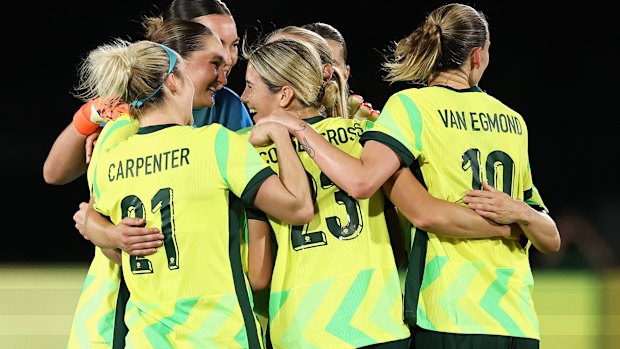
The Matildas were both style and substance in their 5-0 win over New Zealand.Credit: Getty Images
“We’ve worked a lot especially [on] understanding when we can break lines and preparing to go forward,” Montemurro said. “My football’s never been direct, meaning that hit-and-hope sort of stuff. Sometimes you have to be direct, but it’s a prepared direct football, which makes a little bit more sense.”
Sayer said the team’s emphasis was on “establishing possession”.
“We don’t want to rush any attacks going forward,” she said. “We want to establish the possession and make sure we’re progressing up the field with control. Joe doesn’t have a complicated playing style; I think the simplicity is the best part about it.”
Loading
That simplicity, hints of regular rotation throughout the tournament to avoid the first-team World Cup fatigue, and the breadth of scorers (five), means the absence of a player like Sam Kerr for any reason would not feel as catastrophic as it did two years ago when individual effort often trumped collective output.
That said, there is hope Kerr’s “grumbly calf” will be rested enough to constitute one of the foreshadowed starting line-up changes against New Zealand in Adelaide on Tuesday night, when the Matildas will aim to close out the game more comfortably in their last pre-Asian Cup warm-up.
Claire Hunt is expected to return after a rest, and fellow defender Alanna Kennedy will be free to play after serving her suspension for the red card in last month’s loss to England.
Most Viewed in Sport
Loading