3 months ago
21
3 months ago
21
London: Peace in Europe sounded simple when Donald Trump’s special envoy spoke to his Russian counterpart last month. The envoy, property developer Steve Witkoff, was disarmingly direct about what it would take to get a ceasefire in Russia’s war against Ukraine. It was almost as if Witkoff was trading blocks in Manhattan, where he made a fortune estimated at $1.2 billion.
“Now, me to you, I know what it’s going to take to get a peace deal done: Donetsk and maybe a land swap somewhere,” Witkoff told Russian negotiator Yuri Ushakov, a key aide to Russian President Vladimir Putin. Even as he said it, however, Witkoff knew the deal could never be described this way in public by his boss, the US president.
“But I’m saying instead of talking like that, let’s talk more hopefully because I think we’re going to get to a deal here. And I think, Yuri, the president will give me a lot of space and discretion to get to the deal.”
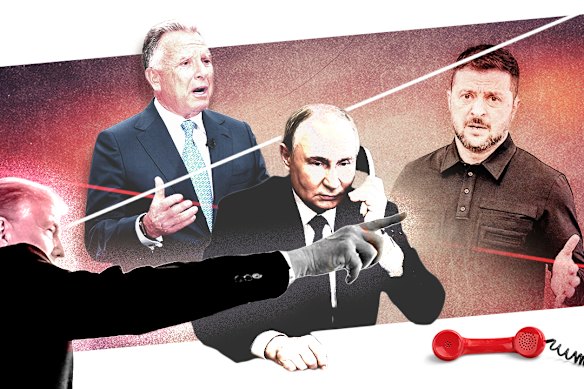
From left: Donald Trump, Steve Witkoff, Vladimir Putin and Volodymyr Zelensky.Credit: Matt Willis
That simple solution is, in fact, a strategic nightmare. And it has Europe worried about a Trump deal that trades away Ukraine for a worthless pledge from Putin. That is why the Witkoff-Ushakov conversation bears repeating several days after Bloomberg published the transcript of the October 14 conversation in an extraordinary leak of a confidential call.
Some US Republicans want Witkoff sacked for the way he heaped praise on Putin, a man who rules through assassination and repression. “You know I have the deepest respect for President Putin,” Witkoff told Ushakov. Republican congressman Don Bacon had a quick response: “It is clear that Witkoff fully favours the Russians. He cannot be trusted to lead these negotiations.”
One of the working theories about the leak is that American insiders released the call to derail Witkoff, but this overlooks the fact that Bloomberg also revealed a recorded call between Ushakov and another Kremlin envoy, Kirill Dmitriev, on October 29. The leading theory is that a European intelligence service has been eavesdropping on the Russians. While the leak to the media will force the Russians to tidy up their security, the European side probably considers this to be an acceptable cost. The priority is to paint Witkoff as a Russian patsy.
Trump is defending his envoy and says his talk on the leaked call is simply “what a dealmaker does” to get an outcome. The broader truth, however, is that Trump is walking back from the peace plan he and his aides were acclaiming just a week ago, with its 28 points and its major concessions to Russia.
That original plan is dead. It developed out of talks between Witkoff and Dmitriev in Miami four weeks ago, and strongly favoured Russia with proposals such as a swift end to sanctions, a cap on the Ukrainian military, a Russian takeover of much of eastern Ukraine and a ban on Western troops on Ukrainian soil. Reuters revealed on Thursday that it drew from a Russian document put to the United States in late October.
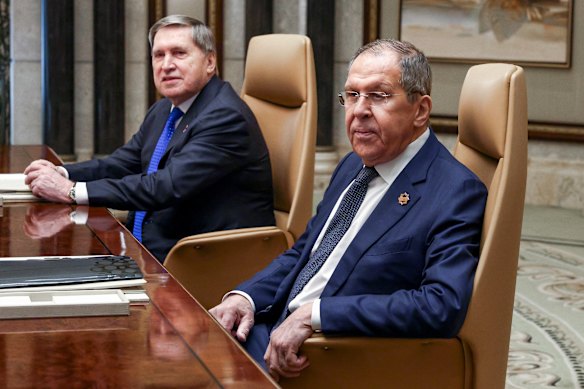
Russian foreign adviser Yuri Ushakov (left) and Foreign Minister Sergei Lavrov at talks with US officials in Saudi Arabia in February.Credit: AP
Can the new plan work?
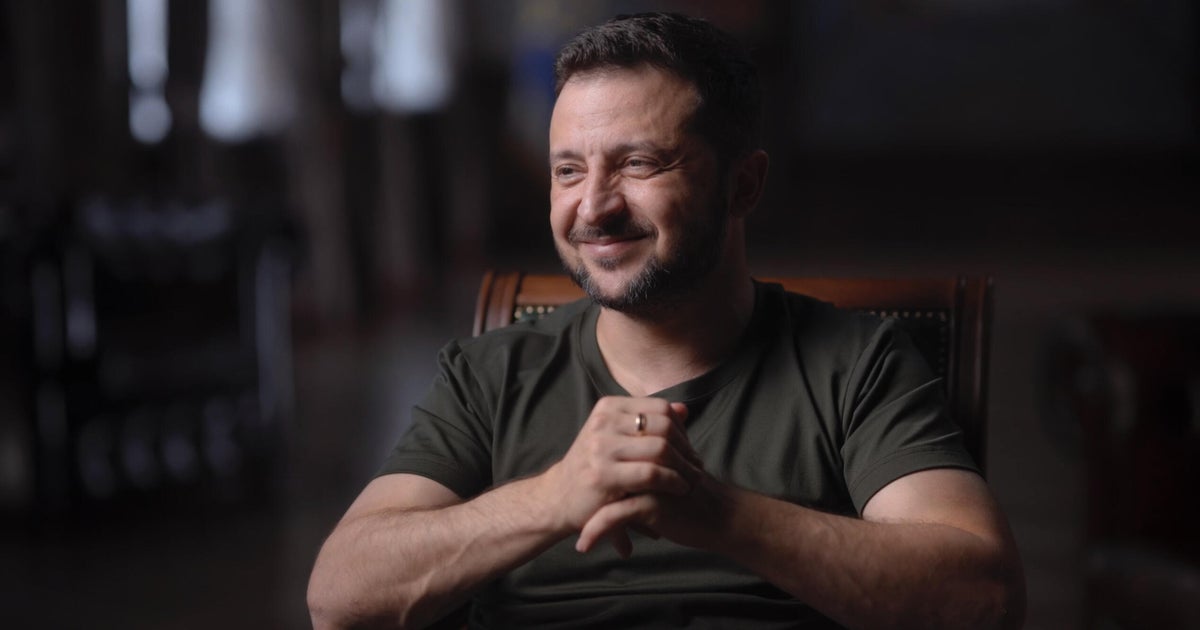
The outcome, so far, is a success for Europe and Ukraine in putting their alternative. Trump seems to accept the amended plan. “I think we’re getting close to a deal,” he said on Tuesday. Ukrainian President Volodymyr Zelensky is assuring Trump that Ukraine is grateful for his help – an essential move to prevent White House complaints – while backing the modified peace deal.
This looks like progress. The amended plan accepts a cap on the Ukrainian military, but sets it at 800,000 rather than the 600,000 the Americans put forward. It allows for sanctions to be eased, but says this has to be done on a “case-by-case basis” so it is gradual. It does not rule out sending Western troops into Ukraine to keep the peace.
Crucially, the modified plan rejects the “land swap” canvassed by Witkoff. It does not formally cede Ukrainian territory such as Crimea (annexed by Putin in 2014) and Luhansk and Donetsk (where Russian forces have been fighting to gain the territories since the same year). It also rejects “de facto” recognition of Russian control in two other territories, Kherson and Zaporizhzhia, where the invading army has gained ground since 2022.
The peace deal leaves territorial claims for a later discussion, although it is obvious that Russia controls most of the contested territory and will not be driven out. The key requirement is that talks should start from the “line of contact” in the current conflict, so Ukraine keeps the ground it already holds.
Putin, however, wants more territory. In remarks reported early on Friday AEDT, he said the peace proposal could be the “basis for future agreements” but insisted that Ukraine withdraw its soldiers from the Donbas.
“Some people demand to keep on fighting until the last Ukrainian dies. Russia is ready for that,” he said during a visit to Kyrgyzstan. “If Ukrainian forces leave the territories they hold, then we will stop combat operations. If they don’t, then we will achieve it by military means.”
So the peace plan is fragile. If Putin does not end the war, Europe will have to find a way to win it.
The way to make a deal stick
Witkoff heads to Moscow in the coming days to talk to Putin, and Trump says he may send his son-in-law, Jared Kushner, to join Witkoff on the mission. The two loyalists helped seal a ceasefire in Gaza, but that does not mean they can succeed in Moscow. Trump is sending US Army Secretary Dan Driscoll to talk to Ukraine.
There is very little trust to go around. Europe is sceptical of Witkoff and will expect him to go weak in his talks with the Kremlin. Nobody in the West can trust a promise from Putin. And the Ukrainians have no easy options. They cannot trust Putin, but they will lose if Trump rushes to announce a ceasefire – and campaigns for a Nobel Peace Prize – while washing his hands of Ukraine’s long-term safety.
“When it comes to security guarantees from Russia, they are empty words,” says Olena Davlikanova, an associate senior fellow at the Sahaidachny Security Centre in Ukraine and a senior fellow at the Centre for European Policy Analysis. Like others, she says the peace deal will not work without robust commitments from the West.
“What would really work is very clear back-up by the US so in the case of renewed aggression, the US will supply Ukraine with all necessary weapons and intelligence,” she says. “Most importantly, also, that the sky is closed with the capacities of NATO, the Americans and Europeans.”
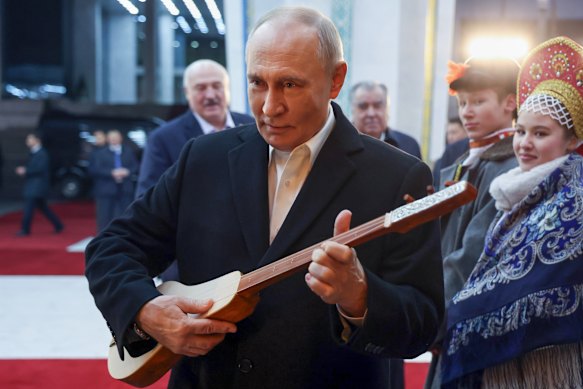
Putin holds a Kyrgyz instrument during a visit to Kyrgyzstan on Wednesday.Credit: AP
When Ukrainians say the sky should be closed, they are reprising a request from 2022 that was rejected in Brussels and Washington. NATO chose not to halt the air attacks on Ukraine out of fear of bringing NATO members into direct combat with Russian forces. Without this commitment, Russia could resume its bombardments at any time.
Davlikanova also makes a fundamental point about US guarantees: they must last longer than Trump’s second term. “The best option is to make them very specific,” she says. “And, second of all, vote for them in Congress. Then they will have more weight. Currently, we are not offered any real security guarantees at all.”
Ukraine, in other words, needs hard power to endorse a peace. The European leaders appear to see this because they reject a condition in the original 28-point plan that barred any Western troops on Ukrainian soil. The question now is whether British Prime Minister Keir Starmer, French President Emmanuel Macron and German Chancellor Friedrich Merz are willing to throw even more military support behind Ukraine.
How to stop Putin
One security analyst, Keir Giles, mocks the idea of Trump’s envoy gaining anything when he lands in Russia in the days ahead. “Witkoff going to Moscow is just the Russian negotiating team getting back together again,” he says. The greater problem with the talks is that anything that looks acceptable to Putin carries immense danger for Europe and America because it rewards the Russian leader for his invasion.
Giles, a senior consulting fellow at Chatham House in London and a director of the Conflict Studies Research Centre, worked in Russia in the 1990s and has tracked its changes since the fall of the Berlin Wall. He says the decisions to be made in Europe and America today are shaped by a question that goes back decades.
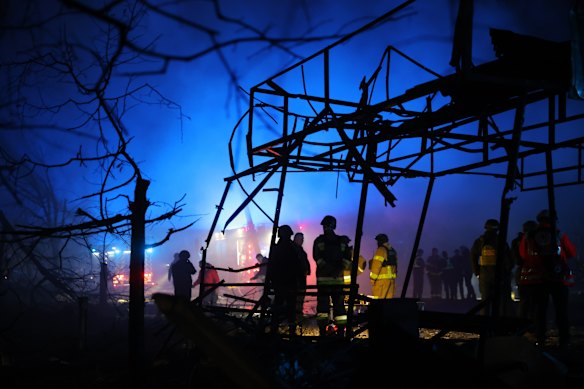
Rescuers work at a market destroyed by a Russian airstrike in Zaporizhzhia, Ukraine, on November 21.Credit: AP
“What causes Russia to stop? That is always the presence of substantial military forces and the demonstrated will and resolve to use them so that Russia understands that the costs of mounting a military attack will outweigh the benefits,” Giles says. “That is the universal answer that is applicable throughout Russian and Soviet history, and has been verified time and again in the post-Soviet period as well.”
Does the peace proposal, at least in its public form, offer this? “Absolutely not,” he says. The proposal so far, he adds, is the opposite of peace because it eases pressure on Russia and leaves Ukraine exposed to future attack. Putin may agree, but Zelensky cannot. It would mean signing away his nation’s safety.
The most likely outcome, then, is no deal. And more war.
Can Russia lose the war?
Russia has obvious weaknesses. Its economy is feeble compared to those of Europe and America. Western sanctions have strangled Russian business, while consumers see disruptions to essential services.
Its power to continue the war, however, remains significant. Until this month, according to NATO, Russia was making more ammunition each week than all NATO members combined. Another measure of this industrial strength is the daily bombardment of Ukraine with hundreds of missiles and drones. Russia, helped by China and Iran, remains capable of making weaponry at a rapid pace despite the sanctions.
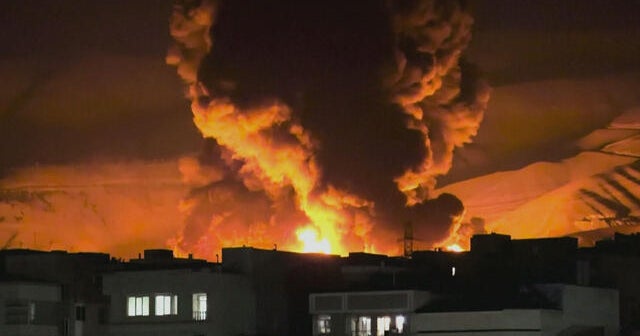
On Monday, for instance, it launched 22 missiles and more than 460 drones against Ukraine. This was days after a devastating attack on the western city of Ternopil that killed 34 people, including six children.
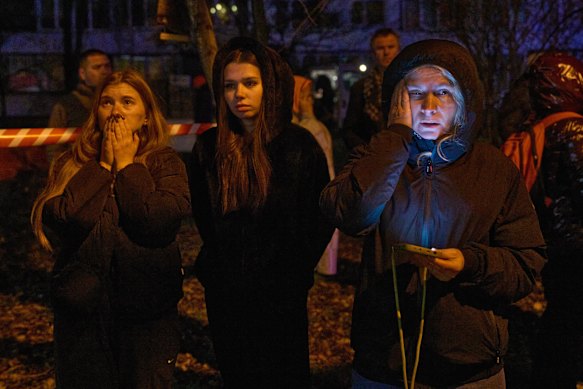
Kyiv residents watch their home burning after a drone attack on Tuesday.Credit: AP
One tally of these strikes, updated by the Centre for Strategic and International Studies, shows a dramatic intensification of the missile and drone numbers this year – the very period European leaders were tightening their economic sanctions. The economic measures taken to date have not been able to cripple Russian manufacturing.
At the same time, Russian officers are sending their soldiers into Ukrainian cities such as Pokrovsk in waves of attacks. The Institute for the Study of War says Russia has made gains over time, but only very slowly. At the current rate, the institute concludes, those soldiers might gain control of all of the Donetsk region by August 2027.
The rational conclusion is to bring Russia to a halt. But can it be stopped? Yes, says Mark Brolin, a strategist who has worked at the Swedish Ministry of Foreign Affairs and in American financial markets. He believes too many in Europe and America have been fooled by a “cognitive bias” into believing that Russia is still a superpower.
Loading
“Wartime bluffs are normal; what is not normal is how eagerly the West has believed this one,” he wrote in The Telegraph this week. “Future historians will wonder how a regime of unelected thugs, with an exhausted army that poured everything into failing to conquer a smaller neighbour, managed to intimidate NATO, the most powerful military alliance in history.”
This is borne out by history. Putin could not seize Kyiv in February 2022 because Ukrainian forces turned Russian tanks into flaming wrecks on the roads toward the capital. Putin wanted to turn Ukraine into a vassal state and failed.
On this view, the answer is for Europe to commit sustained support to Ukraine, authorise long-range strikes from Ukraine against Russian targets, maintain sanctions against Russian oil and rule out options that disarm Ukraine.
Brolin’s conclusion: “Peace without deterrence, when Putin is next door, is not peace – it is a pause.”
The danger is that Putin has a nuclear arsenal. What about this threat? Brolin tells this masthead that pushing the nuclear button would be the end of Putin and therefore an option he will not choose. Elected leaders in Western democracies, of course, will see it differently. The nuclear threat has held them back.
Giles says the best opportunity to defeat Putin came in the early stage of the war. NATO avoided the options that would have heightened the pressure on Russia.
“So it will be longer and harder and messier and bloodier, and more expensive, to defeat Russia now than it would have been earlier in the conflict. But that doesn’t mean it’s impossible,” Giles tells this masthead.
Loading
“Russia has done an exceptionally good job of convincing people around the world, in the media and, sadly, also in the Trump White House, that its victory is inevitable. But that is not borne out by examining the facts of the conflict, and in particular the damage that Ukraine has been able to do to Russia’s ability to continue the war.”
A peace deal is on the table. What if Putin turns it down? The debate about the terms of the peace would be over. The debate would be about the decisions needed to win the war.
Get a note directly from our foreign correspondents on what’s making headlines around the world. Sign up for our weekly What in the World newsletter.