3 months ago
19
3 months ago
19
It is a rivalry as old as Australia’s two largest cities. The opening of Melbourne’s $15.5 billion Metro Tunnel created a new frontline in that endless battle on Sunday, sparking a debate about how it compares to Sydney’s expanding metro rail lines.
If one were to tread delicately, the Metro Tunnel is a major step in reshaping Melbourne’s existing heavy rail network, removing a bottleneck in the CBD and showcasing the city’s cultural identity in the five new stations’ design.
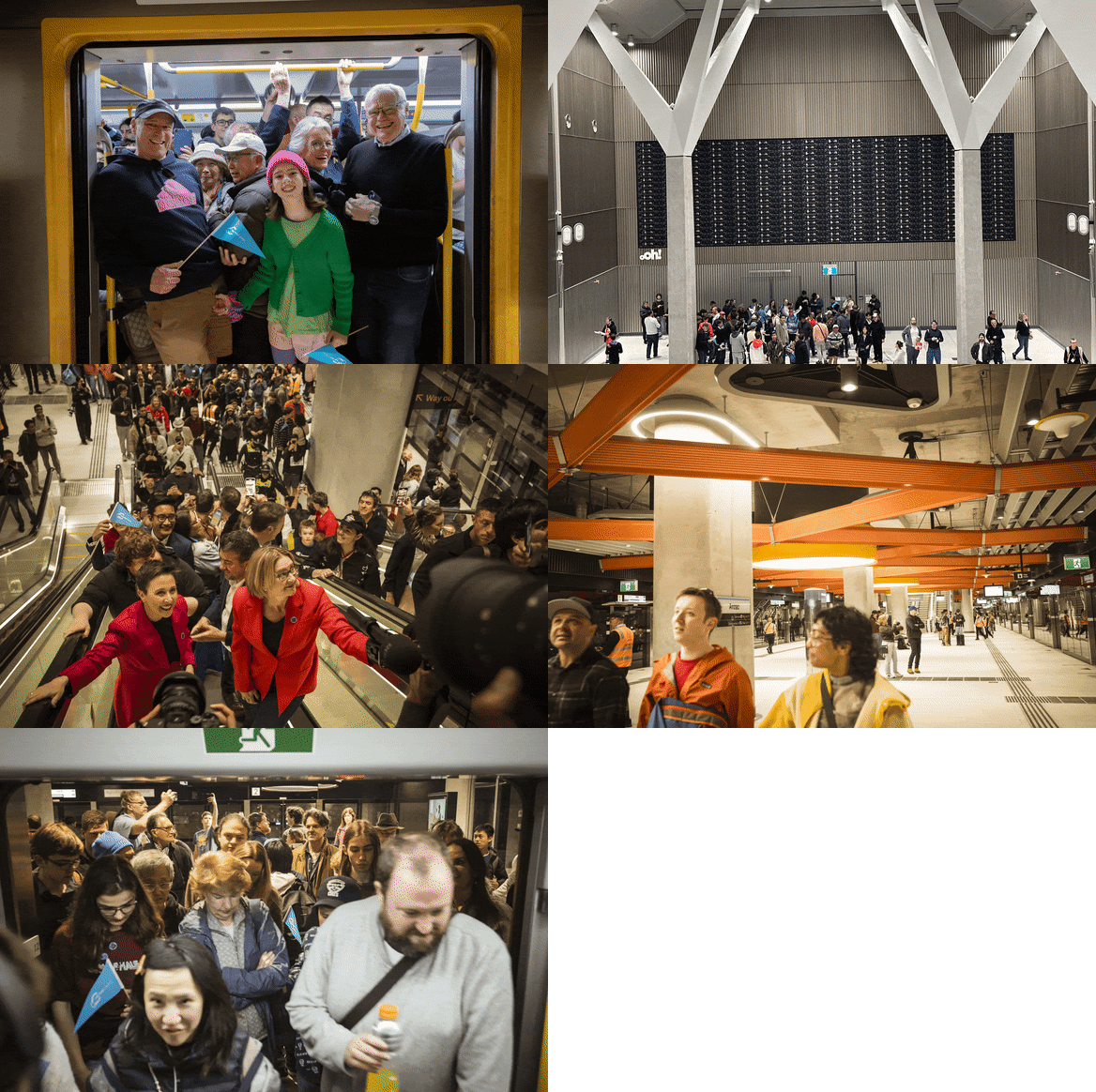
Melburnians flocked to the opening of the city’s Metro Tunnel on Sunday.Credit: Chris Hopkins, Simon Schluter
A blunter assessment is that Sydney’s ambitious metro network overshadows Melbourne’s new rail extension in scale and new-age technology.
More than a year after the city-section of a driverless metro rail line under Sydney Harbour opened, Melburnians flocked to stations along their new nine-kilometre train line under the CBD between South Yarra and South Kensington.
Spruiked as the biggest transformation of Melbourne’s rail network in more than 40 years, the five new stations are undoubtedly the jewels in the Metro Tunnel’s crown, several of which are adorned with distinctive orange-coloured arches.
Arguably, the one area they do beat Sydney’s cavernous metro stations is in the platform lengths of those at Anzac, near the Shrine of Remembrance, Town Hall, State Library, Parkville and Arden in North Melbourne.
They stretch for 220 metres – 50 metres longer than Sydney’s – which will allow for trains up to seven carriages long to be eventually used.
Shortly before boarding the first train on Sunday, Victorian Premier Jacinta Allan sought to characterise the Metro Tunnel as a “vastly more complex” project than Sydney’s driverless train network.
“At their heart, they’re both about providing more and better access for people,” she said.
“Metropolitan, regional and freight trains all have had to be connected into this brand new Metro Tunnel, which makes it by any, not just Australian comparison, but by any international comparison, an incredibly complex project.”
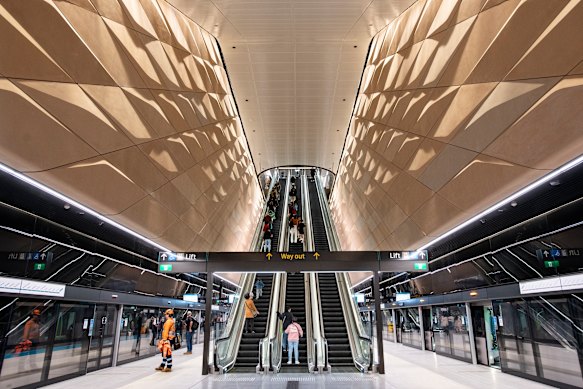
The longest escalators in the Southern Hemisphere extend to platforms for the M1 metro line deep under Sydney’s Central Station. Credit: Steven Siewert
The new cross-city rail corridor will help relieve pressure on the underground City Loop, in much the same was as Sydney’s M1 metro line has eased demand on the City Circle beneath the CBD. The Metro Tunnel bypasses the City Loop, connecting the Sunbury line and Cranbourne/Pakenham lines.
Treading a diplomatic tight rope, Transport for NSW coordinator general Howard Collins, who toured the project last week, said he liked the quirkiness of the new stations, citing the animal footprints in the platform floors.
“But it doesn’t look as massive. When you go down Central Station in Sydney, it’s cathedral-like – I wouldn’t call these cathedrals of stations [in Melbourne]. They’re more functional but arty,” said Collins, a former head of London Underground.
“It’s very different from perhaps most modern metro-style stations around the world, and it’s almost reflecting what you see in the streets. It’s a bypass line, but it still has that feel of metro.”
In what was labelled a Victorian-first, platforms at the inner-city stations on the Metro Tunnel are lined with screen doors, a safety feature Sydneysiders have been familiar with on the M1 metro line since the first and second stages have been progressively opened since 2019.
University of Technology Sydney transport researcher Mathew Hounsell said the harbour city’s metro rail network was a grand and ambitious plan to set it up for the next half century, whereas Melbourne’s Metro Tunnel was a catch-up to relieve congestion plaguing the city’s network.
“Sydney is leaps and bounds ahead. Everyone in the country is well behind Sydney in terms of rail public transport,” he said. “The previous Liberal government’s investment set Sydney up for the next 50 years.”
Hounsell said the Metro Tunnel would ease pressure on the City Loop by providing a bypass of it in Melbourne’s CBD and bolstering service frequency for areas that had lacked it.
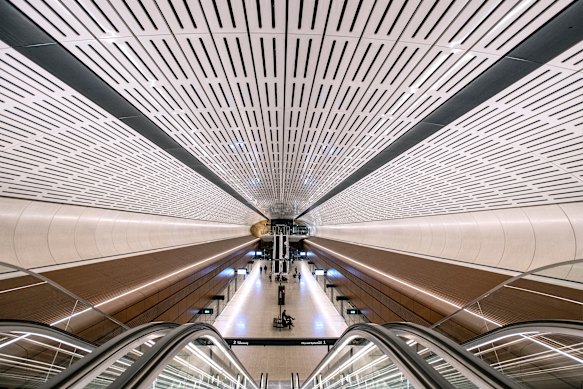
The underground Victoria Cross metro station in North Sydney was opened to passengers in August last year. Credit: Steven Siewert
“The bypass is an old idea but is a good idea, and took inspiration from us [in Sydney] when we started on the metro,” he said.
In Sydney, the M1 metro line has reduced pressure on Town Hall station, which had previously had regularly bouts of overcrowding during peak periods. “By relieving that one bottleneck, it made the entire system more reliable, which is what should happen with the Metro Tunnel,” he said.
However, Hounsell said Sydney’s new metro system was incomparable to the Metro Tunnel. “Sydney went big and bold. Melbourne’s was a sensible, targeted investment to improve the existing heavy rail,” he said.
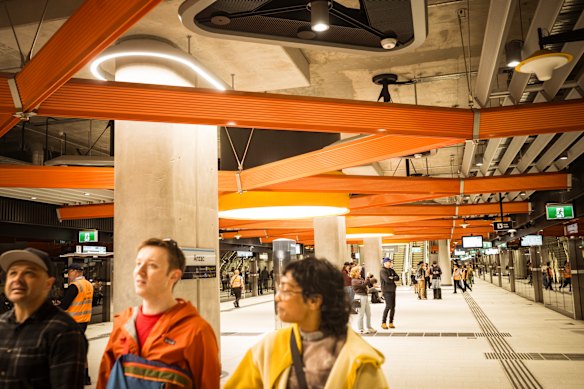
Passengers at Melbourne’s new Anzac station after arriving on the first train to pass through the new Metro Tunnel on opening day.Credit: Chris Hopkins
Once Sydney’s Metro West project is completed in 2032, three driverless train lines will operate independently of each other and the heavy rail network.
The “soft opening” of Melbourne’s Metro Tunnel comes ahead of it running to full timetabled services in early February, which the Victorian government boasts will result in services every three to four minutes during peak periods.
John Hearsch, from Rail Futures Institute, a transport advocacy and research group in Melbourne, described the Metro Tunnel as an enhancement of the existing network but unlike the scale of Sydney Metro’s entirely new system.
Loading
“We are a long way from a fully automated railway like Sydney Metro is. I don’t want to downplay it – it is a significant project. It is an improvement that is many years overdue,” he said.
Hearsch, a former chief operations officer of Victoria’s regional railway, said the Metro Tunnel would boost capacity and journey options for commuters, and the technology installed in the new link was a step towards that used by Sydney Metro. He cited the remote supervision of trains and platform screen doors.
“They have spent a lot of money on the stations, particularly on Town Hall and State Library. They are fairly spectacular,” he said.
If the mega projects share one common theme, it is a tendency to blow their budgets. Melbourne’s rail project was originally budgeted at $10.9 billion but is now costing $15.5 billion. In Sydney, the M1 section between Chatswood and Bankstown is expected to cost $21.6 billion, double original forecasts.
Most Viewed in National
Loading