3 months ago
5
3 months ago
5
Pop music, be it on Spotify radio or radio radio, became a landmine in 2025. You’re sitting there with your family – at the dinner table or in the car – enjoying the latest Taylor Swift album altogether, when suddenly you have to explain to your little children what Taylor means when she says that Travis Kelce’s “redwood tree” was “the key that opened my thighs”.
It’s that, or you find yourself rushing to press skip on Tears by Sabrina Carpenter as she sings about getting “wet at the thought of you... tears run down my thighs”. It’s a catchy chorus, but I don’t need my five-year-old singing that around daycare, you know?
Following the ridiculously bawdy Nonsense outros that marked her breakout last year, Carpenter has since cemented her status as pop’s poet laureate of lewd, the Emily Dickinson of dick ‘n’ sons. On House Tour, my favourite song on her recent album Man’s Best Friend, she spends almost three minutes offering a prospective lover a tour of her, uh, home: “I just want you to come inside/ But never enter through the back door,” she sings, and I blush.
Thanks to Sabrina’s influence, pop got filthy in 2025. It was Lorde talking about getting her “lips ’round your halo” (Clearblue); it was Lola Young yearning for “you to trickle right down my throat” (Post Sex Clarity); it was Addison Rae “with a cigarette pressed between my tits” (High Fashion); it was Lily Allen finding “butt plugs, lube inside, hundreds of Trojans” in (allegedly) David Harbour’s dojo (Pussy Palace); it was budding icon Romy Mars singing “If you wanna know how hard it is to listen to you talk/ just look down at yourself when I take my clothes off” (Ego). Even PinkPantheress, pop’s top purveyor of sweet introversion, got blunt: “You want sex with me? Come talk to me,” she sang on Tonight.
The biggest shock – and one that drew the most controversy around many of her fans who’ve only ever thought of her as a fantasy princess – was that even Taylor Swift, one of pop’s more romantically elevated songwriters, got down and dirty. As well as reflecting on her paramour’s manhood (Wood), she also sings that being chastised as “boring Barbie” is “kind of making me wet” (Actually Romantic).
Coincidentally or not, these were also my favourite pop songs of the year. Am I depraved? Perhaps. But what does it mean that pop music in 2025 got so provocatively unhinged?
The simplest answer is the most obvious: sex sells. “Record labels know that sex sells – a tale as old as time, of course, but in the current climate of lesser censorship and government regulation online, artists can get away with lewd content more easily,” says Ethan Bryant, a PhD candidate at RMIT University researching lyrical meta-reference in pop music performed by major-label female artists.
It’s never been a better time, it seems, for pop stars to get dirty. Perhaps pop is just borrowing – as it has for decades – more spiritedly from the brashness of hip-hop, which has always had a transgressive bent built into its DNA. You can’t talk about bawdy music without discussing 2 Live Crew, Too $hort, Lil Kim and, sure, even Khia. Sometimes, not often, these artists crossed into the mainstream: I remember my 4th-grade teacher giggling uncomfortably as she berated me for playing Wrecx-n-Effect’s Rump Shaker during classroom free-time one afternoon (“There’ll be no more zoom-a-zooming in anyone’s boom-boom!” she ordered).
And if Salt-N-Pepa’s Let’s Talk About Sex felt risqué in the ’90s, it’s positively educational in 2025, when we’ve lived through WAP, where Cardi B compared the sounds of a sexually stimulated woman to “macaroni in a pot” or Sexyy Red’s Pound Town, with its viral catch-cry. Around the clock on the radio right now, you can hear Come N Go, the new hit from cult rapper Yeat – a next-gen follower of icons of filth, Future and Drake – which features a majestic beat from Working On Dying’s Bnyx and horrific lyrics for anyone who’s not a 13-year-old boy.
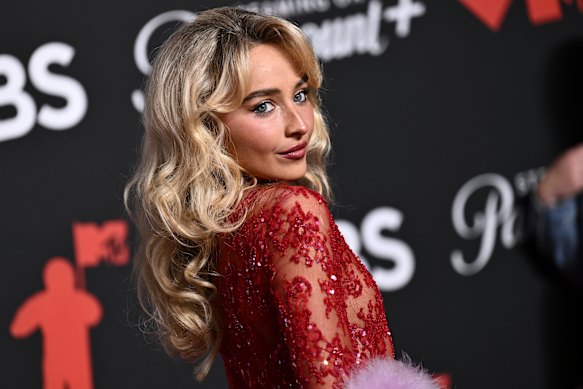
Sabrina Carpenter, the poet laureate of lewd pop.Credit: Evan Agostini/Invision/AP
But unlike hip-hop, pop – with its barriers to mainstream acceptance – has traditionally had to play coy. In the past, going too hard – like, say, Madonna’s Like a Virgin or Divinyls’ I Touch Myself – might risk outrage and censorship. In the streaming age, all bets are off.
For today’s pop stars, self-censorship is unnecessary and potentially even detrimental. Why hold back when the market, as in all aspects of content culture, rewards the most outlandish and extreme? The single that first broke Chappell Roan, after all, was Casual, her graphic lament of sapphic situationships, with its soaring chorus: “Knee-deep in the passenger seat and you’re eating me out, is it casual now?” Sabrina Carpenter was toiling in obscurity for a near-decade until she found her sex-obsessed schtick on Short n’ Sweet.
“There’s an unashamed comical quality to Carpenter’s displays of sexuality, and it seems that Generation Z, characterised by a shared post-ironic mentality, are attracted to such garish exhibitions of explicit sex,” says Bryant of Carpenter’s influence on pop’s zeitgeist.
Lily Allen and Taylor Swift, meanwhile, are playing the same game that Swift long-popularised with her diaristic songwriting, and tapping into the increasingly parasocial relationships fans and celebrities share in the social media age. The more intimate and provocative – be it personally or sexually – a pop star’s work is, the better.
“What’s at play here is the public’s shared infatuation with the messiness of celebrity,” says Bryant of Allen and Swift’s bawdier turns this year. Tapping into the online attention economy, both artists turned interest in their real-life relationships – Swift with her fiancé Travis Kelce, and Allen with her ex David Harbour – into hits. “Allen cleverly commodified her hardship and is now reaping the benefits of that exposure, all while the final season of Harbour’s hit Netflix show Stranger Things is beginning to air,” says Bryant.
There’s a danger here of looking at pop’s dirty pivot in 2025 in cynical terms, an outlandish grab for attention. The truth is that none of the songs feel that way – these are just female artists expressing themselves with maximum freedom. Bryant notes that pop trends tend to be cyclical, and they’re often indirectly reacting to the sociopolitical climate of the time.
“Looking back at the MTV era, we saw similar displays of brazen sexuality in pop music while the world reeled from the September 11 attacks,” he says. “Christina Aguilera’s Dirrty, Britney Spears’ I’m a Slave 4 U, Kelis’ Milkshake, and Nelly Furtado’s Promiscuous all featured young women declaring their sexuality in unflinching fashion.”
If you want to understand why today’s pop stars – and they’re almost exclusively female – have pushed pop’s boundaries so brazenly in 2025, just look to who’s dominating culture. “I think we can identify a direct line between Trump’s second term as US president, and his historic repeals of women’s rights legislation, to an increase in explicit themes being explored in mainstream pop performed by women,” says Bryant. “By using their sexuality in praxis as a device of empowerment and pride, these women subtly refute the system that is trying to regulate that very thing.”
Which begs the question: if all the most explicit pop this year came from female stars, where are the rowdy boys? While queer male pop stars like Troye Sivan and Conan Gray have played their part – Gray’s viral video for Vodka Cranberry, released in July, made explicit the song’s searing love story between two boys – the straight dudes dominating the charts, namely Sombr, Benson Boone and Justin Bieber, are dropping the (blue) ball. Which is, perhaps, for the best: in the post-#MeToo world, no one wants that.
Loading
“Male pop stars have never been at the forefront of the sexual revolution. And I think we are seeing less male pop stars embracing sexuality in the ways their female counterparts are because in our current patriarchal society, explicit male heterosexual sexuality doesn’t serve much of a social purpose,” says Bryant. “The ruling class – white cisgendered heterosexual men – just aren’t as thought-provoking as the plethora of female pop stars that rule the charts, especially in an era when Roe v Wade has been overturned.”
To read more from Spectrum, visit our page here.