3 months ago
27
3 months ago
27
Nina Kennedy knows she has no right to even be at the world athletics championships this month after surgery only weeks ago. But she also knows that, even at 80 per cent fit, she can win a medal.
Five months ago, the Olympic pole vault gold medallist and reigning world champion was cut open to stitch back together a hamstring that had been ripped three times in six weeks.
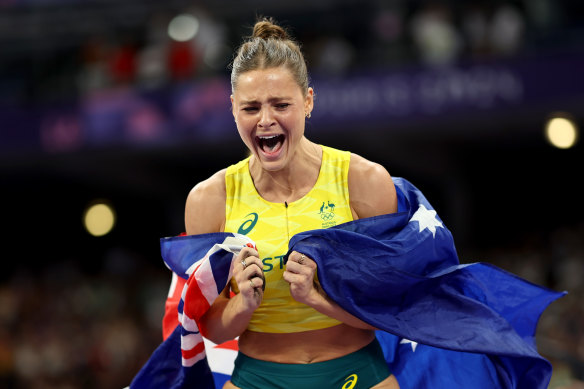
Nina Kennedy celebrates winning gold, the 18th for Australia in the Paris Games.Credit: Getty Images
Now, after a month of rest and four months worth of work smashed into a six-week training block, Kennedy figures she will be at 80 per cent fitness for the championships in Tokyo in a little over a fortnight.
It might be enough.
Kennedy thinks she will be good to clear jumps anywhere in the range of 4.80 metres, and that could get her into the medals. She also knows the snarling competitor in her, and quietly wonders if come the big moment, she won’t find something extra.
“We’re going to see what happens, so [I’m] just embracing the discomfort, embracing the vulnerability and swinging big and giving it a crack 100 per cent,” she said of the championships, which start on September 13.
“If I could jump in the 4.80s on a first attempt, I think that would snag me a medal. I really don’t know what kind of shape I’m in, so we’re going to have to work that out there on the day, which for me, is really exciting.
“In Paris I was in the best shape I’ve ever been in my whole life,” she said, leaving aside the fact that she technically had a broken back.
“So being cut open five months ago, I’m definitely not at 100 per cent, so I want to say I’m at like 80 per cent and if 80 per cent is good enough to make the world champs final, (then) anything can happen.
“I am a competitor, and I do love a first-attempt clearance. So everyone knows that championships are won on first-attempt clearances, and that’s a strength of mine, so we’re leaning into that.”
Still, the injury has forced Kennedy to recalibrate what success will look like in a way that her back stress fracture in Paris did not.
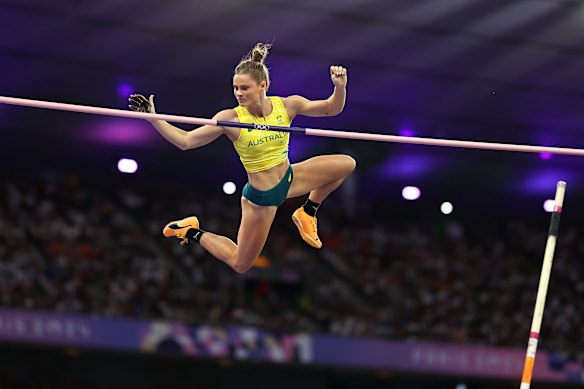
Nina Kennedy cleared 4.90m to clinch outright gold.Credit: Getty Images
“I did have a broken back in Paris. I often forget that. I would still say that I was 100 per cent [there], the back is something that I’ve dealt with my whole career, and will have to deal with for the rest of my career. It’s just one of the cards I have been dealt with – my genetics, my life, the sport I do.”
Kennedy’s latest injury came up early this year when she strained her hamstring three times over a six-week period, in a spot that is notoriously difficult to heal. The choices were rest and recovery for three months and hope it heals, or surgery and the same three-month recovery. She chose surgery.
She now feels the hamstring is better than before the first tear, but the rest of her body has been smashed as she pushes hard to recover in time for worlds.
“I have full confidence that the injury is OK. Do I have full confidence in my body as a whole? Probably not. I say that because only training for six weeks, we have been pushing my body to the absolute limits to get to the world championships. It’s not like I can just rock up and see how I go. We have to push my body in this six-week process. What we’ve done normally takes four months. So we’ve really had to speed it up and that creates niggles elsewhere,” she said.
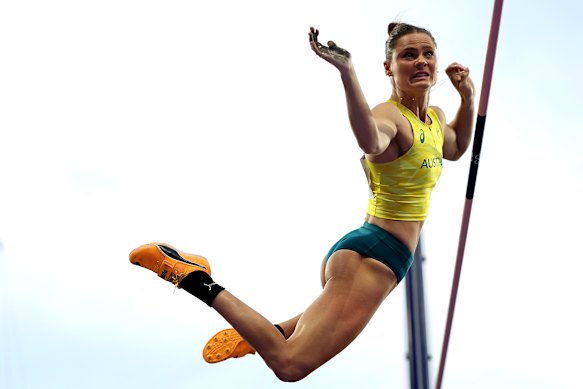
Nina Kennedy in action at the Olympics in Paris last year.Credit: Getty
“A win in our books is getting to the championships and saying that we’ve done everything we can. If we can do all of that and I win, then great. If we do all of that and come fourth, then great. So it is adjusting the goalpost a little bit. You know, last year, it was all about ‘I will win the thing’.
“In a way I’ve just had to redirect that mongrel into this challenge ... I should have no right to have the surgery that I did and to come back to worlds and think I can get on the podium. I have no right to think that.
“So we’ve really just had to channel my mongrel and channel that competitive person into this challenge. I am a big-time competitor. I rock up when it matters.”
Regardless of the injury, Kennedy, now 28, can’t see herself in the sport after the Olympics in Los Angeles in 2028. Before that, she hopes to clear 5m and set a new world record.
“I see myself having three years left in the sport, and I see myself in a position now to be pushing for 5m [her personal best, a national record, is 4.91m] and that world record [5.06m]. I want to finish my career knowing that I’ve done everything I can, and I wouldn’t be saying that if I didn’t believe I could do it. For the next few years, if I stay injury-free, it will be about, yeah, let’s see where I can take the sport.”
The Gout phenomenon
Kennedy emerged from Paris the biggest athlete in Australia. An Olympic gold medal followed her world championships gold medal a year earlier. At Australia’s best-ever Olympics for the athletics team, she was queen.
Months later, a kid became a far bigger name in athletics than Kennedy, than medal-winning high jumpers Nicola Olyslagers and Eleanor Patterson, than outrageously talented silver medal 1500m runner Jess Hull, or Matt Denny, who threw a discus to bronze, or Jemima Montag, who scooted through the walk.
Gout Gout arrived. He broke the national 200m record. In fact, he broke nearly everything, and became one of the biggest names in Australian sport, not just athletics. He didn’t put the other Australian athletes in the shade, he shone a light on the sport.
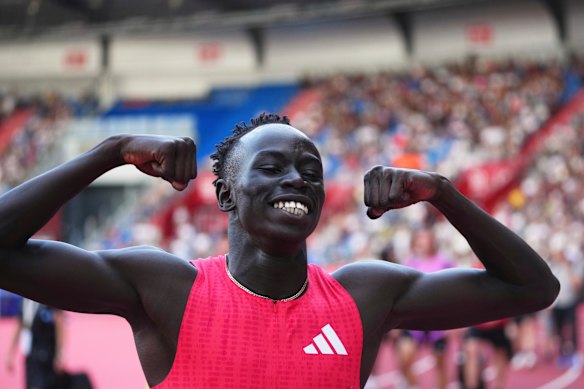
Gout Gout, of Australia, celebrates after winning the men 200 meters during the Ostrava Golden Spike athletics meet in Ostrava, Czech Republic, Tuesday, June 24, 2025. (AP Photo/Petr David Josek)Credit: AP
For Kennedy, with two gold medals in her drawer, it was just enjoyable to watch Gout emerge from nowhere.
“Honestly, I haven’t really blinked an eye at it. The men’s 100m has always been the event. We look at the Usain Bolts, and I could name so many 100m male athletes. Could I name them in the other events? No. That’s just our sport, right? So I think Gout’s great, and I think he’s doing really great things for our sport in Australia and leading into Brisbane [Olympics in 2032], I think it’s exactly what Australia needs,” she said.
“I’m really excited to see how he does the next few years … there’s so many athletes coming up, and I just think Brisbane is so well placed for them.”
She offered a word of caution on expectations and hastening slowly.
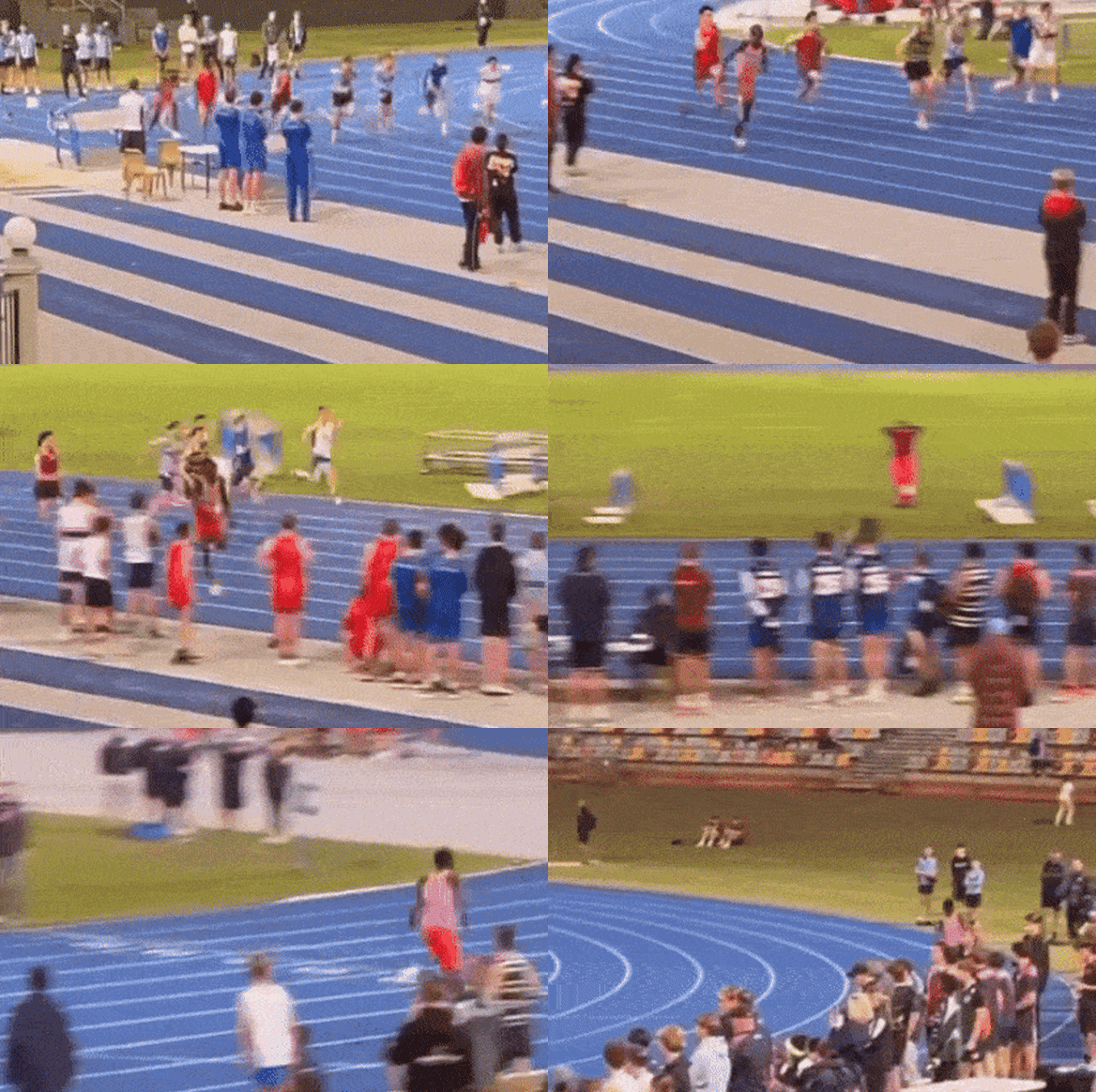
Gout Gout in an outside lane destroys his opponents in this 100m event.
“I made my first Australian team in 2015, and [it was] nine years later was when I won that [Olympic] gold medal. So it does take so many years to master your craft, and do all the work. So LA [Olympics] should be exciting and so should Brisbane 2032.”
Share a medal again?
Kennedy famously shared a gold medal with American Katie Moon when, at the world championships in Budapest, the pair could not be split even on countback. Given the choice of a jump-off or splitting the medal, they chose the split. It split opinion worldwide.
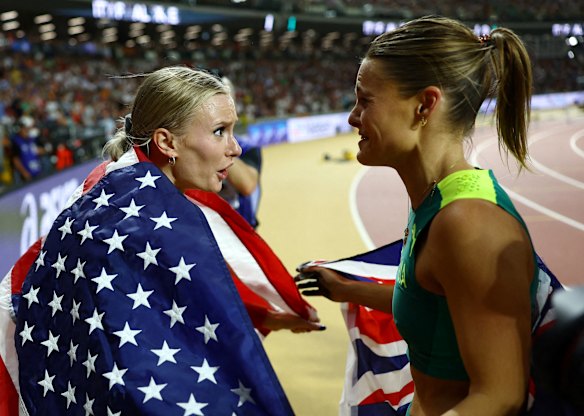
Australia’s Nina Kennedy (right) celebrates with American Katie Moon after they both won gold medals in the women’s pole vault in Budapest.Credit: Reuters
A year later in the lead-up to Paris, Kennedy said she didn’t regret splitting the gold – but she wouldn’t do it again. Then she won gold outright in Paris. So, has being injured ahead of this world championships changed her opinion on splitting gold if the moment arose?
Loading
“Probably not. What’s been so cool about my career is that I have developed so much, and every year I show up as a different athlete. I’m in this phase now where I’m like ‘Nah, I want to win’. I just have this mongrel in me, this dog in me. I don’t think I’d share again, but then in the same light sharing with Katie all those years ago was the perfect stepping stone, and it was so beautiful. I never, ever regret that decision.”
Most Viewed in Sport
Loading