3 months ago
21
3 months ago
21
Victoria’s usually pristine beaches have been invaded.
No, not by exuberant British backpackers basking in the Australian sunshine. But rather by gelatinous, alien-looking bluebottle jellyfish, washing up en masse with stingers at the ready.
Surf lifesaver Henry Kiss said the shoreline he patrols at Portsea was covered in thousands of bluebottles on Tuesday.
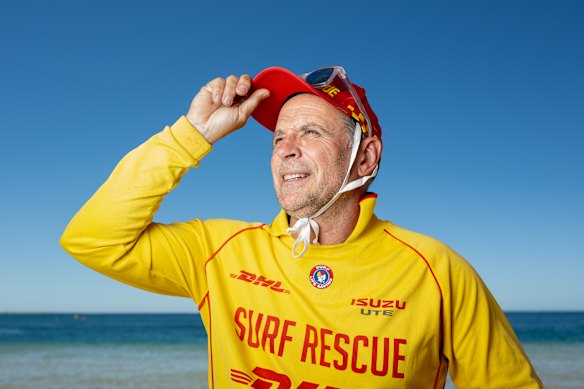
Portsea surf lifesaver Henry Kiss says bluebottle jellyfish have already washed up on Victorian shores in significant numbers twice this summer. Credit: Penny Stephens
“In any one-metre stretch that day, we probably saw 50 or 60,” Kiss said.
“If you’re walking along the beach, and you see a lot of very brightly coloured, moist bluebottles, that means they’re fresh, and the likelihood of them being in the water is high.”
It was the second time in a week so many jellies had washed up on the beach – a strange phenomenon that usually only happens on the Mornington Peninsula every three or four years.
But bluebottles have been washing up all along Victoria’s coastline this summer, with reports of high numbers from Warrnambool to Wonthaggi. In particular, beaches in Melbourne’s south-east like Frankston and along the Mornington Peninsula have been hotspots.
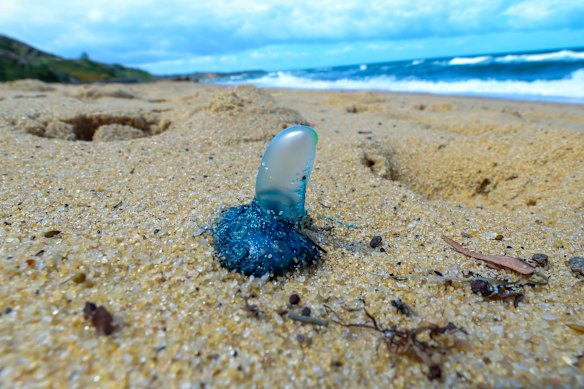
A bluebottle washed up on Sandringham beach last week.Credit: Joe Armao
Bluebottles usually live together in vast swaths out in the middle of the Tasman, somewhere between Sydney and New Zealand. But sometimes wind pushes a big group towards Bass Strait, before funnelling them into Port Phillip Bay.
With no means of propulsion, bluebottles rely on the sail atop their gas-filled float (called a pneumatophore) to move with the winds. Half of the species has a left-facing sail, while the other half faces right – likely an evolutionary tactic to ensure the entire population doesn’t get stranded when the wind blows fiercely.
The beaches along the Mornington Peninsula were clear of the bluebottles on Sunday, owing to the north-easterly winds, which tend to blow any jellyfish that make it into the bay offshore.
But when the peninsula is hit with easterly winds – as it was at the start of last week – that’s when the armada of jellies moves towards our beaches.
Dr Lisa-ann Gershwin, director of the Australian Marine Stinger Advisory Services, says Victoria’s recent influx of bluebottle jellyfish has also been helped along by summer’s hotter water temperatures.
“The warm water amps up their metabolism, so they grow faster, they eat more, and they reproduce more … they’re blooming like crazy at the moment,” she said.
Loading
“That’s why we say: ’tis the season to be jelly.”
When you see bluebottles, prevention is the best cure. Avoid touching them, and protect yourself with a rashie or wetsuit if you’re going into waters when they might be floating.
“Bluebottles have a hair trigger at one end of their little stinging cells, and when they brush up against something a tiny harpoon filled with venom comes flying out, at 40,000 times the force of gravity,” Gershwin said.
“They just slice right through our skin like it’s butter, but any layer at all between our skin and their body, then they can’t get through it. It doesn’t take much to be safe from them.”
But what should you do if they sting you?
Thankfully, the questionable wisdom of urinating on a jellyfish sting has been thoroughly debunked.
Urine is a weak acid, which may be why people assume it would be a good stand-in for stronger acids like vinegar (the first-line treatment to neutralise the stings of more pernicious tropical jellies, like box jellyfish).
But neither vinegar nor urine has much efficacy when it comes to bluebottles.
“About three-fourths of the time, peeing on it actually makes things worse,” Gershwin said.
According to Kiss, being stung by a bluebottle comes with a sharp, intense pain that frustratingly, often does not subside until swimmers have picked off all the jellyfish’s tentacles and washed the wound in hot water.

Jellyfish expert Lisa-Ann GershwinCredit: Carl Bergren
Gershwin also recommends removing the tentacles safely, before thoroughly washing the wound in seawater to sluice off the last of the bluebottle’s stinging cells.
From there, you should run the area under hot water – “as hot as you can stand, without scalding the skin” – for 20 to 30 minutes, or until the pain subsides. An ice pack can also help.
Surf Life Saving Australia said in 2022 that lifesavers helped with more than 40,000 marine stings a year, most from bluebottles.
Professor Richard McGee, chair of paediatrics at the University of Newcastle, said while a systematic review he completed in 2023 pointed towards hot water being the best treatment for bluebottle stings, more research was desperately needed.
A former surf lifesaver himself, McGee said the number of bluebottle stings needing treatment on Australian beaches would only increase due to environmental changes.
”We don’t really have a lot of evidence on what to do when [stings] happen ... It seems so basic, but the impact could be quite large, particularly in a country like Australia, where we’re in the ocean a lot.”
Most Viewed in National
Loading