3 months ago
20
3 months ago
20
Nick Cave’s morning has been, as planned, “absolutely catastrophic to the system”. The London air temperature was in single digits and the rising winter sun a sliver through the trees as he stalked through Kensington Gardens, stripped off and slipped into The Serpentine.
“When you get out, for the next three hours or something the endorphins in your body are literally celebrating that you’ve survived another assault from this freezing water,” he says. “It’s f---ing amazing. It changes everything.” Never mind the swan shit. “It’s good for the skin.”
Other benefits run deeper. “If you have any kind of slightly gloomy disposition in the morning, it deals with that in no uncertain terms,” declares the artist formerly known as prince of a much gloomier realm.
There’s no sign of that character as he speaks, a couple of hours post-plunge, from a big room in London’s inner west that houses “nothing but a piano and a TV. What else could you want?” He’s warm and curious, prone to easy laughter. This cold-water-morning caper is clearly the business.
There are fun things to talk about. His ecstatic and most recent album with the Bad Seeds, Wild God, was almost called Joy, after a song in which an apparition of a flaming boy appears to a despairing man to say, “We’ve all had too much sorrow, now is the time for joy”.
Then there’s The Death of Bunny Munro, the six-part TV drama based on his 2009 novel. Various parties had “tried to film this thing about five times” before Matt Smith signed on to play the dinosaur Lothario of the title: a sleazy beauty products salesman cruising a multi-generational trail of damage in the postcard Brighton seaside.
“Matt’s Bunny Munro is quite different than the one in the book,” Cave says: not necessarily a bad thing given the pornographic inner world of the delusional lady-killer he wrote. “He really loved the character and now the Bunny Munro of the book has disappeared, for me. Now I just see Matt.
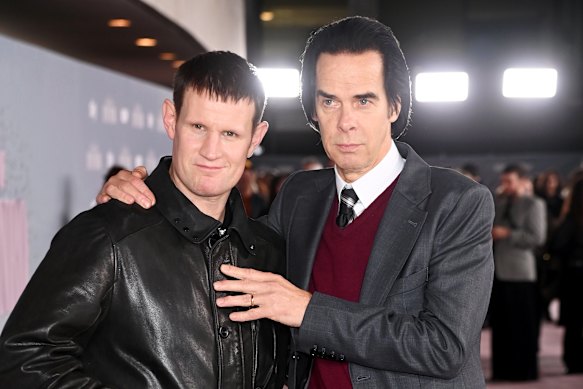
Matt Smith and Nick Cave at the London premiere of The Death of Bunny Munro in October. Credit: Alan Chapman/Dave Benett/WireImage
“What I like about the TV series is the deeply uncomfortable notion that as you watch it, you kind of like him. There is some aspect of him that you feel for, and this is a difficult and complex thing. You know, the women [in the story] kind of like him. They’re complicit in the whole thing. As are we. I think Matt did a great job of that.
“It feels like it’s a good time for this to come out,” he adds. “I think it presents a more interesting, complex view of masculinity then if we had put it out 10 years ago, say. I think the world is becoming more open to discussing these matters in shades of grey.”
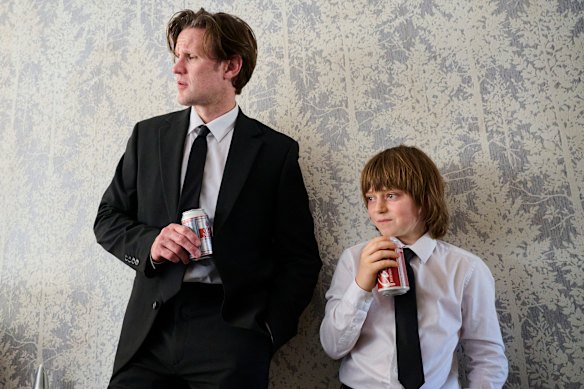
Matt Smith and Rafael Mathe play a mismatched father and son in The Death of Bunny Munro.Credit:
The matters he refers to – desire, power, shame, the armour men wear to survive their own trauma – have circled his work for decades, but they land differently now. Wild God pushes at the edges of old myths as versions of the author meet each other across time: the flaming boy, the bereft man, the spectral lover-saint who’s run out of tricks.
“You’re not aware of that when you’re doing it,” Cave says. “I don’t have the least bit of control over what I’m trying to say, not in one song, let alone an entire album. It is what it is, and then I stand back like everybody else and have a look at it and see what the record is ultimately trying to say. That’s one of the great pleasures, if there is such a thing, of writing songs – that you get to find out stuff.
“There’s a lot of the past on that record, I guess,” he concedes. “It sort of retains its
autobiographical nature, but at the same time it’s more universal in its way of looking at things. It’s not as acutely personal as, say, Skeleton Tree or Ghosteen.”
Those albums, loaded with the tragedy of his son, Arthur, who died in 2015, were a far cry from the violence of previous musical incarnations. But even in that more contemplative context, Wild God feels startlingly tender: a sense that salvation might look less like a stoic force of faith and will and more like surrender to a more feminine stillness.
“The women characters are different now than in the earlier records,” he says. “They’re much more nurturing, for sure. Susie, my wife, is a massive influence over all the records I’ve made since I’ve been married. You write about what you see, I suppose.”
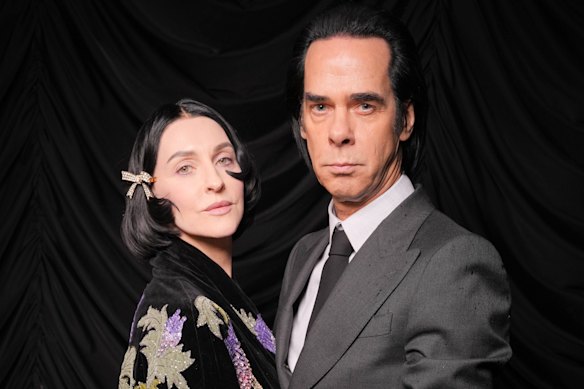
“My point of view has become so entangled in hers that it’s very difficult to know who is who”: Susie and Nick Cave during this year’s Paris Couture Fashion Week.Credit: WWD via Getty Images
The literal rebirth in the last song, As the Waters Cover the Sea, was conceived “while watching my wife, who had fallen asleep in her chair by a window. I’m often writing for Susie, or from her point of view. My point of view has become so entangled in hers that it’s very difficult to know who is who.”
The late Anita Lane, Cave’s long-ago lover and seminal creative catalyst, is a force unto herself in O Wow O Wow (How Wonderful She Is). He plays the smitten schoolboy grappling for words, eclipsed in the final part by Lane’s laughing voice reminiscing down the phone with disarming and eternal – that word again – joy.
Asked whether the softening of Wild God reflects something broader in the world, a cultural drift towards qualities we once coded as feminine, he bristles slightly. “I think that sounds perhaps right,” he allows, “but I’m not sure if that’s what I’m really on about. I’m not sure that I write like that. I’m not sure that I look at the world and try to express how I feel.
“I sit down and I try and formulate a line of some sort that might be interesting. Usually I don’t. It just sits there, and I write a lot of lines that don’t really say much at all. And then I write a line that feels interesting, especially if I put it with one of those other lines. There’s a kind of reverberation that happens. Then I add another line and a song slowly finds itself.
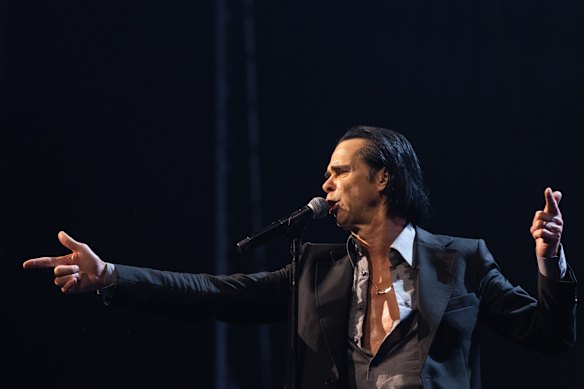
“Part of getting older is to reconcile yourself with your young self, and that’s not as easy as it sounds”: Nick Cave on stage with the Bad Seeds.Credit: Megan Cullen
“But I’m just facilitating a process. I don’t really feel like I have much of a handle on what the songs actually mean … I’m just led along by the song itself. So I often feel uncomfortable when someone suggests that I’m trying to write about particular phenomena within the world. But I am genuinely interested in what people get from the records because I feel we’re all in the same boat.”
Anita Lane looms large again in Stranger Than Kindness, an engrossing museum of Cave’s life and work at the Royal Danish Library in Copenhagen, now open for free exploration online. The first of 300-odd exhibits is her typewritten, hand-coloured lyric to the song that gives the exhibition its name.
‘It often takes a great grief in your life in order for that spiritual side to blossom and flourish.’
Nick Cave“It’s an unbelievably detailed look at my life, chronologically, and sort of existentially as well,” Cave says. “[Curator] Christina Back is this extraordinary woman who was able to do anything that I wanted, so this project blew out of all proportion. Then the day that it opened, the whole country went into lockdown and everything was covered in sheets of plastic.”
Open at last to anyone with a computer and a few hours to spare, the trip details his evolution from the Beautiful Chaos room of his Birthday Party days to the Hall of Gratitude, a distillation of items of lasting personal meaning: a family Bible, a bust of ’70s Elvis, photos of Susie and the kids, an email from Leonard Cohen after Arthur’s passing. “Dear Nick, I am with you, brother. LC.”
The last room, Shattered History, contains a striking painting by Ben Smith titled Ink and Solace. A sulky young Nick sits in the lap of an older, benevolent self, an ink-spattered notebook on the table before them. “You were never the thing you thought you were,” Cave intones in an adjacent video.
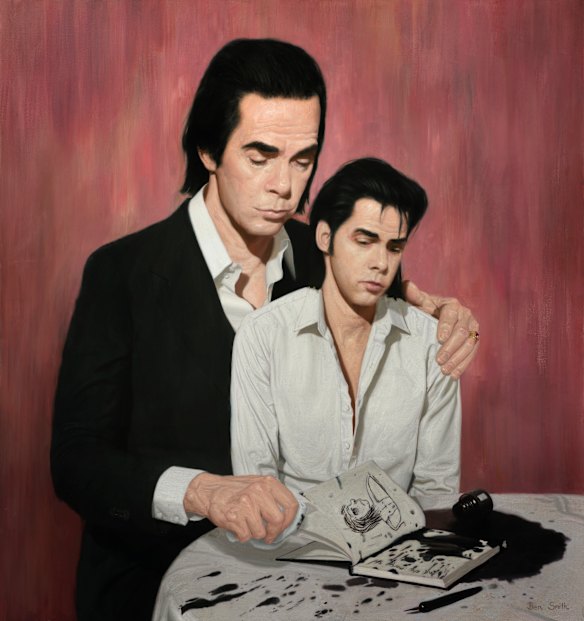
Ink and Solace, a painting of Nick Cave by Ben Smith, part of the Stranger Than Kindness exhibition.Credit: Ben Smith
“I find I can look at my younger self now with my head in my hands, to some degree,” Cave says, laughing, “but also with a huge amount of love and understanding. Part of getting older is to reconcile yourself with your young self, and that’s not as easy as it sounds. I think that the older I get, the more generous I become in that.
“I don’t feel estranged from my former self at all. I just feel an extension of it really. I feel I have pretty much the same inclinations. I just have more room to pursue them now … because things were so much more chaotic back then. Chaos is unbelievably time-consuming.”
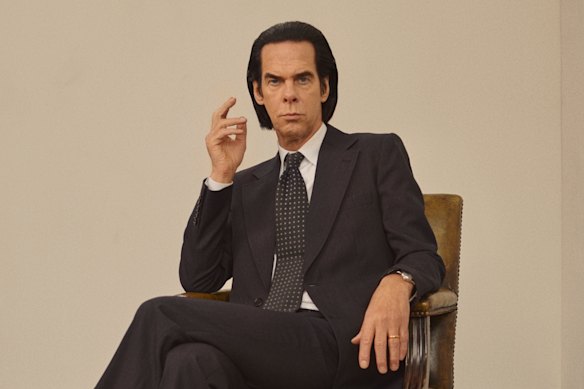
“Why would I want to be the way I was when I was 20?” asks Nick Cave.Credit: Venetia Scott
It was incredibly useful, as older fans never cease remembering, when the Birthday Party tore a streak through Melbourne’s post-punk underground in another age. The myth that Cave subsequently built, by accident and design, was truly a beast. Is laying it all out in a museum in Copenhagen a way of locking it up and moving on?
He allows himself a long, pained laugh. “There’s a certain pressure to retain the myth, and to still be that person, from a fair amount of people.” He can say this with accuracy because of The Red Hand Files, the online fan correspondence he engages in with extraordinary rigour.
“Thousands of people write in every week about what they think, and a certain percentage of those think that I should be as I was. There’s what’s considered by some a sort of youthful ideal that is lost and compromised as we get older, and a lot of people don’t like that. Rather than growing and learning and becoming something else, they see that as a sort of betrayal.
“I don’t know what to do with that. I mean, why would I want to be the way I was when I was 20?” He sounds genuinely mystified. “Maybe some people live their lives, they grow old and they just never change. I don’t know.”
Spoiler alert. At the end of Bunny Munro, Cave makes a comic cameo as a kind of spirit guide to the deplorable character’s final, clumsy act of reparation. When he looks back on his past – all that blood and thunder, the speed and heroin, the violence and murder references – does he feel a need for atonement?
“I don’t really see my younger self as something that I need to atone for. But I certainly see myself as much more of a fully formed human being now than when I was 20. Part of that is through having a bomb go off in the middle of my life.”
He means, of course, the loss of Arthur, followed in 2022 by the death of his oldest son, Jethro. It was, he says, “devastation that allowed a part of my character – let’s say the spiritual side – to be animated, and to become my full nature as a human being. As a younger person I had that interest, but I didn’t have the room for it.
“It’s funny, I was just writing about this today in a Red Hand File. I think that we as human beings have two aspects to our nature, a kind of rational side and a spiritual side. And I think that the world is no longer interested in the spiritual side, and it sort of withers away. And it often takes a great grief in your life in order for that spiritual side to blossom and flourish.”
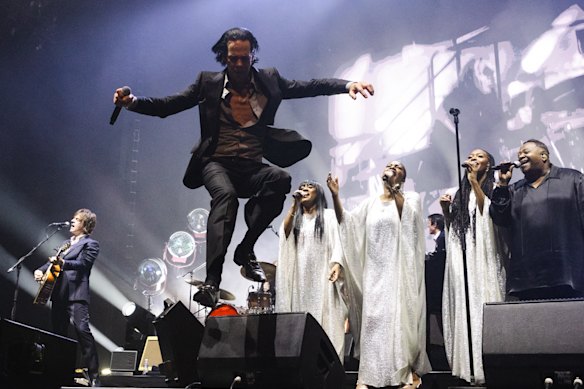
Nick Cave and the Bad Seeds performing in London.Credit: Megan Cullen
The title track of Wild God plays like a small parable from that waning spiritual world: the old certainties collapsing, the old gods running on fumes. “That Wild God character is an entity looking for someone to believe in him,” Cave says. “And I think that may be God’s predicament at the moment.”
The idea sounds like a kind of invitation. In a sense, Nick Cave has become the real-world evangelist his myth has been auditioning for decades. The Bad Seeds’ return to Australia this summer will doubtless further a rolling act of revelation to those who want to believe.
“I feel that the Bad Seeds have been released in some way, both as a band and each of us individually,” he says. “I could go through each member ... but when we made the Wild God record, everyone seemed to have been trapped in something for a while, and we were just free. It feels like that on stage too. It’s insanely good. It’s just … joyful.”
Nick Cave and the Bad Seeds play The Domain, Sydney, on January 23 and 24, RNA Showgrounds, Brisbane, on January 27 and Melbourne’s Alexandra Gardens on January 30, 31 (sold out) and February 1. A new concert album, Live God, is released on December 5. The Death of Bunny Munro is screening on Binge. Stranger Than Kindness: the Virtual Nick Cave Exhibition, is at www.thenickcaveexhibition.com