3 months ago
19
3 months ago
19
Rio Tinto’s boss says the company’s new simplified structure will deliver hundreds of millions of dollars in productivity benefits and make the mining giant a stronger, sharper business.
Simon Trott told an investor briefing on Thursday that he intended to reduce costs at the global resources company by 4 cent to 2030 and outlined a vision to simplify the business.
“We are delivering strong early productivity benefits and cost savings with more to come,” he said. “Freeing up cash from our asset base where it makes sense will strengthen the balance sheet and maintain returns as we invest for the future with discipline.”
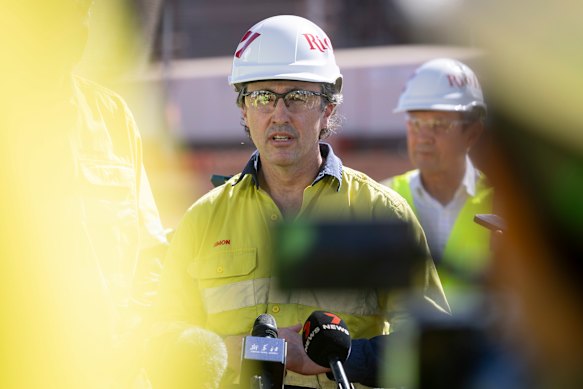
Rio Tinto Simon Trott told investors he intends to reduce costs at the global resources company.Credit: Matt Jelonek/Rio Tinto
Trott officially took over from Jakob Stausholm as the mining giant’s chief executive in August.
He has been quick to introduce changes at the $50 billion company, announcing a major restructure of Rio’s operations, a review of assets in America and Africa and the exit of two high-ranking executives - Rio Tinto Australia chief executive Kellie Parker and chief executive of minerals Sinead Kaufman.
The company expects to grow its production of key metals by 7 per cent in 2025 and by 3 per cent compounding annually to 2030 after ramping up copper output at its Oyu Tolgoi mine in Mongolia, iron ore in Simandou and lithium from its Rincon project in Argentina and following its March acquisition of Arcadium.
Loading
It also expects to bank annualised productivity benefits of $650 million, Trott said.
Trott said by 2028, the miner will produce 200 kilotonnes a year of lithium – a white mineral that is a key ingredient in the batteries that power electric vehicles – but will only commit to new projects if there is sufficient demand and adequate returns.
Trott said the company will free up to $10 billion from existing assets through sales, partnerships and lowering the cost of capital to boost its balance sheet.
Under Trott, the dual-listed London and Australian company will be reorganised into three key divisions – iron ore, copper and a merged lithium and aluminium business – down from four previously.
Rio’s all-important iron ore division has been expanded into the one global unit under Matt Holcz, combining the miner’s flagship Western Australia Pilbara assets with others in Canada and the newly inaugurated Simandou project in Guinea.
“We are building from a position of strength for Rio Tinto’s next chapter, sharpening and simplifying the business to deliver leading returns,” Trott said.
The company said it was upgrading guidance for both copper and bauxite production.
Rio makes most of its revenue from digging up iron ore in the Pilbara – and soon adding ore from Guinea – shipping it to China’s blast furnaces to be turned into steel.
The trade has delivered enormous profits for Rio and its rival BHP over recent years, making iron ore one of Australia’s most valuable exports. However, the booming demand from China’s insatiable steel mills is plateauing as the Asian giant struggles to overcome a crisis in its property market, leading to a sharp fall in the price of iron ore this year.
Loading
The commodity is being hemmed in by slim profit margins at China’s mills and ore stockpiles on its wharfs. “With steel inventory also maintaining high levels, the overall iron ore market was expected to come under pressure,” Barrenjoey analysts said in note.
Simandou’s projected output of 60 million tonnes of high-grade iron ore a year by 2028 or 2029 at a time of softening demand from China is also dragging on the commodity’s outlook, although prices are still above the critical $US100 barrier.
The global resources giant is also being caught up in geopolitical change on another front. Rio’s big Canadian aluminum smelters have become a target of the Trump administration’s hostile trade stoush with its largest neighbour, and the metal was hit by an initial 25 per cent tariff later hiked in June to 50 per cent.
The Business Briefing newsletter delivers major stories, exclusive coverage and expert opinion. Sign up to get it every weekday morning.
Most Viewed in Business
Loading