3 months ago
14
3 months ago
14
The life of Australia’s biggest coal-fired power plant could be extended for a second time as NSW Premier Chris Minns flagged he was open to a deal to avoid blackouts if the plant shuttered before the grid could cope.
Energy experts declared on Monday the electricity grid would not be ready for Eraring, the nation’s largest coal-fired power station, to shut down by its scheduled end date in mid-2027. The warnings came after the Australian Energy Market Operator said there would be a heightened risk of blackouts from the time when Eraring is set to close.
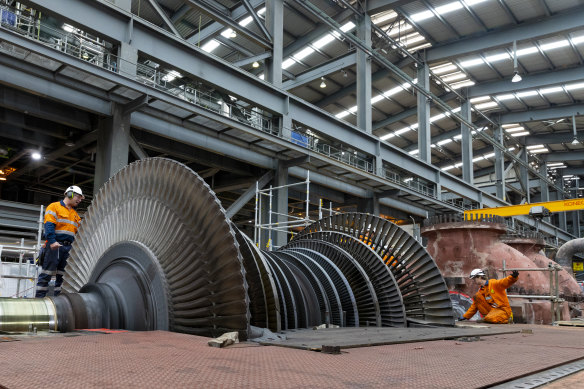
A generation unit at Origin Energy’s Eraring coal plant, during scheduled maintenance work.
Officials are increasingly worried that, while there are enough renewables and power lines under construction to replace coal plants, there will not be enough infrastructure to prevent sudden blackouts by maintaining a safe and stable electricity flow.
Minns on Monday gave his strongest indication that his government was willing to work with Origin Energy, which owns Eraring, on a deal to delay its planned closure date.
“We are not necessarily opposed to a conversation with them about it,” Minns said.
Loading
Such a deal is expected to require taxpayers to provide a guarantee worth hundreds of millions of dollars a year if the Eraring plant is required to keep running at a loss.
The state government offered in 2024 to cover potential losses of Eraring, valued at up to $225 million a year, in a deal to ensure Origin ran the plant past its former 2025 closure deadline. Origin agreed to the deal but did not activate it as it made money in a favourable energy market.
While Origin has not activated that deal, there is an option for it to kick in from 2027 until 2029, but the terms have not been written.
Energy expert Matt Rennie, at Rennie Advisory, said the grid would not be able to cope in the short term without Eraring.
“We need to pay proper regard to the reality that coal will come out of the system at some point, and therefore the preparation for the new energy system is absolutely critical,” Rennie said.
Macquarie Equities infrastructure analyst Ian Myles said market watchers are already factoring in Eraring’s closure being deferred under another agreement with the NSW government.
“My expectation is, and we’ve modelled this, that Eraring will be operational until 2029. That is probably a common expectation [across markets],” he said.
Grattan Institute senior fellow Tony Wood said it was likely Eraring would need to stay open beyond 2027, but bill payers would bear a cost even if AEMO advised there was an option to function without the plant.
“Even if the grid limps along without Eraring, there’ll be costs, and what would annoy me if I lived in NSW is the question: who’s going to pay for all this?”
AEMO said on Monday that NSW grid owner Transgrid is racing to install new equipment to keep the grid stable, but that equipment is unlikely to be delivered until “at least 2028”.
To run smoothly, power grids must not only match supply and demand, but also maintain “system security”, including inertia, which comes from the steady frequency traditionally provided by the spinning turbines of gas, coal and pumped hydro plants.
Good system security enables the grid to ride through sudden spikes or lulls in demand, power line faults or power plant breakdowns.
Most of Australia’s coal plants are scheduled to retire by 2035, while soaring maintenance costs and competition from renewables are driving owners to speed plans for closures.
AEMO has warned that the loss of inertia and system strength from the scheduled closure of Origin’s Eraring coal plant in 2027 would create a heightened blackout risk in NSW.
Loading
If Eraring does close in 2027, another option to keep the grid stable would be to secure extra supply from gas or hydropower to meet minimum system strength requirements, the cost of which would be ultimately borne by bill payers.
NSW government was aiming to speed up Transgrid’s installation of synchronous condensers – grid-connected machines that don’t burn fuel but deliver the same stabilising effects as the spinning turbines of coal and gas plants.
Minns said his government this year passed new laws to fast-track synchronous condensers, “a crucial piece of infrastructure”.
He also said despite warnings that the extension would slow down the rollout of renewable energy, NSW was number one in the country for renewable energy investment.
Climate Change and Energy Minister Chris Bowen said the federal government was getting on with building the renewables grid as Opposition Leader Sussan Ley warned that “this government’s energy policy has not recognised that you need baseload generation in the system for as long as it takes to transition to affordable renewable alternatives”.
Origin has said it would not close Eraring if there was a need to keep it running.
“Origin has always acted responsibly in this regard, and the community should have confidence we will continue to do so,” a spokesperson said.
Cut through the noise of federal politics with news, views and expert analysis. Subscribers can sign up to our weekly Inside Politics newsletter.
Most Viewed in Politics
Loading