3 months ago
18
3 months ago
18
Sean Kelly makes an excellent point about how persistent unethical and downright shady business conduct slowly wears us down into grudging acceptance (“Australians in a curious tug of war”, December 1). How have we been forced to accept business decisions that do not improve our lives but instead simply enrich corporations while prices rise? Self-serve supermarket checkouts, ineffectual call centres, self check-in at airports, the closure of face-to-face bank branches, credit card use charges and the sneaky ongoing subscriptions Kelly mentions are just a few examples. The government of the day has a choice to continue enabling profiteering that benefits big business or to prioritise individuals’ rights and needs. Congratulations to Labor frontbencher Andrew Leigh in his efforts to crack down on destructive and unfair business practices. Alison Stewart, Riverview

The closure of face-to-face bank branches has been a major inconvenience to many customers.Credit: AFR
A beautiful line from Andrew Leigh – “the stories we tell about our society shape the society we become”. It captures why it’s vital to uncover and share stories that shape us positively. Often, an idea, a story, or an emotional nudge helps us see differently and sparks a movement. I liken this to the creation of a dune in the desert: a twig becomes an obstacle and the wind begins to pile sand against it. Over time, the accumulation of sand grows into something significant. In the same way, good stories, those that cut through the din of negativity, can start small and gather momentum. Each one adds to the mound, shaping our collective behaviour. Often these stories are told around dinner tables and are the most potent. Manbir Singh Kohli, Pemulwuy
Coalition power trip
Is it any wonder we face a glaring shortage of power supply infrastructure in coming years (“Blackout risk: Grid ‘not ready’ for coal plant closures, solar surge”, December 1)? The Coalition’s decades-long effort to mislead the public and obstruct the rollout of renewable energy is nothing short of civic vandalism. Propping up an ageing fossil fuel industry by distorting the reasons for rising power prices, and then using those prices to attack Labor, is both deceitful and indefensible. The National Party has consistently fuelled hostility toward renewables, leaving rural landholders opposing installation of clean energy projects and critical infrastructure. The Coalition resolutely ignores its 10 years of inaction while in government and chooses to blame Labor instead. Bruce Spence, Balmain
Readers might wonder why the grid is not ready for coal plant closures and why electricity bills are rising. They may be unaware that only about one third of the electricity bill is for the actual cost of generation. Most of the rest goes to network costs, which are rising due the transformation needed to shift to cheaper forms of energy. Both sides of politics underestimate this cost and disagree about which to use. Personally, I trust the scientists who have studied this and recommend the renewable pathway as the most economical – even before considering the environmental benefit. Brad Elliott, North Rocks
Our energy revolution
My wife and I have made a full energy transition in our lives – solar, battery, heat pump, induction cooktop and electric vehicle – and, like Jenna Price, have experienced how confusing the process can be (“I’m nearly as confused as the Liberals on clean energy”, December 1). Nevertheless, the result has been more than satisfying as we are saving about $5000 a year, not to mention many tonnes of CO2. It’s interesting that one of the biggest savings we’ve made was by properly insulating our home. It used to be freezing in winter and boiling in summer, but now it’s liveable all year round without heating or cooling. It cost a bit to do this, but we’ve already paid it off through the savings we’ve made. Ken Enderby, Concord

Rooftop solar systems help consumers keep their energy bills down. Credit: Getty Images
Jenna Price articulated some of the hurdles she encountered in her attempts to make her home more carbon friendly. She and other readers should know that there is a charity called 1 Million Women that is helping people all over the world make their homes more energy efficient. Tom Meakin, Port Macquarie
Climate conundrum
Correspondent Chris Roylance’s assertion that “every credible climate scientist on Earth” agrees that rising CO2 pollution is the primary driver of climate change is inconsistent with the full body of published climate science (Letters, November 29). Many highly credible, peer-reviewed scientists hold differing views. It is disheartening to see how consensus-based modelling has directed global policy, leading to significant societal effects, such as people choosing not to have children because of their climate concerns. Peter Phizacklea, Sydney
Migrants deserve praise
There seems to be a misguided belief among some Australians that immigrants are the root cause of various social problems such as crime and violence (“Pauline Hanson speaks at Melbourne anti-immigration rally”, December 1). As a proud resident of Lane Cove, a Sydney suburb where 39 per cent of the population was born in another country, I can personally attest to the positive contributions of immigrants in our community. Contrary to the rhetoric of anti-immigrant politicians, Lane Cove was rated as the most liveable suburb in Australia, thanks in part to factors such as safety, very low crime rate and a strong sense of community. At 30 per cent, Australia has one of the highest rates of residents born in another country in the world, yet it’s consistently ranked as very safe and one of the most liveable countries internationally. Rather than scapegoating immigrants, we should recognise the positive impact they have on our communities and economy. Don Mills, Lane Cove
Pauline Hanson told anti-immigration protesters that she wouldn’t choose to live in Victoria. Pauline, it’s time to take a good look in the mirror. I’m quite sure there are many Victorians out there breathing a large sigh of relief. Rose Lysnar, Windsor (Qld)

Credit: Cathy Wilcox
Mobilise data safety
Your story on controlling behaviour through the medium of cars is timely (“Abusers using GPS to control partners”, December 1). In November 2023, I wrote to then attorney-general Mark Dreyfus, pointing to the urgency of stronger protections from the wholesale collection of personal data on drivers and their passengers. This can extend to real-time location, facial images, voice recordings, driving behaviour and so on. Apart from women escaping domestic violence, data can be collected from judges, politicians, police, ASIO staff and children. His department replied that current and proposed (some now implemented) changes to the Privacy Act provided adequate protections. Evidently not. The privacy policy of my car’s manufacturer has me agreeing to send all the above data anywhere in the world, which could theoretically compromise my safety. Best not to collect the data in the first place or at least provide an opt-out. Ronald Watts, Newcastle
Bright idea
If culling dangerous sharks is not an option (Letters, December 1), why not discourage them from attacking people by using swimwear, wetsuits, surfboards and kayaks with nature’s aquatic warning hues – fluorescent yellow, green, red or orange? Not in good taste for us, sure, but the ocean’s predators know not to take a bite of creatures displaying these high-vis warnings. Andrew Cohen, Glebe
Old sounds best
I share Clare Raffan’s love for retro music systems (Letters, December 1). I recently took the final step and bought a 20-year-old, fastidiously maintained Nissan Maxima that came with not only a CD sound system, but a separate disc player in the glovebox for back-seat passengers to watch movies on a drop-down screen. Brian O’Heira, Point Frederick
The news that NSW poker machines will be turned off between 4 and 10am is welcome but the rule change doesn’t go far enough (“Pokies in NSW to be switched off in danger hours”, December 1). I have a 35-year-old stepdaughter with a dangerous gambling addiction. On more than one occasion she has lost more than $1000 in a single session on the pokies. To make it worse, she holds RSA and RCG certificates, but it is clear to her mother and me that responsible gambling training just does not work. What is laughable is that some venues claiming financial hardship can apply for an exemption – which will allow them to continue lining their pockets at the expense of their punters. Name withheld
The state government is at least trying to do something about problem gambling by making pubs and clubs in NSW switch off poker machines in the “danger hours”. But why is Prime Minister Anthony Albanese dragging his heels on banning gambling advertising? It’s not hard to guess the answer. Jenny Greenwood, Hunters Hill
Spender’s AI solution
Allegra Spender is right about AI and the crisis in planning delays (“In the right hands, AI can help save the housing crisis”, December 1). As a planner I have recently come to the same blinding realisation. I have worked in many roles to return urban planning to a rational process. Paradoxically, the endless quest for a “simpler, faster, cheaper” approval process somehow makes it more complex and arbitrary. Spender correctly invokes robo-debt; I now know that hand-crafted attempts to unpick the tangle cannot succeed. We are left with two options. The first is already with us: centralised, top-down, one-off executive decisions on major projects. The Housing Delivery Authority is a version of this. The second option is to bypass tangled rules and executive authorisation by using AI to distil vast amounts of data to enable accurate predictions for urban development. I have no idea how this might play out but I do know which of the two options will lead to a fairer and more liveable city. Jeremy Dawkins, Waverton

Could AI help speed up the complex business of urban planning?Credit: Shutterstock.com
Allegra Spender provides a persuasive argument for embracing AI in urban planning. She gives no consideration, though, to its downsides – a voracious appetite for power, water and data storage, which have huge environmental impacts. To be wary is to be wise. Liz Adams, Kareela
I have been using AI – actual intelligence – for more than 80 years. It has been easy to use; no technical skills are required. It has provided natural, sensible and correct solutions and satisfactory results for numerous problems. Everyone should try it. Richard Arndell, Avoca Beach
Women worse off
The problems outlined by Associate Professor Vinay Rane appear to be mainly ones of bureaucracy and co-ordination (“Women’s hospitals aren’t working”, December 1). Some of the comments made about gender segregation (i.e. “gentleness is no substitute for competence”) ignore the reality that women who are processed through our normal health system often come off second best. This was recently outlined in the Herald’s Medical Misogyny series about how women’s pain has been routinely under-diagnosed and ignored by our male-dominated hospitals and medical systems. I think women need to be treated as “a special category”, particularly in the areas of obstetrics and gynaecology, and having access to women’s-only services means there is at least a fighting chance that female patients will be listened to. Unfortunately, women will never be the centre of healthcare in a unisex system. Pauline Croxon, Earlwood
Watch out, Venezuela
Venezuela is a prime candidate for a Trump-driven regime change because it is rich in oil, and another war will provide a good distraction from problems at home in America (“Trump declares Venezuelan airspace closed”, December 1). Regime change has been pursued by numerous other US administrations elsewhere in the world: Allende in Chile, Mosaddegh in Iran, Arbenz in Guatemala, Bishop in Grenada, to name a few. Venezuela is right to feel nervous because there seems no doubt that the USA still thinks it has a right to jump into a sovereign country and reorder it, despite the knowledge and history of how things went in Afghanistan, Iraq and Vietnam. Joe Weller, Mittagong
So now we see it. Donald Trump will never solve the Ukraine conflict because clearly his morals, beliefs and sense of reality are the same as Vladimir Putin’s. Trump is looking to do to Venezuela what Putin is doing to Ukraine. Warwick Spencer, West Pymble
Sole man
It should’ve been obvious to anybody who voted for Barnaby Joyce that they weren’t voting for the National Party, but for Joyce (Letters, December 1). He has never been a genuine member of any political party, just an opinionated outlier. Chris McKimm, Karangi
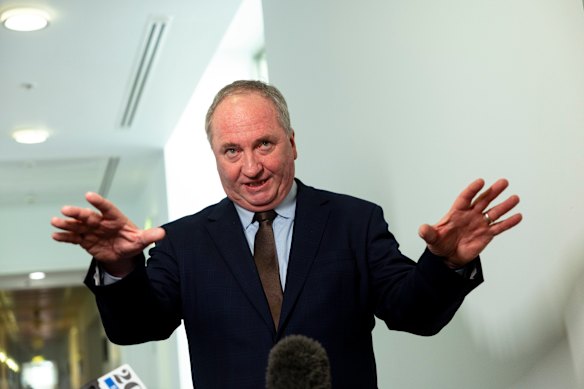
Former Nationals MP Barnaby Joyce.Credit: Dominic Lorrimer
T time’s over
Following Christine Hanrahan’s pet hate of the pronunciation of “s” on the airwaves (Letters, December 1) may I add my observation. The ledder (sic) “t” is now often pronounced as “d” or omidded aldogether. It can happen on Sadderday or any other day of the week. The commendador may recite Hanrahan’s words as “it is not from parroding the American language … [and] their obsession with dennal innerference”. Opportunidies seem to arise erradically and repeadedly and the escalading percenages need deeper scrudiny. Peter Lino, Lennox Head
Christine Hanrahan, I suggest you steer clear of Hungary, where their capital city Budapest is pronounced “Budapesht”. Cosmetic dentistry has nothing to do with it. Brian Jones, Leura
- To submit a letter to the Sydney Morning Herald, email [email protected]. Click here for tips on how to submit letters.
- The Opinion newsletter is a weekly wrap of views that will challenge, champion and inform. Sign up here.