3 months ago
6
3 months ago
6
James L. Brooks, the triple Oscar-winning writer-director behind film masterpieces like Terms of Endearment (1983), Broadcast News (1987) and As Good as It Gets (1997), and the beautifully gritty TV comedy The Mary Tyler Moore Show (1970-1977), has always had a problem with Hollywood and its tendency to wrap everything up in a neat bow.
“I’m always a little perversely bothered by Hollywood movies ending in you forgiving the person who was such a shit-head and everybody goes merrily along,” Brooks says. “And, having had a father who misbehaved very badly, I want to question whether that’s the way that you should take off the bonds of trauma and move on. I want to explore that.”
Brooks’ new film – his first in 15 years, since the Reese Witherspoon/Owen Wilson/Paul Rudd romantic comedy How Do You Know – tackles that subject with gusto. A comedy-drama about an American state lieutenant governor who takes her first faltering steps in the corridors of political power, Ella McCay is full of crunchy turns and bumpy personal twists.
But does it have a happy ending? It might be a little too early to spoil that but Brooks does say: “Happy endings are a proper thing for Hollywood to do … I mean, people are paying to come see this. You don’t want to send them home all depressed or more depressed than they came in. But [sending them home] thinking differently than when they came in? That’s OK.”
Brooks is the kind of Hollywood legend around whom the natural hyperbole of that term is never overstated. In addition to The Mary Tyler Moore Show his television credits include co-creating Taxi (1978-1983) and The Simpsons (1989-present). And next to his three Oscars he has 22 Emmys and a Golden Globe on his mantel. His company Gracie Films, in addition to his own films, produced Big (1988), The War of the Roses (1989), Jerry Maguire (1996) and many others.
Born in Brooklyn, New York, Brooks was raised down the road in New Jersey, “primarily by women”, he says, notably his mother Dorothy and his older sister, Diane. His father, Edward, more or less abandoned the family when Brooks was a child. Despite that hardship, or maybe because of it, Brooks became a great writer of women’s voices, from courageous television journalist Mary Richards (Mary Tyler Moore) to his new muse, Ella McCay (Emma Mackey).
“My father was errant, and I had an older sister and a very hard-working mother, and he would drink away his salary and we, especially my mother, were left just to scramble,” Brooks says. “My mother had two sisters, and I was close to my aunts, and my father had three sisters. There were a lot of women around to help me grow up and help me survive him.”
It might also explain the inherently optimistic tone of much of Brooks’ work. Terms of Endearment is steeped in tragic comedy but is ultimately deeply affecting and rich in sentiment. Broadcast News taps into a dark vein of American media life but is also surprisingly optimistic about the triumph of journalistic ethics in the face of media manipulation.
In its heroine’s pursuit of idealism in a complex and sometimes broken political landscape, Ella McCay may not be a linear sequel to Broadcast News but it could be an emotional or tonal follow-up in that the heroine is motivated by the kind of honest optimism you do not see every day in American politics.
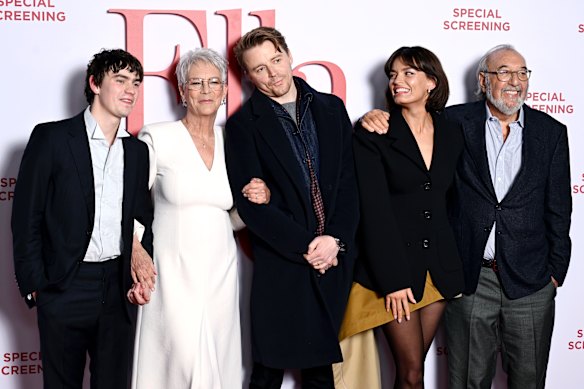
Brooks, far right, with Spike Fearn, Jamie Lee Curtis, Jack Lowden and Emma Mackey in London last month.Credit: Gareth Cattermole/Getty Images
“That may be true,” Brooks agrees. “In Broadcast News the heroine was living for integrity and journalism and the survival of broadcast journalism in a way that it hasn’t. And here her dirty secret is: Lord, help me, I can make people’s lives better. That’s something she’d never said out loud until that moment. I think that’s what’s at the heart and soul of her. And you can call it a burden or a beautiful thing pulling you. It’s complicated.”
Such optimism would perhaps not have worked in a present-day setting, where American politics verges at times on farce. Brooks instead dialled back the clock to 2008 “to separate us from the Trump years and the division of the people in the country”, he says. “It’s very much looking at that time. [And it is] coincidentally and arbitrarily when money took over so much that it blocked the sun in politics. That was consciously why I chose that time.”
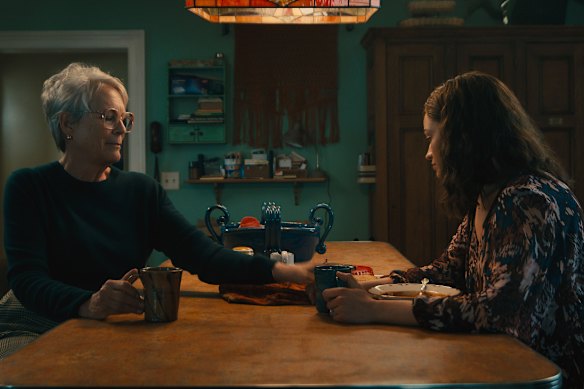
Jamie Lee Curtis and Emma Mackey in Ella McCay.Credit:
The film co-stars Jamie Lee Curtis as Ella’s Aunt Helen, an opinionated firebrand who is not afraid to speak her mind and has always encouraged Ella; Jack Lowden as Ryan, Ella’s husband, who lurches from political asset to political liability with a speed that could outflank Elon Musk, and Woody Harrelson as Eddie McCay, Ella’s father, whose absence and presence are equally challenging.
Though the work is not autobiographical, Brooks infuses a lot of himself into it. Ella’s name was derived from John McCain, the American war hero-turned-politician, who Brooks credits for “transcending party and just doing what his heart and soul told him to do”. Ella’s problematic dad, meanwhile, is an echo of Brooks’ own. “I got off my chest some things that I had to deal with about my own father,” he says.
At the heart of the film, however, is the relationship between Ella and her mentor, the outgoing Governor Bill (Albert Brooks). And, perhaps unsurprisingly, Brooks seems to write that relationship with the greatest of ease, the 85-year-old filmmaker having been an instrumental figure in the careers of many other filmmakers.
TAKE 7: THE ANSWERS ACCORDING TO JAMES L BROOKS
- Worst habit? Wasting time.
- Greatest fear? Not wasting time.
- The line that stayed with you? When Jimmy Hoffa (Jack Nicholson) says in Hoffa, directed by Danny DeVito: “Are we talking words, here, we usin’ words? That’s what we’re doin’?”
- Biggest regret? That I wasn’t able to give my mother a better life.
- Favourite book? I was a F. Scott Fitzgerald nut. I just absorbed everything about his life, everything. There was this wonderful romantic thing always happening, and always implicit longing, in almost everything he did. He wrote The Pat Hobby Stories, these gorgeous stories that break your heart.
- The artwork/song you wish was yours? Judy Garland’s Born in a Trunk [from the 1954 film A Star Is Born]: ‘But it’s all in the game and the way you play it/And you’ve got to play the game you know/When you’re born in a trunk at the Princess Theatre/In Pocatello, Idaho.’
- If you could time-travel, where would you choose to go? I can go forward or backward? The writers’ room at The Simpsons. I always said that the best job is a comedy series that’s working. It’s not solo, it’s a community, and everybody hangs together. Instead of a movie, where you’re all blown apart after it’s over, you can be together for six, seven years. Or, in The Simpsons’ case, 36 years.
Brooks executive produced Cameron Crowe’s directorial debut and encouraged Crowe to transition from writing to directing. “He gave me the confidence to do it,” Crowe said later. Ditto Wes Anderson. “He didn’t have any reason to trust me but he did,” Anderson said. Judd Apatow, another filmmaker who credits Brooks as an influence, described him as a “great cheerleader for risk-taking”.
“Television has always been a writer’s game, and movies have always been the director’s thing. At Gracie Films what we try and do is maintain a writer’s control of the work, that he or she stays with the film,” Brooks says. “It’s nice to have an ethos, to say we’re actually standing for something. I believe it works.”
As for the generation after that? Brooks is confident human writing will win in the face of AI and he’s in no hurry to mentor a non-human computer program, even one with delusions of writer’s room grandeur. If I gave an AI a close approximation of the story and characters of Ella McCay, is he curious to see what it might produce as a result?
“Has AI done jokes yet? Somewhere there’s an AI talking and the other AI is saying, ‘Is this funny?’” he replies, gruffly. “It’ll never be original, right? It’ll never be original. So AI doesn’t even have to worry about that the way we do. I think of AI doing jokes – there’d be a lot of groaners in there. I think AI trying to be funny, you’d end up with a depressed AI.”
Brooks does not confine his encouragement and embrace just to writers. The composer Hans Zimmer, who wrote the music for Ella McCay, has previously worked on five of Brooks’ films: I’ll Do Anything (1994), As Good as It Gets (1997), Spanglish (2004), The Simpsons Movie (2007) and How Do You Know (2010).
They met when Zimmer composed the score for Penny Marshall’s 1992 film A League of Their Own and Brooks walked into a preview screening and heard Zimmer talking. “He was saying very smart things about the story and very smart things about what they should do to correct it. I thought he was the best associate producer I’ve ever seen,” Brooks says. “It turned out he was the frigging composer.”
Loading
Zimmer’s skill, Brooks says, is much like the skill of a great writer: he has a tremendous sense of story. “When he approaches the music [he will say], this is where you need help, and this is where it has to do this. He’s remarkable that way. He’s remarkable in that he absorbs what you need, what the story needs, and the way he becomes a writing force for the film. He’s unique that way.”
Which makes it serendipitous, perhaps, that Brooks’ own signature on the film is as much the vanity card for Gracie Films as it is his sharply funny and deeply personal script. The vanity card, familiar to anyone who has seen any of the 800-plus half-hour episodes of The Simpsons, is set in an animated cinema and features a woman sitting in the audience, shushing the murmuring crowd.
For the viewer it triggers an almost Pavlovian reaction, in the same way that the Fox fanfare, despite opening a thousand other films, is still deeply connected to the opening of Star Wars movies. And, despite the fact the cultural mind seems to collectively own it, or at the very least react viscerally to it, Brooks says the sting itself comes from a very specific and very personal place.
“It was my daughter, who now has two children of her own,” Brooks says. “She was a 12-year-old child at that time, and she had those glasses, and I just used to think, geez, wouldn’t it be nice if there’s an intelligent 12-year-old just beginning to watch your movie? And that’s what we did. Humble beginnings.”