3 months ago
8
3 months ago
8
Public prosecutors in most states will not alter their approach to shaken baby syndrome court cases despite legal controversies in this country and a recent landmark US court decision that the diagnosis is based on conjecture.
In the wake of several failed or withdrawn cases in Australia, as well as a New Jersey Supreme Court judgment last week that found “no test supporting a finding that humans can produce the physical force necessary to cause the symptoms associated with [shaken baby syndrome]” , this masthead asked prosecutors if they would reconsider their approach.
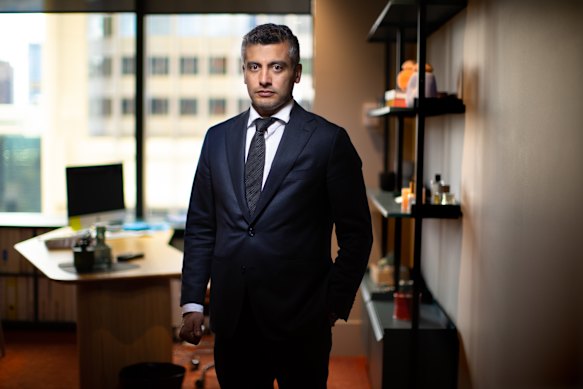
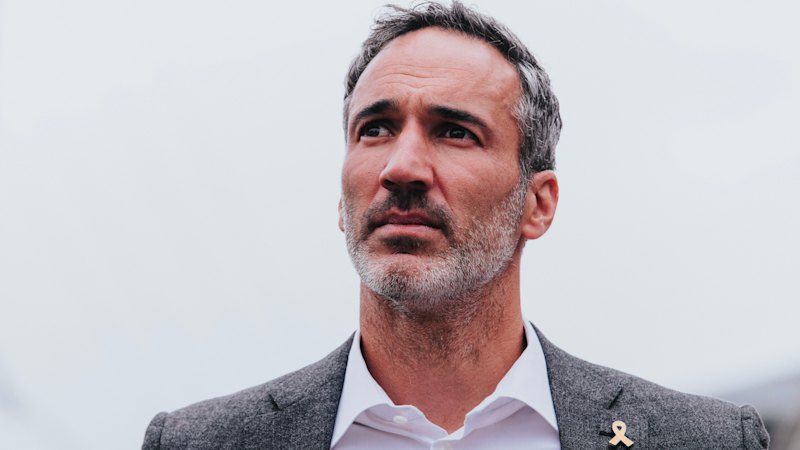
Barrister Rishi Nathwani, KC, is calling for a rethink on the handling of shaken babies cases.Credit: Simon Schluter
In response, the directors of public prosecutions in Victoria, NSW, Tasmania, South Australia and Queensland indicated they would make no change in their standard approach to assessing cases. The ACT director had no comment, saying the question was hypothetical.
Defence barrister Rishi Nathwani, KC, who successfully defended a shaken baby case in a jury trial last year, said it was time state and territory authorities examined the medical evidence underpinning prosecutions.
“Around the world there have been miscarriages of justice relating to allegations of baby shaking,” said Nathwani, who is based in Melbourne.
“It is time for the director of public prosecutions to take action to protect citizens and family members from allegations based on such controversial science. On any view, to shake or assault a child is terrible and abhorrent. However, false allegations based on questionable science that rips families apart is just as deplorable.”
There are about 20 shaken baby cases diagnosed in Victoria alone every year, and this masthead and its podcast Diagnosing Murder have revealed details of several where families lost access to children and faced criminal prosecutions on evidence too weak to sustain the original accusation of abuse.
A highly anticipated judgment from New Jersey’s highest court tested the evidence of medical experts who insisted in two cases that fathers had shaken their babies and caused them harm. The doctors’ belief was based on the so-called “triad” of clinical findings at the heart of the shaken baby orthodoxy – subdural and retinal haemorrhages and swelling of the brain.
After considering in detail the history of the diagnosis, which was first proposed in the 1970s, six of the seven judges found it could not be considered scientifically reliable. They adopted the view that it was “more conjecture than a diagnosis because it is an option embraced once a diagnostician runs out of diagnostic options”. Since it could never pass the legal standard of beyond reasonable doubt, it could not be used in future prosecutions in the state.
Australian courts do not apply a reliability test to scientific evidence, which is generally provided by experts selected by either the prosecution or the defence. Unlike other witnesses in criminal cases, experts can express opinions. Judging the credibility of competing experts’ scientific views is a job for the jury.
Australian Academy of Science chief executive Anna-Maria Arabia said last year in remarks unrelated to shaken baby syndrome that this approach made Australian courts vulnerable to junk science.
“Every member of the public should be concerned about a justice system that is not adequately informed by science,” Arabia said.
However, when this masthead asked state and territory prosecution agencies if they were still happy to run shaken baby cases, those that replied restated their existing policies. It is not known whether those existing policies would lead them to consider the judgments of overseas courts.
None answered as to whether they would institute an inquiry into their approach.
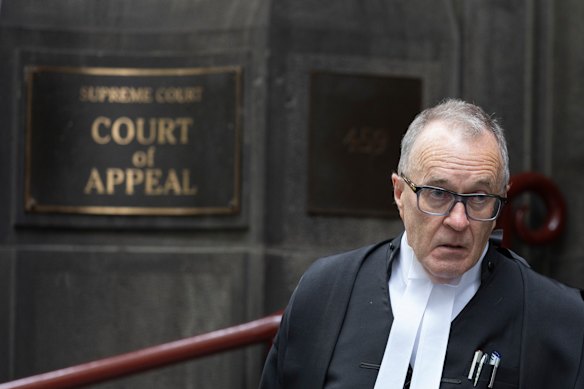
Victorian Director of Public Prosecutions Brendan Kissane, KC.Credit: Jason South
Through a spokesperson, the Victorian director said: “We confirm that every case is assessed on its merits and may only proceed if there are reasonable prospects of conviction and that a prosecution is in the public interest. In conducting the relevant assessment, all the evidence is considered, which includes, but is not limited to, medical opinions.”
The NSW office of the DPP had a similar response, saying the tests of reasonable prospect of conviction and the public interest were “applied in every matter on the facts and evidence available in the particular case.
“In deciding whether to prosecute, the public interest is the paramount consideration. It has never been the rule that whenever sufficient evidence exists, a prosecution must take place,” the director said.
The office of the Queensland director said it considered each matter on its merits, “including the available medical evidence”, and the Tasmanian office said: “The DPP considers evidence on a case by case basis.”
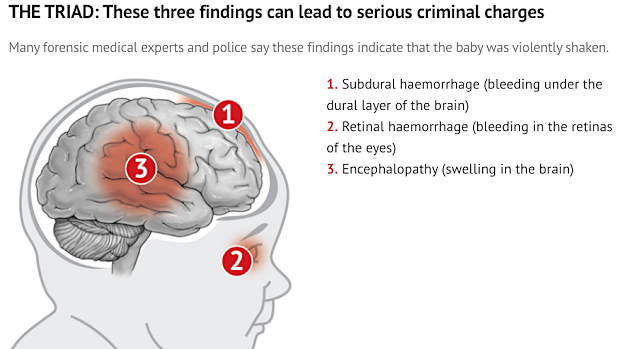
The signs forensic experts have relied on as evidence of shaken baby syndrome.Credit: The Age
The South Australian director said homicide cases involving baby shaking would be handled in “the normal way”. Experts giving evidence would be expected to address the latest research in their field.
The Northern Territory and the ACT declined to comment. West Australian prosecutors were approached.
In Victoria in recent years, the DPP has at least twice withdrawn criminal charges against men – in one case after pursuing a man over the death of his child for a decade – after new defence expert evidence cast doubt on the medical diagnosis of shaking. No compensation or apology was offered.
Diagnosing Murder also revealed that a jury acquitted a man, David, in another child homicide case last year. In that trial, the evidence of an expert doctor from the Royal Children’s Hospital’s Victorian Forensic Paediatric Medical Service (VFPMS) was demolished in cross-examination by Nathwani. The trial also revealed how police had refused for years to gather statements from treating doctors with a contrary view.
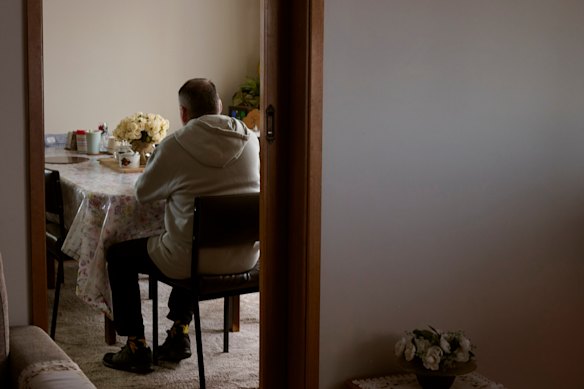
David was acquitted of baby shaking in a Supreme Court trial last year.Credit: Josh Robenstone
Respected forensic pathologist Stephen Cordner has raised serious questions about a fourth case, in which a young man, Jesse Harvey, spent six years in prison after his baby had a seizure and became ill. Cordner has called for an independent inquiry.
Doctors from the VFPMS, who are proponents of shaken baby orthodoxy, initially diagnosed shaking in all these cases and then gave evidence for the prosecution.
In the UK, the Court of Appeal ruled in 2010 that cases based on the triad should be considered with considerable caution. The country’s Crown Prosecution Service later held an inquiry and ruled the “triad” of clinical signs “is rarely conclusive of NAHI (non-accidental head injury)” so prosecutors “should look for other, supporting evidence”. Non-accidental head injury is another term for shaken baby syndrome.
Nathwani said Australia should adopt a similar policy.
“Just in the last few years, allegations made by VFPMS have resulted in families being ripped apart pending the outcome of the criminal process,” he said.
Most Viewed in National
Loading