3 months ago
17
3 months ago
17
When the Powerhouse Parramatta opens next year, it won’t just be the largest museum in NSW. It will be the first real test of a $1.3 billion-plus cultural experiment, a decade in the making.
The Museum of Applied Arts and Sciences – founded in the spirit of the European Enlightenment and the 19th-century fairs of design, technology and science – is about to remake itself in a new, purpose-built home in one of Australia’s most populous and fast-growing regions.
Construction giant Lendlease has begun the phased handover of the Moreau Kusunoki-designed building’s two main exhibition halls, as chief executive Lisa Havilah locks in a rotating schedule of massive, immersive, temporary blockbuster shows.
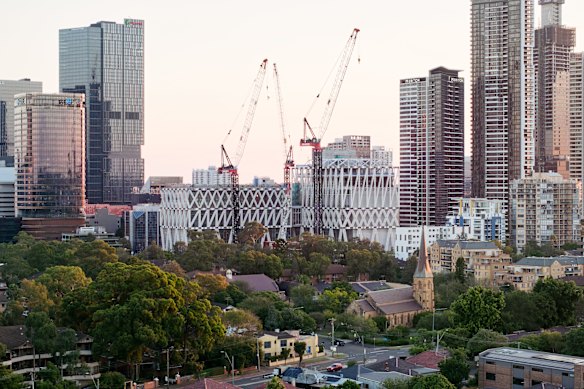
The Powerhouse is due to open its doors in Parramatta next year.Credit: Rory Gardiner with Colby Vexler
Under Havilah, the new Powerhouse is primed for the TikTok generation, for audiences who may have felt excluded from traditional institutions, and for multicultural communities largely absent from the museum’s collection.
In these respects, Havilah sits at the vanguard of a cohort of cultural leaders rejecting the “neutral temple of expertise” model in favour of self-aware museums that foreground multiple perspectives and points of view.
The Art Gallery of NSW, Australian Museum and National Gallery of Australia have all flirted with these postmodern ideas – from Mike Hewson’s Tank Gallery playground to Lego-built exhibitions – but none occupy a building designed expressly to “upend the hierarchy of the museum”, as Havilah puts it.
Critics argue that she has abandoned the museum’s core business and legislated core purpose in pursuit of “shallow entertainments”, dismissing the Powerhouse as “Carriageworks west”, the multi-arts centre she once led.
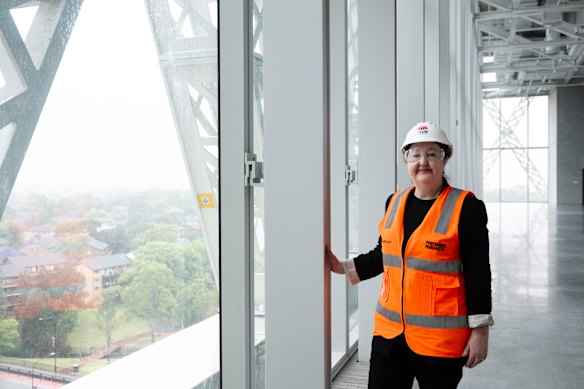
Powerhouse chief executive Lisa Havilah tours the construction site in October.Credit: Janie Barrett
Many of the controversies plaguing the Powerhouse – allegations of overspending, the marginalisation of curatorial and conservation teams – at least partly stem from this core battle and the political decisions that reshaped the museum’s future.
A bold statement
Parramatta will become the Powerhouse’s fourth home in 150 years. The original Garden Palace museum burned down in 1882. And in the early 1980s, the Wran government relocated the institution to the repurposed Ultimo Power Station.
In 2014, then NSW premier Mike Baird dropped a bombshell: he planned to relocate the Powerhouse to a parking lot on the Parramatta River to deliver western Sydney its first dedicated cultural institution. The announcement sparked protests, several inquiries, and policy backflips. Labor ultimately inherited the project, pledging to complete the Parramatta build and committing to an Ultimo renovation. The combined price tag now tops $1.4 billion.
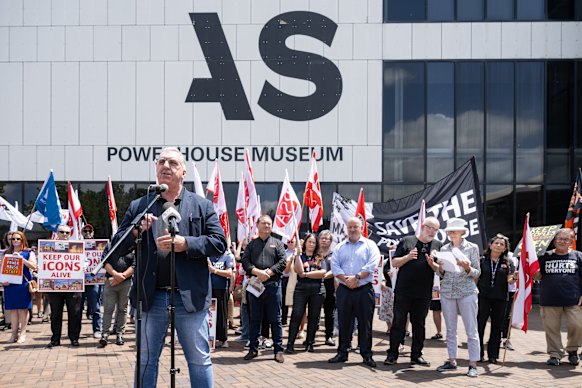
Public Service Association members protest at the Ultimo museum in early 2024.Credit: Louie Douvis
The new Parramatta headquarters – dubbed the milk crate by locals – will offer column-free spaces for five opening exhibitions, the largest of these the size of an aircraft hangar. “Not a church, not a cathedral but a basilica,” Powerhouse chairman David Borger says.
It will also house a demonstration kitchen, a 55-seat cinema, retractable theatre seating for 600, bunk accommodation for school groups, and a rooftop garden with greenhouses and telescopes. Several spaces will be available for commercial hire, including product launches, conventions and keynote addresses.
“What I like about the place is that it has been designed with artists and audiences in mind,” says Alex Poots, director of New York’s The Shed, an early inspiration for the Powerhouse and leader of community engagement and “democratic” programming. “It feels impressive, but it doesn’t feel ominous. It doesn’t feel like this place isn’t for me because it’s got these steps leading to this kind of effigy.”
But an Australian version of the Smithsonian – a la Ben Stiller’s Night at the Museum – it is not.
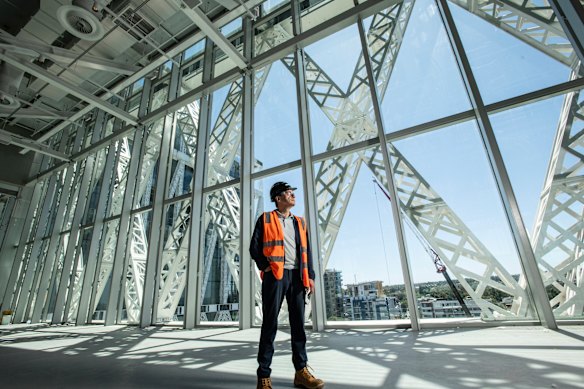
Alex Poots, artistic director of New York’s The Shed, inside the Powerhouse. Credit: Steven Siewert
What it will not have, unlike Ultimo, is a permanent collection display or on-site storage. Its collection – numbering more than half a million objects recording grand events and small from Australian history and once held at Ultimo – now sits in the expanded Castle Hill facility. A Coalition promise to create a dedicated STEM museum has quietly evaporated; the Powerhouse removed the word “museum” from its brand three years ago.
“What the people of western Sydney are effectively being told is that we don’t have the attention span for a real museum experience – something on the level of the Smithsonian, which was promised. So instead it appears we are being handed a dumbed-down version,” says heritage campaigner Suzette Meade.
“It’s like selling tickets to a blockbuster film and then showing the audience a TikTok; it’s frankly insulting, especially when we are completely ignoring the enormous demand in the visitor economy for authentic experiences, something Parramatta has in absolute abundance with multiple significant world and nationally listed heritage sites.”
Plans for a planetarium were superseded by an $8 million-plus immersive art installation by leading global designer Es Devlin, one of five global art commissions that have fuelled claims that Powerhouse Parramatta will function more as a contemporary arts venue than a museum.
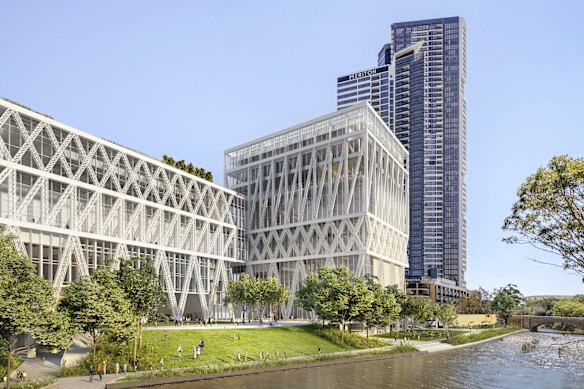
An artist’s impression of the Parramatta Powerhouse.Credit: Museum of Applied Arts and Sciences
“Powerhouse is becoming an exhibition space like Carriageworks, not a museum that hosts exhibitions,” one insider says. Havilah contends that their charters and homes are incomparable.
Museum curators and conservators have also complained, via their union, that they have been sidelined for “artistic associates” – including chefs, writers and photographers – with limited knowledge of the collection. The appointment of a Heartbreak High actor as a guest curator of a textiles exhibition prompted a complaint from the peak public sector union to Arts Minister John Graham.
Former executive staffers told a recently convened parliamentary inquiry the scholarly research and documentation of the collection was being downgraded at great risk to the museum’s standards of professionalism and its education mission.
They nominate dozens of specialist positions they say have been deleted over the last two decades through attrition, budget cuts and restructures.
Controversy has also engulfed the Powerhouse’s first literary publication, a memoir by playwright S. Shakthidharan. Havilah defends it as a crucial western Sydney migration story to be highlighted in its opening program.
Former trustee Kylie Winkworth says it falls well outside the museum’s legislated remit, let alone the promised Science, Technology, Engineering and Maths focus, when so many literary organisations and publishers in western Sydney and the State Library of NSW have the same job.
“If Sydney needs another contemporary art museum, the minister should say so and change the Museum of Applied Arts and Sciences Act instead of allowing this long-running museum heist to reach its destructive unguided conclusion,” she says. “No wonder they’ve dropped the museum word from the brand.”
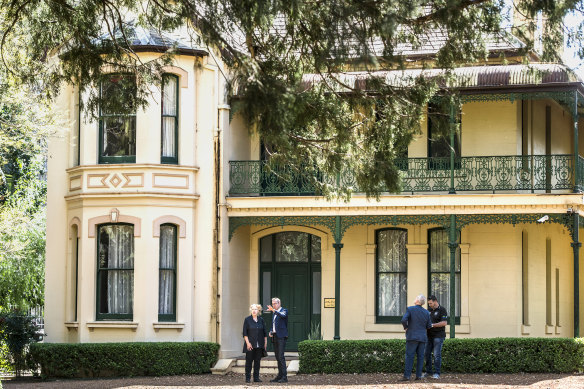
The Italianate villa Willow Grove was demolished to make way for the Powerhouse.Credit: Steven Siewert
Spectacle and spending
The 21st century has hit the culture sector like a juggernaut, with shifts in demographics and changes in audience expectation, says Dr Gus Casely-Hayford, director of the new offshoot of London’s Victoria and Albert Museum.
Museums have no option but to be bold, he says, to change up programs, develop new audience strategies and build in new neighbourhoods.
“Powerhouse is in the vanguard, part of a generation of institutions around the world who are enfranchising young and diverse audiences through transformational contact with wonderful things. I salute them,” he says.
Borger says: “Some people are going to be lining up at the front door to get in, and other people will be looking gingerly across the bank wondering what’s inside it. I think museums have to work harder, we have to drag people’s eyeballs off their screens and from across the bank to dive into our enormous collection of stories.”
The museum’s opening blockbuster, Task Eternal, is built around a sci-fi novella and will feature loans from the Smithsonian and the British Museum, NASA rockets and Charles Kingsford Smith’s Southern Cross, suspended from the rafters.
Running for two years, the exhibition will rotate elements to encourage repeat visits before the hall is turned over for periods of commercial and community use.
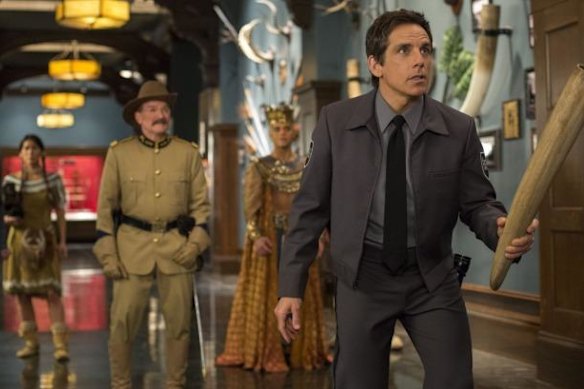
Ben Stiller in the film Night at the Museum.Credit:
The price tag all up for this blockbuster: $18 million-plus, more than double the Art Gallery of NSW’s total budget for opening shows at Sydney Modern. Upstairs, The Mall is a $15 million-plus deep dive into the psychology of the shopping centre, showcasing Australian brands. For younger audiences, The Dark is led by award-winning theatre director Kip Williams.
Havilah says her goal is to create “broader collaborative pieces of work” that unite art, fashion, science, design, technology and industry and are aided by modern technology, which is transforming audiences and museums from spaces of looking and learning to spaces of interaction, participation and engagement.
Havilah stresses that 2500 objects from the Powerhouse’s collection will appear in the opening shows, some never on public display before. These objects will sit alongside hundreds of others from important museum collections across Australia and the globe.
“You can move into one room that is completely interactive or immersive, but there might be something completely behind glass in another room ... It’s not an either-or,” she says.
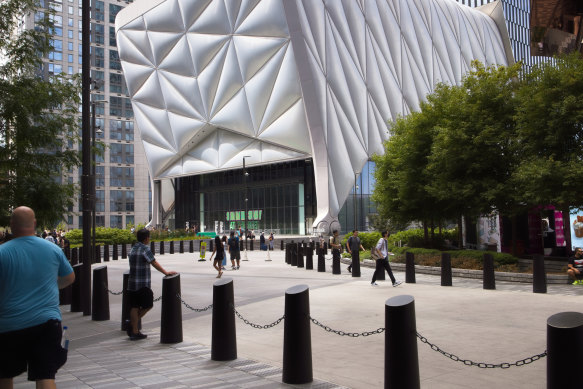
New York’s The Shed: The building can expand or contract thanks to a telescoping outer shell.Credit: iStock
“It’s like upending the hierarchy of the museum so it’s in the service of story, in service of the community and in service of industry. Opening up the museum to create worlds are part of our legitimate mission that the government has given us to do.”
As an example, the Powerhouse is collaborating with Blacktown’s We Are Studios to rethink the way stories of disability are shared, moving beyond the technological achievement of the cochlear implant to the lived experiences of the deaf community.
As a “museum born of its time and place, representing a generational shift in international museum practice”, Havilah says the Powerhouse will eschew the traditional show-and-tell model of display and object labelling: “Within Powerhouse Parramatta exhibitions you will hear directly from the person who innovated within their industry, that created the object and who directly experienced a moment in time,” she says.
Loading
Younger audiences weaned on social media don’t care anyway for the shingle on the building, Poots says. “They don’t know if The Shed is a museum or an art gallery or a concert hall, but they know that Bjork’s playing there.”
But this model and pivot into creative industries brings financial and ethical challenges. Traditional museums rely on predictable, curator-led costs. The new approach demands digital producers, videographers and outside creatives as well as endlessly rotating and immersive displays – expensive roles and modes for a state institution, even one expected to generate significant commercial revenue.
A museum for whom?
The Powerhouse has the potential to shift how western Sydney sees itself – and how the rest of Sydney sees the region. Novelty will drive crowds, and it will probably exceed its 2 million-visitor first-year target. Havilah and her team will, however, need to walk a fine line between embedding the institution in its community and catering to interstate and international visitors drawn by a new airport. That delicate task was made harder by the decision to retrofit the Powerhouse to the Parramatta riverside.
The new Powerhouse might have looked much different had previous directors had time to plan and research what western Sydney needed and “not treated the Powerhouse as a trophy or football”, as one told the Herald.
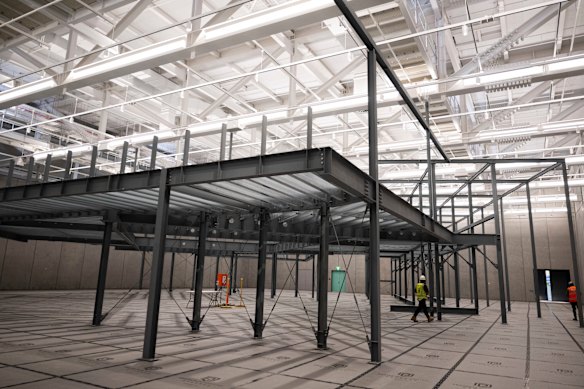
The new Powerhouse (pictured in late October 2025).Credit: Janie Barrett
The Public Service Union says a “decade of trauma” to its members and the community could have been avoided if the government had heeded its advice and established the museum in Parramatta without gutting Ultimo.
“However, it is never too late. The museum everyone loved can be re-established at its flagship location of Ultimo,” the union says.
The building’s scale is also a concern. Political promises to build the biggest and best have resulted in a large, some say oversized, building. Filling it will weigh heavily on future state budgets, and likely necessitate operational funding far greater than for any other state cultural institution if show entry is subsidised. The Art Gallery of NSW, now forced to slash 44 staff to plug a $7.5 million shortfall, stands as a cautionary tale of the pressures that follow an opening.
“Let’s be real here,” says one sceptical Powerhouse staffer. “The art crowd of London and New York are not coming to Parramatta. This museum was intended for the people of western Sydney ... and at this rate, they won’t be able to afford the ticketed shows.”
‘You can move into one room that is completely interactive or immersive, but there might be something completely behind glass in another room ... It’s not an either-or.’
Lisa Havilah, chief executive of the Museum of Applied Arts & SciencesBuoyed by five new hotel openings in Parramatta in the next 12 months, Borger predicts the city will be an international tourism destination by the end of the decade.
Locally, there has also been rising disquiet that the Powerhouse food programs are pitched to elites, be it gelato-making videos or curated food tours. “It’s ‘here, let’s poke the cute bear in the zoo’ kind of stuff,” says one Powerhouse insider. Another describes the internal consternation as this: “Would a western Sydney kid go on a school excursion to learn about sustainable stir-fry cooking from Kylie Kwong or go to an immersive experience on sound?”
The loss of local heritage also stings. The historic Willow Grove villa was demolished in 2021 to make way for the Powerhouse. Meade, who led the protest, says: “All I see is a huge convention centre where we could have the Museum of NSW.”
Loading
Havilah says engagement has been extensive, with 102 collaborators from western Sydney, 117 from NSW, 90 nationally and 97 internationally. She points to the institution’s participation in the Parramatta Lanes festival, its Sydney Science Festival Family Day and hundreds of schoolkids who took part in a program to address heat in schools.
Cultural commentator Professor Andy Marks says the museum has connected well with corporate partners but must give disadvantaged communities greater agency.
“The idea of a science-led institution was never a concept that captured the imagination of western Sydney. What got people excited was that it was an institution that it could shape.
“That means the most disadvantaged members of the community in the region need to be at the top of [the] list of those the museum speaks with. They may be doing that, but I don’t see it. There is so much for any institution, large or small, to learn in western Sydney.”
Start the day with a summary of the day’s most important and interesting stories, analysis and insights. Sign up for our Morning Edition newsletter.