
Bahrain confirms it air defenses shot down "3 missiles and a number of drones" fired by Iran
Bahrain's military condemned on Wednesday what it called Iran's ongoing "systematic hostile approach through its sinful attacks using missiles and drones targeting civilian objects," hours after the U.S. military said it launched strikes on an Iranian military facility in retaliation for Iranian missiles fired at Kuwait and Bahrain.
Central Command said earlier that U.S. and Bahraini forces had intercepted missiles aimed at Bahrain, after Iran's Revolutionary Guard Corps claimed to have targeted the headquarters of the U.S. Navy's 5th Fleet, which is based in Bahrain, and another country in its attack, without naming Kuwait.
Bahrain's military command said it stood ready to repel any further attacks with "strong will and high combat readiness," confirming that its air defense systems "were able to intercept and destroy 3 missiles and a number of drones" fired by Iran overnight.
Kuwait says at least 63 people wounded in Iranian attack on airport
Kuwait's health ministry said Wednesday that "a full-scale health emergency was declared" after at least 63 people were wounded by an Iranian drone and missile attack on the country.
The Kuwaiti foreign ministry confirmed earlier that one person was killed in the Iranian attack.
Ministry of Health spokesman Dr. Abdullah Al-Sanad said in a statement released by the agency that "63 injured individuals" were admitted to hospitals in Kuwait City and seven "urgent major surgical operations" were carried out after the attack, which included weapons hitting the capital's main airport.
"Emergency medical teams, supported by 25 ambulances, were dispatched to Kuwait International Airport to conduct on-site triage, provide urgent care, and transport the injured to hospitals," Al-Sanad said, adding that the casualties included civilians, airport personnel, and passengers, "ranging from severe trauma such as fractures, head injuries, intracranial hemorrhages, limb amputations, blast injuries, and smoke inhalation."
Kuwait says one person killed, others wounded in "brutal and ongoing Iranian attacks" on civilians
Kuwait's Ministry of Foreign Affairs voiced its "condemnation and denunciation" Wednesday over "the brutal and ongoing Iranian attacks by ballistic missiles and drones, the latest of which occurred at dawn today and once again targeted civilian and vital facilities, including Kuwait International Airport, resulting in the death of one person and the injury of others, in addition to damage to vital facilities, including diplomatic missions."
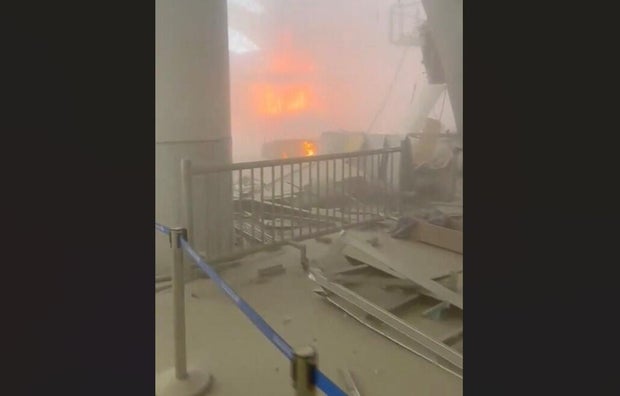 Debris lies on the floor as fire burns in the background, in the aftermath of Iranian strikes, according to the foreign ministry, at Kuwait International Airport in Kuwait City, Kuwait, June 3, 2026, in a still image obtained from a social media video.
Social Media/via REUTERS
Debris lies on the floor as fire burns in the background, in the aftermath of Iranian strikes, according to the foreign ministry, at Kuwait International Airport in Kuwait City, Kuwait, June 3, 2026, in a still image obtained from a social media video.
Social Media/via REUTERS
The statement from the ministry said Kuwait reserved its "full and inherent right to take appropriate measures in response to these sinful and repeated Iranian attacks, in a manner consistent with international law."
Iran's Revolutionary Guard claims it hit U.S. bases in Kuwait in retaliation for latest American strikes
Iran's Islamic Revolutionary Guard Corps claimed Tuesday to have struck U.S. military bases in Kuwait, causing the "destruction of targets and the ignition of fires," in retaliation for the latest American strikes on Iran overnight.
The IRGC "carried out precise and concentrated missile strikes against the military bases of the American occupiers in Kuwait, resulting in the successful destruction of targets and the ignition of fires in the fortresses of the aggressors," the paramilitary force declared in a statement, warning that any further U.S. attacks "will be met with a shocking, crushing, and decisive response that goes beyond conventional rules and limits"
The U.S. military's Central Command said earlier that it had "downed multiple drones" targeting American forces in Kuwait, and Kuwaiti authorities confirmed Iranian weapons had hit the country's main airport, causing damage and casualties.
Iranian drones hits Kuwait airport, causing injuries
Kuwait said Wednesday it had suspended commercial flights after an Iranian drone attack hit the country's airport, injuring a number of people hours after Iran and the United States traded missile strikes in the region.
The attacks came after Iran stopped communicating with mediators about extending a ceasefire in the war with the U.S. and Israel, according to reports Tuesday from two semiofficial Iranian news agencies. President Trump disputed that claim and said talks were continuing.
Defense Ministry spokesperson Brig. Gen. Saud Abdulaziz Al-Otaibi said that "a number of hostile drones" had targeted Kuwait International Airport's passenger building, severely damaging the building and injuring "a number of individuals."
The airport reopened on June 1 after closing due to the Iran war.
Late Tuesday, the U.S. military said it had launched strikes on an Iranian military facility in retaliation for Iranian missiles fired at Kuwait and Bahrain. It said Iran had fired two missiles at Kuwait that fell apart en route, while U.S. and Bahraini forces intercepted missiles aimed at Bahrain. U.S. Central Command also said it had "downed multiple drones" targeting American forces in Kuwait.
Iran's paramilitary Revolutionary Guard said it had targeted the headquarters of the U.S. Navy's 5th Fleet in Bahrain and another country in its attack, without naming Kuwait. It said it launched its attack in response to the U.S. firing a missile into the engine room of an oil tanker that was trying to reach Iran despite the U.S. blockade.
Central Command said it responded with strikes on an Iranian military ground control station on Qeshm Island in the Strait of Hormuz.
Iran's Fars and Tasnim news agencies, both believed to be close to the Guard, reported that Iran's negotiators have stopped communicating with ceasefire mediators as tensions flared in Israel's separate but related fight against the Iranian-backed Hezbollah militia in Lebanon.
Oil prices rise on doubts over Iran deal, stocks build on tech rally
Oil prices extended gains Wednesday as Middle East peace talks stuttered, though stocks mostly rose on the back of continued demand for all things linked to artificial intelligence.
Despite President Trump's assurances that the U.S. and Iran are edging closer to ending their three-month-long war and reopening the Strait of Hormuz, crude investors appear unmoved as they await solid progress.
Uncertainty about a peace deal pushed oil prices up more than 1%, with both main contracts up around 5% this week.
However, stocks extended their breathtaking rally, fueled by the tech sector and demand for artificial intelligence. Tokyo climbed more than 2%, helped by a more than 11% surge in chipmaker Tokyo Electron, while Advantest also jumped.
Taipei was up a similar amount thanks to Taiwan Semiconductor Manufacturing Company's strong advance.
Shanghai, Sydney, Singapore and Manila were also up, though Hong Kong, Wellington and Jakarta retreated. Seoul was closed for a holiday.
The gains followed another record for the S&P 500 and Nasdaq on Wall Street, where chipmaker Marvell Technology soared more than 32% after Nvidia CEO Jensen Huang hailed it as the next trillion-dollar firm.
Adding to the upbeat mood among equity traders was data showing U.S. job openings jumped in April to their highest level in 23 months.
The reading comes ahead of employment data on Friday that could determine if the Federal Reserve will keep its benchmark rate stable or potentially hike borrowing costs to fight inflation.
U.S. military says it conducted "self-defense strikes" against Iran in response to attacks across Middle East
The U.S. military said it conducted more "self-defense strikes" after shooting down Iranian missiles and drones in the latest test of the ceasefire.
U.S. Central Command said its forces struck an Iranian military ground control station on Qeshm Island and multiple other targets in response to attempted attacks by Iran across the Middle East on Tuesday.
"Iran launched several ballistic missiles toward regional neighbors; however, all failed to hit their intended targets," CENTCOM said in a statement.
No U.S. personnel were harmed, CENTCOM said.
U.N. chief proposes options to help end conflict between Israel, Hezbollah
The United Nations chief has proposed three options to help end the decades-old conflict between Lebanon's Iran-backed Hezbollah militant group and Israel when the 8,100-member U.N. peacekeeping mission in southern Lebanon ends on Dec. 31.
All of the options presented to the U.N. Security Council by Secretary-General Antonio Guterres would continue U.N. military monitoring of the boundary between Israel and Lebanon, support Lebanese forces in deploying throughout the country and strengthen political efforts to end the fighting, which has persisted despite a nominal ceasefire.
In his letter to the Security Council on Monday, Guterres said U.N. military monitoring of the U.N.-drawn boundary between Israel and Lebanon, known as the Blue Line, was "paramount."
Guterres proposed three options for the U.N. military force, ranging from 1,980 to 5,525 personnel, including some unarmed military observers. He said the largest force would be able "to most credibly observe developments along the length of the Blue Line."
U.N. spokesman Stephane Dujarric told reporters Tuesday that the secretary-general hopes the Security Council will make a decision soon.
Energy experts say gas prices are likely to remain high for months
American motorists would face pain at the pump for months even if the U.S. and Iran strike a peace deal and move quickly to reopen the Strait of Hormuz, according to energy experts.
"It is all contingent on when boats start moving through the Strait of Hormuz," GasBuddy petroleum expert Patrick De Haan told CBS News. "If and when that happens, it will be a very long, multi-month to multi-year process for things to fully normalize."
Across the U.S., a gallon of regular gas on Tuesday sold for an average of $4.29, down from more than $4.50 in May, according to AAA. Gas averaged $2.98 a gallon just before the U.S. and Israel attacked Iran at the end of February.
"We won't see those levels until potentially mid-to-late 2027," De Haan predicted, referring to pre-war fuel prices.
Negotiations with Iran are "going on continuously," Trump says
President Trump dismissed claims Tuesday by Iranian state media that Iran and the U.S. had stopped negotiating indirectly via mediators as "false and erroneous."
"The conversations between us have been going on continuously, including four days ago, three days ago, two days ago, one day ago, and today," Mr. Trump wrote on Truth Social. "Where they lead, one never knows, but as I told Iran, 'It's time, one way or another, for you to make a Deal. You've been doing this for 47 years, and it cannot be allowed to go on any longer!'"
Trump said Iranian media were incorrectly reporting that negotiations had ended a day after Iran's semi-official Tasnim news agency, which is closely linked to the country's Islamic Revolutionary Guard Corps, said Tehran had halted the dialogue with the U.S. due to Israel continuing its war against Hezbollah in Lebanon.
Iran's semi-official Fars News agency then said on Tuesday that the exchange of messages between Iran and the United States via mediators had stopped several days earlier.
Fars quoted an unnamed "informed source" as saying the last message sent by Tehran to Washington conveyed a clear stance regarding Iran's demand for an end to Israel's fight with Hezbollah as part of any agreement between Washington and Iran's leadership.
"The exchange of messages between Iran and the U.S. has been suspended for at least a few days for what is called the initial memorandum of understanding" between the countries, Fars said.

















































