3 months ago
38
3 months ago
38
Gisèle Pelicot is very clear about her reason for writing a book, she says; she wants people to know her better. Her name is recognised worldwide; people have learnt, in grim, almost unimaginable detail, of the abuse she suffered at her husband’s hands over the course of almost 10 years. They have also seen how resolutely she dealt with it. What she reveals in her book, however, is something else, something more profound, personal and elusive.
A Hymn to Life begins on November 2, 2020, the day when police officers informed Pelicot that her husband, Dominique, had been regularly drugging her, and raping her while she was unconscious; that he had brought scores of men to their house to rape her and that he filmed and photographed it. By the time the case went to trial in Avignon, in southern France, in September 2024, the story had become news around the world. It was not only because of the horror of what happened: it was also because Pelicot was prepared to forgo the anonymity to which she was legally entitled and call the perpetrators to account for what they did to her.
The world watched and admired her. And that is part of what she wants to address, she tells me. “When people saw me in court for those 3½ months, they didn’t really know me. I thought that this book would help them to understand who I was, and how I was able to recover from the terrible things I went through.”

We are talking over Zoom, while Pelicot is in London promoting her book. She is quick, focused, clear about what she wants to say. For her, A Hymn to Life is in part “a homage to my parents. A look at the paths taken by three generations of women, my grandmother, my mother and me … I wanted to convey this because it’s partly from them that my joie de vivre has come.”
She recalls the texture of the quotidian, of a rural childhood: her grandmother “making cheese in the cellar, pulling the scalding laundry from the tub”, her beloved mother, who died of cancer when Gisèle was nine, and whose warmth and smile she still invokes. Her melancholy father, a soldier; her cold and punitive stepmother. At the age of 18 Pelicot met Dominique, who was the same age, and seemed to offer her companionship and affection. Marriage followed, children, a career. There were fault lines in the relationship and financial troubles. Finally, they arrived at what was meant to be a peaceful retirement in Mazan, a small town in France’s south-east.
Following the police investigation, she began to re-examine the previous 10 years. She learnt that Dominique had been drugging her since 2011, administering sleeping pills to knock her out and a muscle relaxant to ensure that her body did not resist when he raped her. Some time after this he joined an online chat group called À son insu (without her knowledge), and brought other men to their house to do the same.

Her book highlights how much these drugs undermined her daily life. They affected her health, her memory, her balance, her energy, her independence. She was no longer able to drive. She had memory gaps, she was often exhausted and in pain. She wondered if she was suffering from the illness that killed her mother. Her husband accompanied her to doctors, who canvassed everything from Alzheimer’s to a stroke. All the while, he seemed to be the most supportive and caring of husbands.
“He had no pity,” she says. In the end, she suggests, matter-of-factly, “I’m lucky to be in good health because I went through 10 years of medical misdiagnoses, of searching for answers.”
On the day the police showed her a fraction of the evidence they had already compiled, she called her daughter, Caroline, and her two sons, David and Florian, to tell them. A Hymn to Life chronicles the pain of a family coming to terms with the unthinkable and struggling to make sense of it all. There was additional trauma for Caroline, who learnt that her father had secretly taken pictures of her. She believes he drugged and abused her, too. She became an activist on behalf of abuse victims who had been chemically sedated. And for a while, she distanced herself from her mother.

“Things are better,” Pelicot says. “It takes time to heal, a lot of time, but we’re all on the right track right now. We’re together, and we’re trying to move forward. My daughter got back in touch with me just before Christmas, we talk a lot. Caroline and I were very, very close before, and I missed her a lot during that time. We need each other, and it’s important to say that. And to say that we truly love each other and that we’re reconnecting. My sons too, of course, and my grandchildren as well.”
The way Pelicot engages with her past is striking; her determination not only to re-examine the life she thought she was leading but also to hold on to some of it. “Everything was splintering. Objects, our history. Us,” she writes, describing what happened when her children helped her move out of the family home, and they started throwing things out, willy-nilly. There were items she wanted to keep. And, she discovered, there are memories she wanted to retain, aspects of her earlier life that still felt significant. It’s a complex, challenging notion. “I needed to explain, I dared to hope,” she tells me, “that those 50 years with Monsieur Pelicot had not simply been a lie. I needed this in order to continue living.”
She found herself thinking about feelings of shame, and the part they played in her life. Her book is subtitled “Shame has to change sides”, a feminist injunction that perpetrators should feel shame rather than victims.
The word recurs through the book. She understands it as part of her experience. If these events had taken place 20 years earlier, she thinks she might not have opted for an open court. There’s a good chance, she says, that “I wouldn’t have had the strength to do it because I would have been afraid of the stares, afraid of society’s judgment. The thought of being watched was very difficult for me.”
Writing the book had its confronting moments. She often found herself in tears as she dug deep into her memories. But working with her co-writer, Judith Perrignon, was “a beautiful experience”, she says. She invited Perrignon to stay in her home. “I wanted her to know how I went about things, what my daily habits were. And I also wanted her to know about my appetite for life … Often people said to [Judith], ‘Oh la la, it can’t be easy to do a book with Gisèle Pelicot’, and she would say to them, ‘You’ve got it wrong, she has a good sense of humour!’”
Writing “was a kind of therapy, of course”, but only part of the process. “I also learned about myself through the moments of solitude I went through, when I lived in isolation on Île de Ré” , a small island off the Atlantic coast. The place became a retreat in the midst of the surrounding chaos. Then she met someone there: Jean-Loup Agopian, who has become her partner. Her face lights up when she talks about him. “The important thing is that you can fall in love again, even at the age of 73. And this meeting has changed my life. We’re both very happy. I’m calm, fulfilled, at peace.”

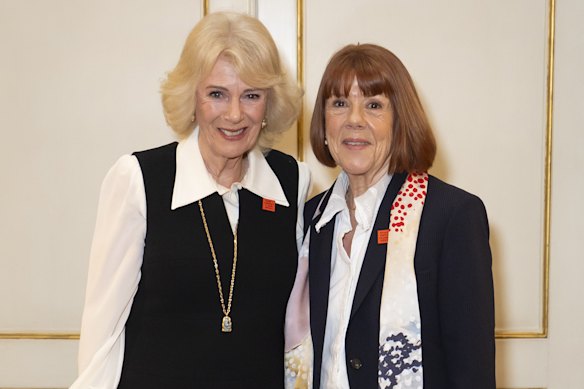
She talks about the ways that she felt supported in so many ways during the trial. “I don’t know whether you noticed,” she says, “but I’m wearing the scarf that a group of women from Australia gave me.” She takes it from around her neck and holds it up. It is designed by Martu artist Mulyatingki Marney, and was sent to her by organisation called Older Women’s Network NSW. “I wore it in Avignon. They sent me their strength, their support. I felt connected to those women, and I wanted to thank them.”
A Hymn to Life has been published simultaneously in 22 countries, and she is very much in demand and in the public eye. The night before we spoke, Pelicot had been at a gala book launch at Royal Festival Hall, with readings by Kate Winslet, Kristin Scott Thomas and Juliet Stevenson. A couple of days later, she was invited to meet Queen Camilla at Clarence House.
“I was often called an ‘icon’ during the trial, but I don’t think it applies to me at all,” she says. “The word ‘awakener’ [the French word éveilleuse], was used about me by a historian on a television program, and I think that fits me much better.” She understands that circumstances vary, that victims’ needs can be very different. She doesn’t want to be seen as a symbol; she hopes that people might feel, “If she can do this, so can I.”
In October 2025, the French parliament voted to update rape laws to explicitly include the need for consent. It was a long-gestating change given impetus by what had happened to her. “Laws are good,” she says, “but it’s mainly about changing people’s ways of thinking … It’s a small step on a path where there is still a long way to go, We need education, respect, positive attitudes towards others.”
Some things remain unresolved for her, however. At the end of A Hymn to Life she writes about her wish to confront Dominique in prison. I ask if there is any chance she might change her mind. She is adamant that she won’t.
“It’s not that I need to see him, but I need answers. During the four or five years of the judicial process, I never spoke to him. And in the trial in Avignon I only addressed myself to the president of the court, I didn’t address him directly. I want to look him straight in the eye. I want to know, from him, why he harmed us, why he betrayed us.”
Dominique is now being investigated for two other cases, a rape and a murder, and she wants to confront him about that too. There is only way it won’t happen, she says. “Perhaps he won’t agree to see me.”
The Booklist is a weekly newsletter for book lovers from Jason Steger. Get it delivered every Friday.