3 months ago
21
3 months ago
21
Opinion
December 24, 2025 — 5.00am
December 24, 2025 — 5.00am
Mindanao, the second-largest island in the Philippines, has white beaches, turquoise waters, and a lush tropical hinterland. It could be up there among places vying for the Queensland tourism slogan; Beautiful one day, perfect the next. Except that tourism and indeed the island’s economy have been gutted by a decades-long Muslim insurgency, which is estimated to have cost more than 120,000 lives since 1990.
The island has a Muslim population as high as 20 per cent in some areas. Rival Islamist militant groups have carried out bombings, kidnappings and even beheadings, fighting with each other and the Philippine military, climaxing in a months-long showdown with the army in 2017.
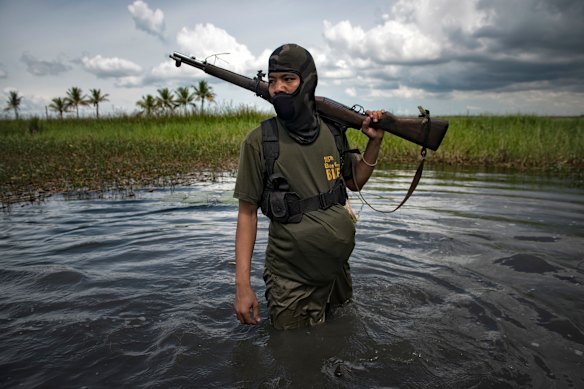
Soldiers being deployed to the front line of Islamic militant-held Marawi in 2017.Credit: Getty Images
But despite various battles and peace processes, the insurgents have never been vanquished entirely.
This is the reason there is so much focus on Bondi gunmen Sajid and Naveed Akram’s choice of Davao city in Mindanao for a month-long visit this November, two weeks before the Bondi shooting.
I was one of a handful of Australian journalists who visited the militant training camps in Mindanao at their height in the 1990s, on a reporting trip with my colleague Catherine McGrath for the ABC’s Foreign Correspondent program. We were on the island to interview rebel leader Nur Misuari, a Muslim academic who had set up the main insurgent group, the Moro National Liberation Front (MNLF) in 1972. It had a separatist agenda for the island’s Muslims, based on a more secular vision, reminiscent of Muhammad Ali Jinnah’s original ambitions for Pakistan.
By the time we were there in 1996, following nearly 25 years of the MNLF campaign, Manila was ready to set up an autonomous Muslim region on the island, the first official Muslim area in a Catholic country. Nur Misuari was ready to come in from the cold to run for governor.
The insurgency was broader than just the MNLF, of course. It was split into a variety of groups, most of them increasingly Islamist – and extremist. The largest and most well-known was the Moro Islamic Liberation Front (MILF). Note the almost identical names. Perhaps the most infamous of the militant groups was Abu Sayyaf, formed in 1991 after its founder Abdurajak Janjalani met Osama bin Laden in Afghanistan in the 1980s. By 2014, Abu Sayyaf was pledging allegiance to ISIS.
It was tense in Cotobato city ahead of the vote in 1996. The streets were empty at night. No one went out after dark without an urgent reason. The MNLF gave us “personal security” as we drove about town, an armed guard for protection and to keep an eye on what we were filming. Then the MILF agreed that we could visit Camp Abu Bakr, their main militant training camp and headquarters.
We drove north, up into the hills to a vast primitive jungle camp. Camp Abu Bakr was carved out of about 100 square kilometres of rainforest. Most buildings were of wood and bamboo. It was powered by a solar energy system. There was a weapons factory.
We saw hundreds of people, including women and children. There were jihadists from all over the world, including some Afghanis, and locals who had been to Afghanistan. I didn’t comprehend the significance of that back then, but within five years, post 9/11, I was reporting from Afghanistan myself and the connections became clearer.
“No filming!” shouted teenagers, their eyes shielded by sunglasses on a cloudy day, AK-47s slung over their shoulders.
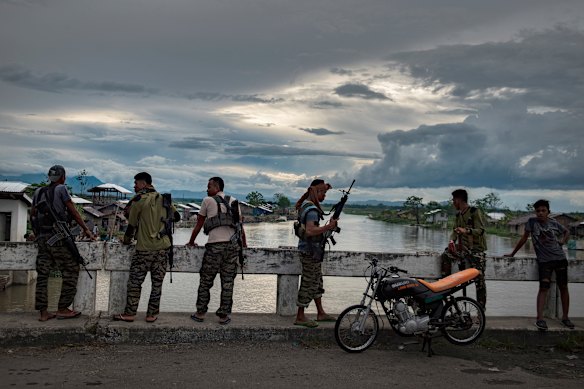
Moro Islamic Liberation Front fighters in 2017.Credit: Getty Images
I have a jumble of memories. My strongest impression was how wary and fearful everyone we encountered was. It was the first place in the Philippines where no one smiled, not even children. The other thing that’s stayed with me was that camp Abu Bakr had its own prisons. They were no more than holes dug into the earth, where a number of men were shut in together beneath a bamboo gate, with slats for air. It all felt very Heart of Darkness.
I also remember that our local fixer, a journalist called Alvin, had great jihadist contacts because he had been kidnapped himself. He said it was frightening because it was an Abu Sayyaf group, but once they’d let him go, his abductors were somehow transformed into sources, and he now called them to confirm details on new kidnappings or bombings.
“Once I made it out, it was good for me,” he said philosophically.
Four years later, in the year 2000, the Philippine military hit Camp Abu Bakr with airstrikes followed by a ground offensive. It was brutal – and successful. The Philippine military took the camp over and the militants fled further into the hills, forming into splinter groups based in smaller camps. It’s reported that some of the Jemaah Islamiyah militants who carried out the 2002 Bali bombing trained on Mindanao. Later, IS established a presence there too.
The Philippine government declared a state of emergency in 2017 taking on IS in a protracted five-month battle in the town of Marawi, not far from Davao city, where the Bondi gunmen stayed.
What were Sajid and Naveed Akram doing for a month in Davao city? “Training” with IS for their rampage – according to security sources.
Or booking into a hotel and “staying there”, according to hotel staff and Philippine officials keen to downplay the current role of militant groups in Mindanao.
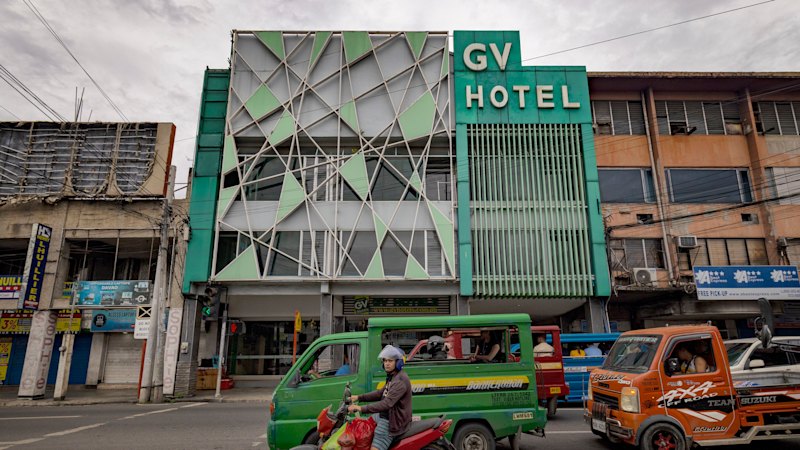
Either way, Davao city isn’t really a tourist hotspot – and the GV Hotel where Sajid and Naveed Akram washed up, paying cash week by week, is not a luxury destination. But it is practical if you’re on a job. Seven kilometres from the airport. Free Wi-fi. Cheap. Seven days in a twin room will set you back approximately AUD $160. There are still rooms available for this Christmas week.

A view of the GV Hotel in Davao city, Philippines, where Sajid and Naveed Akram stayed in November. Credit: Getty Images
More details are emerging from CCTV footage and phone records, including evidence that the gunmen’s phones might have pinged in the town of M’lang, three hours drive from Davao city.
If true, this contradicts staff accounts that the gunmen spent their days inside the hotel, or only left for an hour a day. At this stage, it would be naive to conclude the Bondi gunmen’s stay in Davao city had nothing to do with the island’s most dangerous export – its militants and militant ideology, as well as weapons expertise.
Irris Makler was a foreign correspondent for more than two decades. She reported from Mindanao in 1996 and visited the militant training camps on the island.
Bondi Beach incident helplines:
- Bondi Beach Victim Services on 1800 411 822
- Bondi Beach Public Information & Enquiry Centre on 1800 227 228
- NSW Mental Health Line on 1800 011 511 or Lifeline on 13 11 14
- Kids Helpline on 1800 55 1800 or chat online at kidshelpline.com.au
Get a weekly wrap of views that will challenge, champion and inform your own. Sign up for our Opinion newsletter.
Most Viewed in National
Loading