3 months ago
19
3 months ago
19
Hospitals singled out in sweeping state spending review
We’re sorry, this feature is currently unavailable. We’re working to restore it. Please try again later.
Victoria spends more per capita on health than any other Australian government, according to a sweeping review of the public service that endorses the state Health Department’s recent crackdown on hospital budgets.
The review, led by former top bureaucrat Helen Silver, singles out hospitals as a “significant cost pressure” on the state and raises concerns about top-ups being provided to hospitals after their budget allocation.
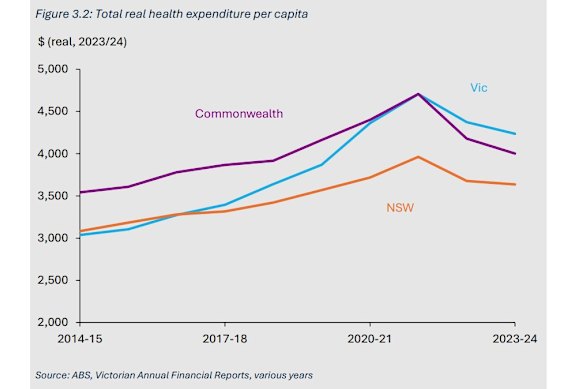
The review compared health spending by Victoria, NSW and the Commonwealth.
It found 41 per cent of emergency department cases involved lower urgency patients who should have been dealt with through primary care services, such as GP clinics.
“High numbers of people access hospital emergency departments as the ‘front door’ to the health system, which are not always the most appropriate point of contact for patient need,” the report says.
It also found that Victoria’s health spending surged by 39 per cent over the past decade, and while Victoria spends $4200 per capita on health, the more populous NSW spends $3,600 per capita.
One of the most significant changes to come out of the review will involve Victoria’s independent health promotions agency, VicHealth, ceasing to exist as a standalone entity. It will instead be absorbed into the Health Department.
Public Health Association of Australia chief executive Terry Slevin slammed the agency’s axing, describing it as a backwards step that would make more people sick. VicHealth partners with community groups to promote initiatives including healthy eating programs.
In her review, Silver also recommends the Commonwealth fully fund Victoria’s 12 state-funded urgent care clinics, which were established in the wake of the pandemic to reduce the pressure on hospital emergency departments.
Premier Jacinta Allan said on Thursday that the state would step up its calls for the federal government to take full control, but would continue to fund the clinics in the meantime.
Loading
“We have had to shoulder the burden of a primary care system that was brought to its knees by the chronic underfunding by the former federal Liberal government,” Allan said.
Special COVID-19 leave for health workers will also be axed as part of the review. But the Allan government will not adopt the recommendation to cease state funding for its doctors-in-schools program.
The report says the schools program is no longer needed because the federal government is increasing access to bulk-billed healthcare and after-hours GP appointments and telehealth.
Silver found that Victoria’s Health Department spent $30.7 billion in the 2023-24 financial year – almost a third of all state government expenditure at that time.
Her recommendations for the department – included the axing of 47 full-time equivalent positions – would save the government just over $1 billion through to June 30, 2029.
State Health Minister Mary-Anne Thomas has long said it is time for hospitals to tighten their belts.
The findings coincide with revelations that cash-strapped Seymour Health was allegedly ordered by the government to raid money set aside for staff and employee liabilities to reduce its debt.
The Age revealed on Thursday that the health service had sought reassurances from the department that it would be bailed out should it not have the cash reserves available to pay its workers their leave entitlements.
The department insists there has been no change to the way Victoria’s public hospitals treat employee entitlements on their balance sheets as part of cost-saving measures implemented since 2024.
Australian Medical Association Victoria president Dr Simon Judkins said the allegations were nonetheless troubling.
Loading
“There is no doubt there are significant financial pressures that all hospitals are under,” Judkins said.
“We are mindful that we need to manage costs. But quick and easy savings are not real solutions. Both the review and the government response state that there will be no cuts to frontline healthcare workers, and we will hold them to that.”
An estimated 1000 or so allied health workers and public hospital support staff aligned with the Health Workers Union marched to the steps of parliament on Thursday to demand an end to a pay dispute that has dragged on for 11 months. The strike action led to about 1000 planned operations being cancelled.
A government spokeswoman said it was working with the union and the Victorian Hospitals Industrial Association to minimise disruption to critical patient care.
“We will always back our dedicated healthcare workforce and the extraordinary care they provide to Victorians who need it most,” she said.
The union has accused the government of offering a below-inflation pay rise. Unionised nurses and midwives last year approved a 28.4 per cent pay rise over four years, while paramedics received wage increases of between 17 and 33 per cent over four years.
Victoria will start negotiating a new enterprise bargaining agreement with Victorian doctors early next year.
Cut through the noise of federal politics with news, views and expert analysis. Subscribers can sign up to our weekly Inside Politics newsletter.
Most Viewed in National
Loading