The first Persian Gulf War lasted six weeks. Kuwait was liberated from the murderous grasp of Saddam Hussein, and the Iraqi army admitted defeat, at a surrender ceremony presided over by the charismatic General Norman Schwarzkopf, who said of Iraq's leadership, "I'm not here to give them anything. I'm here to tell them exactly what we expect them to do."
"Stormin' Norman," as he was called, became the most popular battlefield general since World War II. His commander-in-chief, President George H.W. Bush, had an 89 percent approval rating, and for the first time in a generation, America felt good about its military. "By God, we've kicked the Vietnam syndrome once and for all," Bush said.
More than half a million Americans served in Operation Desert Storm; 148 were killed in action. Yet today, it is all but forgotten. "I just felt like that was not right, and that something had to be done to change that," said Scott Stump, who was a lowly Marine Lance Corporal in that war. He set out to build a memorial to Desert Storm on the National Mall, probably the most-prized real estate in all of America.
"I'd been to Washington D.C. one time in my life; that was the summer of 8th grade," said Stump. "I had no connections, didn't know anybody."
First, he had to persuade Congress to pass a bill authorizing the memorial – a process he likened to "pulling teeth." He said the responses he got included, "Well, there weren't enough people that died, you know, for there to be a memorial."
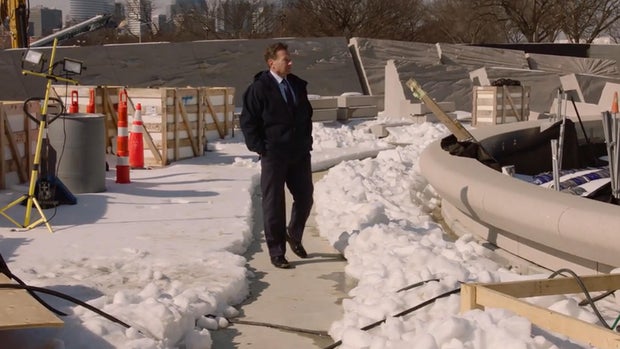 Marine veteran Scott Stump fought for years to have a memorial to Operation Desert Storm erected on the National Mall.
CBS News
Marine veteran Scott Stump fought for years to have a memorial to Operation Desert Storm erected on the National Mall.
CBS News
Before his acclaimed volumes on World War II and the Revolutionary War, Pulitzer Prize-winning historian Rick Atkinson wrote a book about Desert Storm ("Crusade: The Untold Story of the Persian Gulf War"). He called each of the 148 lives lost in that war "unique and precious as a snowflake.
"As a nation we should always remember all those who die for us," Atkinson said. "The fact that the casualty rate was relatively low, compared to the thousands or tens of thousands that many had feared would be the case, is a measure of success."
The U.S. had not committed so many troops to battle since Vietnam. "We all felt like there was a chance that we might never come home," Stump said. "We were rallied around the commanding officer one Friday afternoon and he gave us the speech – you know, 'Look to your left, look to your right, one of you is not going to be coming home.'"
Stump tried to recruit big names to his cause, like Colin Powell, who as Chairman of the Joint Chiefs became one of the breakout "stars" of Desert Storm. But in an e-mail to Stump, an aide quoted Powell as saying Desert Storm was "a short operation and not an extended war and he would be surprised that Congress would pass this and allot a place on the Mall for such a memorial."
"He thinks that, you know, it's behind us," Atkinson said, "that the country is not going to support it, either politically or financially. And you know, he's obviously wrong."
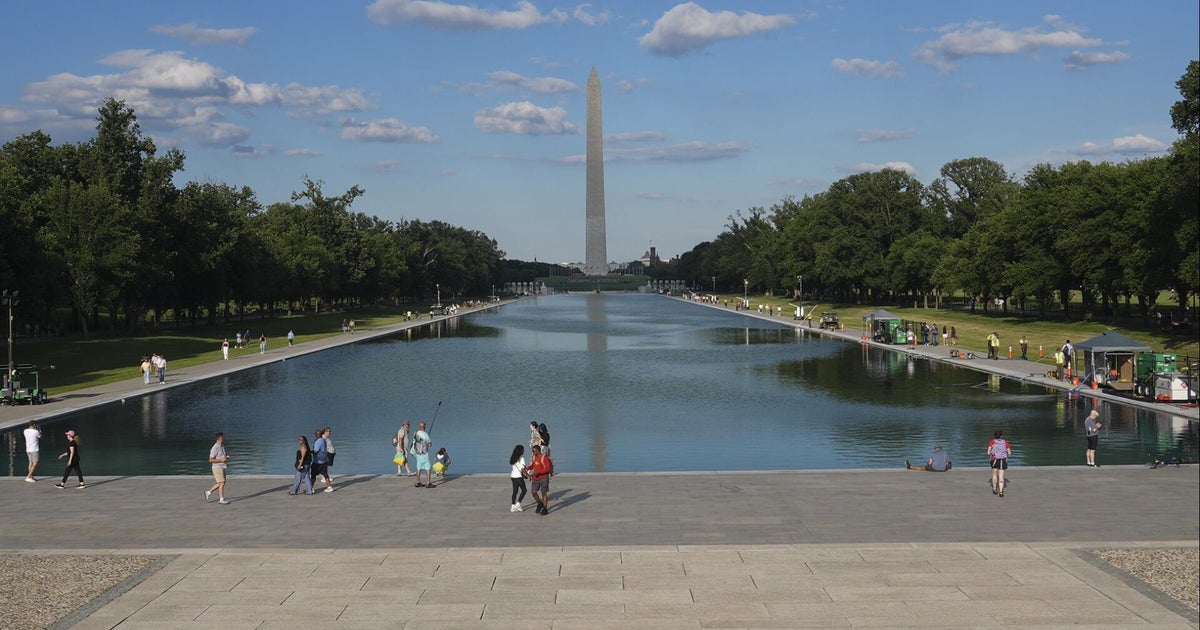
The Desert Storm Memorial is now scheduled to open in October, and in a prime location: next to the Lincoln Memorial, and down the street from the Vietnam Memorial.
The main wall – referred to as the Storm Wall – is a bas relief that tells the story of the various phases of Operation Desert Storm: the stealth fighter that dropped the first bombs on Baghdad; and then after the air war comes the four-day ground war.
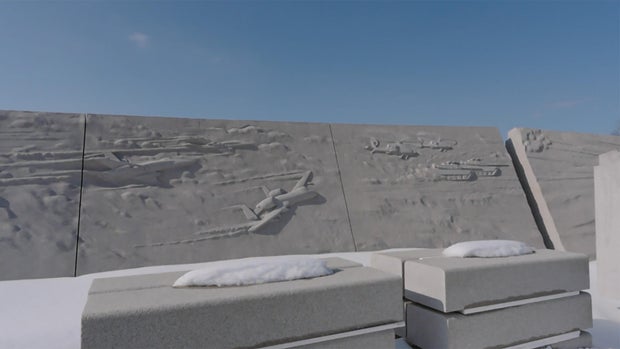 The Desert Shield and Desert Storm Memorial, under construction on the National Mall in Washington, D.C.
CBS News
The Desert Shield and Desert Storm Memorial, under construction on the National Mall in Washington, D.C.
CBS News
Stump said, "We had to fight tooth-and-nail to secure this site, and in fact the typical time period for site selection takes 18 months. Ours took 39 grueling months."
When requesting this site, Stump says he was told, "You don't belong there. This isn't important enough to be located in that spot."
But the location makes its own statement. "A visitor is going to say it must be important, otherwise it wouldn't be right here by the Lincoln Memorial or the Vietnam Memorial," Stump said.
The memorial will cost about $42 million, all of which Stump had to raise. Well over half of it was donated by Kuwait, which owes its freedom to Desert Storm.
Does it bother him, that he had to depend upon Kuwait to honor an American-led war effort? "It doesn't bother me from the fact that it's making it happen and we're getting it done," Stump said. "But it's not right."
He admits that, despite his success, he has been disillusioned by the process: "Absolutely – been disillusioned at every turn of the way."
After the war, the American people became disillusioned, too. President Bush went on to lose his run for reelection, while Saddam Hussein remained in power. Then came 9/11, and the "forever wars" of Iraq and Afghanistan. "You're only as good as the last war you fought," Atkinson said. "You can be shown by history that military power will only take you so far, that the success of Desert Storm is not a predicate for success in future combat."
Desert Storm was relegated to a footnote. As Atkinson observed, "That doesn't mean it should be forgotten. We've got a lot of footnotes in our history, and the footnotes are important."
And how might the approximately 600,000 Desert Storm veterans feel about this memorial? "Most of them will think, 'Well, gosh, we thought they were never going to remember," Atkinson said.
It took 35 years and one man's obsession to construct not just a tribute to those who served, but also a remembrance of a moment in time.
Atkinson noted, "Almost two generations ago, we amassed this very large force, with a lot of international allies, and very competently set out 6,000 miles to right a wrong and to do it at minimal cost. I think that's a pretty good history lesson."
Stump said, "They're going to look at that a hundred years from now and say, 'Wow, if they could come together and do the right thing, maybe we can, too.'"
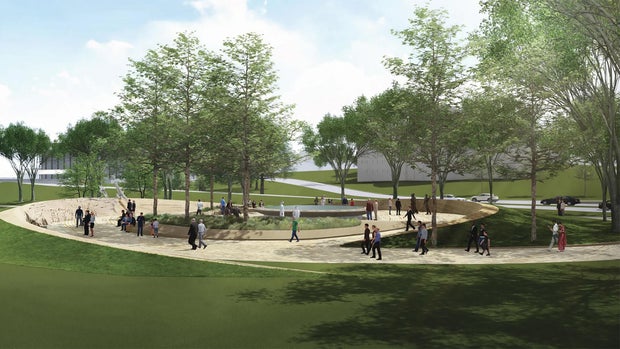 Concept art for the memorial, which will open on the National Mall in October.
The Desert Shield and Desert Storm Memorial
Concept art for the memorial, which will open on the National Mall in October.
The Desert Shield and Desert Storm Memorial
For more info:
- The Desert Shield and Desert Storm Memorial, National Mall, Washington, D.C.
- "Crusade: The Untold Story of the Persian Gulf War" by Rick Atkinson (Mariner Books), in Trade Paperback, eBook and Audio formats, available via Amazon, Barnes & Noble and Bookshop.org
Story produced by Mary Walsh. Editor: Emanuele Secci.
In: