3 months ago
9
3 months ago
9
The news
A $370 gap between the subsidy offered to rural patients travelling for specialist health care and the allowance handed to regional MPs headed to Brisbane for parliament will be reviewed by the Crisafulli government ahead of next year’s budget.
“The cost of accommodation has gone up, the cost of travel has gone up,” Health Minister Tim Nicholls told reporters on Saturday after fresh fears reported by this masthead last month that people were delaying life-saving treatment as a result.
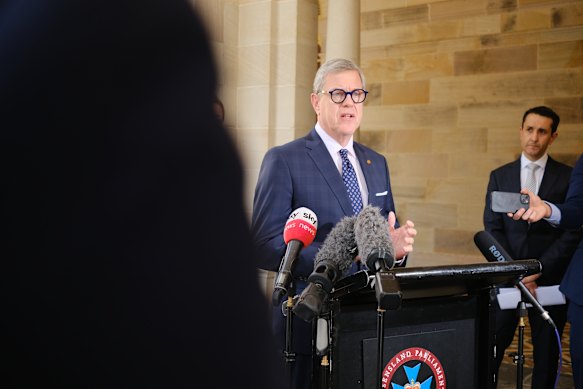
Contacted for comment last month, Health Minister Tim Nicholls pointed only to the $123.4 million budgeted for it this financial year, touting the figure as the largest amount ever allocated.Credit: Matt Dennien
“So it’s something very much that we’re aware of, and we’ll be talking about as we go into budget preparations at the end of this year.”
Why it matters
While MPs from regional electorates are given a daily accommodation allowance of $440 to travel to Brisbane when state parliament sits, a rural patient travelling more than 50 kilometres for specialist healthcare can claim just $70 a night and 34¢ per kilometre for petrol.
The patient subsidies were doubled by Nicholls during the Newman government, with the former Labor government lifting the nightly rate (from $60 to $70) and petrol reimbursement (from 30 cents per kilometre to 34) to their current levels in 2023.
Patients, advocates and peak bodies have long pushed for the scheme to keep pace with increases in costs. Several told this masthead last month the rates did not reflect the real costs faced by those needing to travel for care in the heavily decentralised state.
The government has previously refused to increase the subsidy. Contacted for comment last month, Nicholls pointed only to the $123.4 million budgeted for it this financial year, touting the figure as the largest amount ever allocated.
What they said
On Saturday, Nicholls acknowledged the subsidies were covering less of patient’s costs – which had increased since 2013 while the amount available to them under the scheme remained static – and said he was aware of the scheme’s administrative and financial constraints.
“That is a matter that I will be taking up, and have, in fact, taken up in the past as part of our budget consideration process. It’s a fairly significant amount of money, and it is administered by the HHS [Hospital and Health Services],” he said.
“It can be done better, in my view, and the funding amount is something that we’re always monitoring.”
“It needs to be a consideration as to whether it is actually adequate as a subsidy to help defray the costs of families travelling here. I know those families, they stay at supported accommodation through places like Ronald McDonald House, the various hospital foundations also provide accommodation on or nearby our hospital services. But obviously over the last five years, prices have gone up.”
Loading
Another perspective
Husband and wife Pauline and Rod first travelled from their home near Emerald to see specialists in Brisbane in April last year, after Rod was diagnosed with mouth and throat cancer. Major facial surgery meant a month-long stay in a hotel near a city hospital.
Complications which emerged after a return home saw Rod rushed back to Brisbane and a further five-month stay for the pair. Pauline praised aspects of the scheme, but estimated out-of-pocket expenses of nearly $25,000 during their extended stay in the city, and said the current rate wasn’t enough.
Rural healthcare advocate Justine Christerson has said the gap between the subsidies shows the government is “out of touch with the constituents they’re representing” and wanted to see the daily rate for a single person increased to at least $100 per night.
Queensland Aboriginal and Islander Health Council acting chief executive Paula Arnol said if $440 a night is considered reasonable for MPs, “then $70 for sick patients is inexcusable”. “The Queensland government needs to do better,” she said.
With Courtney Kruk
Most Viewed in Politics
Loading