3 months ago
30
3 months ago
30
The nation’s state and federal governments will soon spend more than $50 billion a year servicing a record level of debt as they all struggle to get on top of their health spending that is eating into growing revenues.
A snapshot of the state of the nation’s public budgets by the independent Parliamentary Budget Office, released on Thursday, shows total net debt held by the states, territories and federal governments will reach $1.08 trillion next financial year.
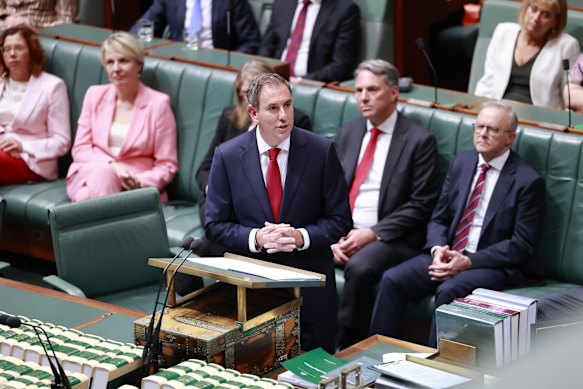
Jim Chalmers delivers his fourth budget earlier this year. Along with financial blueprints of the states and territories, it told a story of more debt .Credit: Getty
Before the pandemic, all state and federal net debt was $551 billion.
The interest bill will next year hit an all-time high of $52.6 billion, or almost the same as what the federal government expects to spend on the NDIS. By 2027-28, government interest payments are expected to jump to $61.3 billion, of which more than half will be paid by federal taxpayers.
Interest payments have more than doubled since COVID due to the sharp lift in debt and the jump in global interest rates.
While the federal government has the largest share of net debt, it is the states and territories which are increasing their debt levels fastest.
Total federal net debt is expected to climb by 13 per cent between this financial year and 2027-28, reaching a record $697.5 billion.
State and territory debt is forecast to climb by 17 per cent to almost $500 billion. The biggest increases are in Queensland (by 47 per cent), Tasmania (38 per cent) and South Australia (31 per cent). Tasmania’s credit rating was last week downgraded by two agencies over concerns about the state of its budget.
Victoria’s net debt is expected to reach the highest of any state or territory at $187.8 billion, an increase of 11 per cent, while NSW’s debt is tipped to grow by 14 per cent to $139.5 billion.
Loading
While debt held by governments grew during the early stages of the pandemic, it has continued to rise even as the economy has recovered and tax revenues have lifted.
“This deterioration is despite improved forecast revenue in each jurisdiction, which has been more than offset by increases in forecast expenses,” the budget office found.
Total government spending is expected to climb from almost $1 trillion this year to $1.06 trillion by 2027-28. Health is the single largest expense for all governments, having increased steadily over the past 15 years.
As a share of the economy, spending by all governments is expected to ease from 35.1 per cent in the just completed financial year to 33.5 per cent in 2027-28.
That would be the lowest proportion since 2007-08. It is predicated on governments, some of which face elections between now and mid-2028, not increasing expenditure beyond what they have set in their current budgets.
Government revenues are expected to rise by almost $100 billion over the coming three years. Much of that will flow to the federal government, which is expecting a lift in personal income tax collections.
However, much of Canberra’s extra revenue flows back to the states and territories through the GST or inter-government programs.
Revenue collected by all governments as a share of the economy is predicted to fall marginally to 33.4 per cent from 34 per cent in 2024-25. That would be the lowest revenue share of the economy since 2014-15 but still well above the low of 30.8 per cent reached in 2010-11.
The imbalance between government spending and revenue means only one government, Western Australia, is expected to run a fiscal balance surplus by 2027-28. The surplus will be almost solely due to the special GST deal put in place by the Morrison government, which is costing federal taxpayers almost $7 billion a year.
Federal Treasurer Jim Chalmers is due to release the mid-year budget update within the next fortnight. It is likely to reveal the federal budget, originally forecast to show a $42.1 billion deficit, in slightly better shape due to stronger personal and corporate tax collections.
The budget office data follows this week’s national accounts, which revealed economic growth out of the private sector continuing to lift. But government expenditure, particularly on health, defence and infrastructure like roads and railways, continues to grow.
IFM Investors chief economist Alex Joiner on Thursday said the Australian economy was beset with imbalances, led by the dependence on a growing population.
Loading
This had helped cover the malaise of all governments to consider policies to strengthen the economy and lift growth.
“Governments, both federal and state, are far more focused on redistribution rather than reform, this has resulted in the public sector being too prominent in economic growth, and employment, at the expense of the private sector,” he said.
“It is difficult to see this being wound back but it should slow, or we risk even wider fiscal deficits.”
Most Viewed in Politics
Loading