3 months ago
54
3 months ago
54
Jayne McCormackPolitical correspondent, BBC News NI

 PA Media
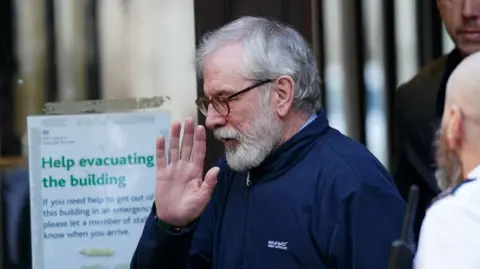
Former Sinn Féin leader Gerry Adams entering court on Wednesday
Gerry Adams has said the London Docklands bomb in February 1996 left him "stunned" and could have ended talks to reach peace in Northern Ireland at that time.
The bombing, carried out by the IRA, marked the end of a ceasefire that had been in place since 1994.
It is one of three attacks central to the civil case against the former Sinn Féin leader in London. A victim of that attack and two victims of other bombings in London and Manchester are seeking to hold Adams, 77, personally liable for the injuries they received.
Adams has denied any involvement in the attacks and said he held neither rank nor role in the IRA.
Speaking about the 1996 bombings in court on Wednesday, Adams said: "That may well have heralded the end (of talks) but thankfully it didn't, we were resilient and we re-engaged," he said.
"The government knee-jerked and wouldn't meet with us, and then agreed to meet at official level slowly."
Asked if he had known anything in advance about the attack would he have done anything, Adams said that was a hypothetical question as he "didn't know" about it.
The court was played a recording of a video of Adams at a republican rally in August 1995, where he was quoted as saying "they haven't gone away, you know", in reference to the IRA.
Adams said his words at the time were an indication of the anger within the republican base of the "refusal of the British government to engage with Sinn Féin".
"This was a man in the crowd voicing his anger and I put the reply," he said.
"The IRA hadn't gone away at that stage, the IRA have thankfully gone away and that is the difference between that period and this period."
The court was also told about details of an internal memo from the UK government in 1993, in which the home secretary at the time took the view that Adams was at the "nerve centre" of the IRA.
The former Sinn Féin leader insisted that was not true and suggested the government had "dodged its responsibility" in the peace process by seeking to describe him as a "terrorist".
He added later: "The bombings in this case, the killing of three people and the wounding of others, I regret very much, but the folks giving this information have a vested interest."
 Pacemaker
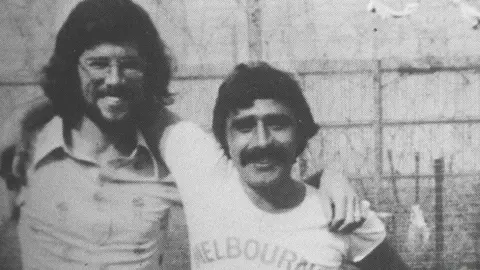
Gerry Adams (L) and Brendan Hughes were photographed together in Long Kesh prison in 1973
Adams also told the civil trial in London that he used his "influence" as a republican as best he could to move from war to peace, but insisted he had always told the "truth" about his role.
He rejected a claim that he had ever been a "major player" in the IRA.
The allegation was made by Brendan Hughes, who was with Adams in prison in the early 1970s and died in 2008. The words were said in a recorded interview that was played in court.
Hughes was a hunger striker and officer commanding of the IRA.
When it was put to Adams that they were "fellow IRA operatives and IRA volunteers", the former Sinn Féin leader replied: "That is not true."
Sir Max Hill KC, barrister for the three claimants, said Hughes had spoken about Adams' alleged involvement in the organisation, referencing interviews cited in the book Say Nothing, by Patrick Radden Keefe.
"You're in denial about your role in the IRA to this day," said Sir Max.
Adams responded: "No, I tell the truth on that issue."
The trial is now in its seventh day and is being heard by Mr Justice Swift.
The action was brought by John Clark, a victim of the Old Bailey bomb in 1973, and Jonathan Ganesh and Barry Laycock, who were hurt in the 1996 attacks in London's Docklands and at Manchester's Arndale Shopping Centre respectively.
They are seeking £1 each in "vindicatory" damages.
Adams' lawyers have argued the case is based on "an assortment of hearsay" and that it has been brought several decades too late.
They have said the action should be subject to the three-year limitation period set out in legislation passed in 1980.