3 months ago
38
3 months ago
38
March 17, 2026 — 5:00am
Emirates Palace Mandarin Oriental has to be seen to be disbelieved. A $3.5 billion product of the House of Nahyan, the ruling royal family of Abu Dhabi in the United Arab Emirates, this luxury-hotel-cum-tourist-attraction spans one million square metres and boasts a one-kilometre-long main wing.
Inside, it features the stuff of a Donald Trump precious-metal wet dream: 1002 Swarovski crystal chandeliers and 114 massive decorative Arabian-style domes, all smothered in gold leaf and glass mosaic.
It’s difficult to believe that such a mini-Pentagon could become a symbol, of sorts, for the house of cards that the ostentatious cities and nations of the Gulf have been reduced to in a matter of a few weeks.
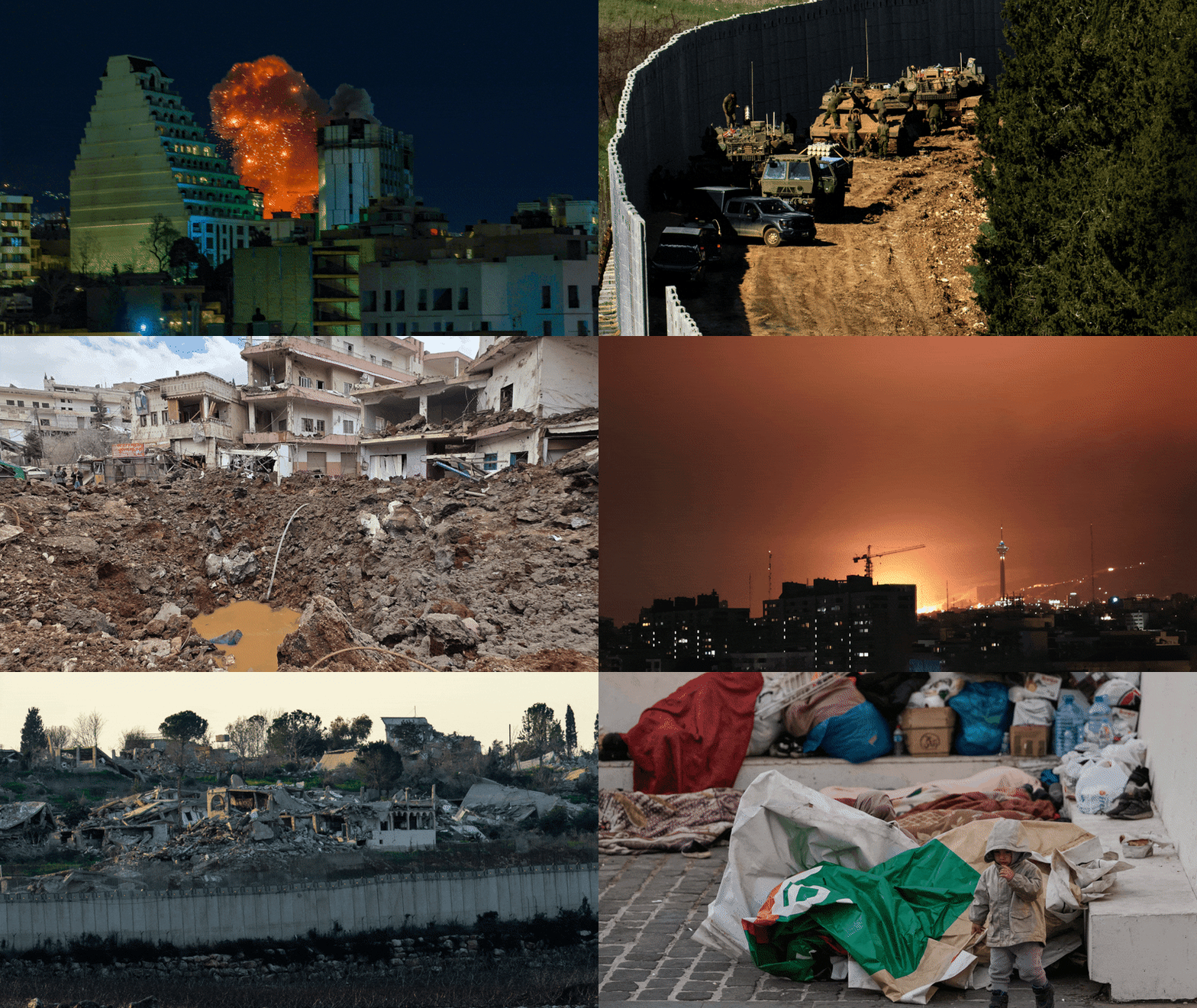
As we’ve all witnessed, the likes of Dubai, Doha and Abu Dhabi have been under attack from Iran for the past fiery fortnight.
Sign up for the Traveller newsletter
The latest travel news, tips and inspiration delivered to your inbox. Sign up now.
So too have their (until now) renowned growth models, designed to establish their cities as tourism, aviation and investment behemoths, as hedges against finite fossil-fuel reserves.
As a repeat traveller to each of those cities, as well as Muscat, Oman, I’d always feared that it would be a major terrorist attack in a Dubai or a Doha that would be most destabilising to those otherwise remarkably stable models created from virtually nothing in little more than three decades.
Until the 1980s Dubai was little more than a sleepy fishing and pearling port with minimal or no air-conditioning and a not-so-plentiful water supply.
The Emiratis’ subsequent “build it (high and lavishly) and they will come” strategy proved an inspired approach, and one dependent on peace and security. Then their cities became embroiled in the consequences of what’s been widely perceived as an ill-conceived and executed US-Israeli conflict with Iran.
While most of the world’s attention has focused on Dubai, Abu Dhabi, the rich cousin of the former, has also spent billions honing its image.
It aimed to transform into a cultural powerhouse, distinguishing itself from a more culturally low-brow, glitzier and less oil-rich Dubai.
The most recent addition to Abu Dhabi’s museum-rich Saadiyat Cultural District, following the 2017 opening of an outpost of Paris’ Louvre, is a long-delayed Guggenheim, built at a cost of $US1 billion ($1.4 billion), and designed by the late Frank Gehry.
Now the question is: How will these extravagant Gulf states recover in the aftermath of the stunning and events that have seen their image as havens in the midst of a notoriously unsafe and unstable region destroyed?
As Emile Hokayem, a Middle East expert at the London-based International Institute for Strategic Studies, was quoted recently in The New York Times, beyond the immense wealth the Gulf states possess, “[their] real currency was confidence.
“It’s the fact that they could realistically tell people it’s a good business environment, you will feel safe,” Hokayem added. “We’re immune to regional politics. You can invest here. You can use us for your trade, your airlines, for your comms, your tech and so on. And that’s what the Iranians are after, right?”
Whenever the Gulf states recover from the mayhem the Iranians have managed to unleash on their greatest jewels, it’s certain to be a test of not merely the deep pockets of its rulers but also the pragmatism of international travellers. How immune or adaptive have travellers become, if at all, to the cycle of global shocks?
Once the dust from the missiles and drones has settled, stand by for what may turn out to be the mother of all discount airline-seat and hotel-stay campaigns – high fuel costs or not – as the Middle Eastern carriers fight to entice the world back.
Already there are indications Emirates and Qatar Airways have been discounting airfares to lure passengers back on future flights.
Dubai, as a destination, was supremely fortunate that the Iranian drone that landed recently near the Fairmont The Palm hotel did not score a direct hit on its main guest wings and public areas.
Elsewhere in the region, in a sign that the Gulf states’ at times garish growth model is nearing its use-by date, even before the war began Saudi Arabia had been forced to draw a line on The Line.
Known also as Neom, work on the House of Saud’s excessively ambitious $50 billion, 170-kilometre-long linear city for nine million residents has been scaled back, rendering it the world’s most costly elongated sandpit.
Furthermore, the 2029 Asian Winter Games in Saudi Arabia, which were meant to be held in Neom, had to be postponed indefinitely last year with Almaty, Kazakhstan, named the replacement host city.
The Saudis must also surely be rethinking their scheme to challenge the Middle Eastern aviation and tourism domination of Emirates and Qatar Airways. They have ordered scores of passenger aircraft for the kingdom’s Riyadh Air, with ambitious plans to service 100 destinations around the world by 2030.
Back at Abu Dhabi’s Emirates Palace Mandarin Oriental, the houseguests and sightseers alike may eventually stream back in, but it’s never going to be quite the same for the Gulf’s houses of cards that overnight went from havens to hells.