3 months ago
17
3 months ago
17
The world changed on July 15, 2012. A tuxedoed man by the name of Psy horse-danced into our collective psyches, enticing us with energetic beats and encouraging far too many people to overuse the phrase “ay sexy lady”.
This was, of course, Gangnam Style, one of the most viral songs of the early 2010s. By the end of the year, it became the first video to ever hit 1 billion views on YouTube. It also debuted on the Billboard Hot 100, broke three Guinness World Records and inspired many a Halloween costume.

Psy didn’t just introduce us to horse-dancing. He introduced us to Korean pop-culture.
But perhaps most significant of all, the song – performed almost entirely in Korean – is credited with helping bring K-pop to a global audience. Since Psy released the earworm of all earworms, other South Korean groups have gone on to claim worldwide fame. BTS remains one of the best-selling groups of all time, and Blackpink’s Rosé recently became the first K-pop star to be nominated for Record of the Year at the Grammys. Then there’s Netflix’s K-pop Demon Hunters, which has transformed practically every child under 12 into a K-pop mega-fan.
This is just one element of hallyu, a Chinese term that translates to “the Korean Wave”. It has seen South Korean pop culture – from music and movies to fashion and food – rip through the world over just a few decades. Squid Game, Bong Joon Ho’s Parasite, Korean skincare, Buldak ramen – they’re all deeply Korean, yet almost universally recognisable.
Hallyu goes beyond simply planting Korean pop culture in other countries, too. In Australia, Korean-Australian hip-hop groups like 1300 are rapping in both Korean and English, weaving local Aussie experiences with Korean pop-culture references to create their very own version of hallyu.
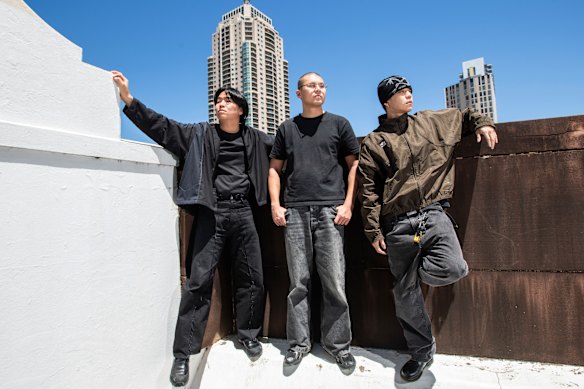
1300 rappers Rako, Goyo and DALI (left to right) are reimagining hallyu through a distinctly Korean-Australian context.Credit: Steven Siewert
While most of us have danced along to Golden or eaten our weight in kimchi, few know why we’re so drawn to these things in the first place. But an upcoming exhibition at the National Museum of Australia may have the answer.
Originally curated by Dr Rosalie Kim for the Victoria and Albert Museum in London, Hallyu! The Korean Wave will travel Down Under in December to present the history behind this cultural phenomenon, as well as how it’s being reimagined in Australia.
“I wanted people to understand that all these joyful aspects actually stem from something a bit darker and deeper,” Kim says, noting that the exhibition contains about 200 objects, including K-pop idol costumes and studio props, as well as digital displays and interactive experiences. “After seeing the exhibition, hopefully people will hear new [Korean] music, or go see a new film and have a different understanding and new appreciation for it.”
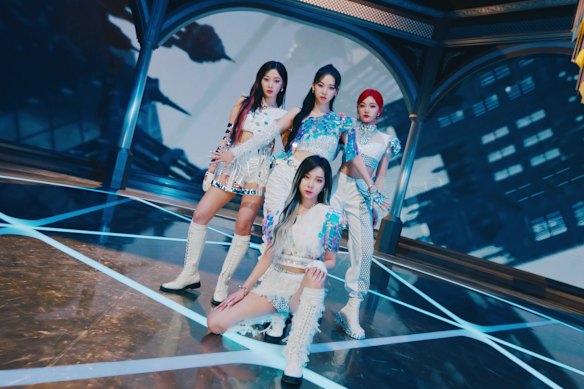
Sure, it’s glitzy and glamorous. But why are we so drawn to K-Pop and all things hallyu?Credit: SM Entertainment
The seeds of a phenomenon
As glossy and glamorous as hallyu appears, it’s ultimately rooted in South Korea’s turbulent history. Curator of the National Museum’s hallyu exhibition Kate Morschel says its beginnings can be traced back to the end of the Korean War, which saw the country divided into North and South. The latter experienced a major economic transformation, as “family dynasty” companies like LG aided the country’s rapid industrialisation.
By the 1980s, Morschel says South Korea democratised, and interest in its creative output began to spike.
“Hallyu came about through the repeal of censorship laws and the opening of the country to the wider world,” she says. “Then there were government policies that really supported creative industries and a mass investment in digital infrastructure as well.”
Loading
Its spread was initially contained largely to parts of Asia. But once the internet appeared in the late 90s, South Korea quickly made use of the new technology to distribute its pop culture even further, intent on carving out space for itself.
Kim also attributes much of hallyu’s success to the generations that grew up with it – millennials and Gen Z.
“These generations are generally more culturally inclusive and diverse and usually more socially conscious,” she says. “So, you have an audience that’s ready for something new on one side, the Korean production on the other, and then this kind of in-between, which is technology that brings it all together and helps their pop culture explode at a speed and scale not really encountered before.”
Like, subscribe, stream
Once social media emerged, hallyu levelled up massively. Kim says early social network sites saw fans translate K-pop lyrics and K-drama dialogue for overseas audiences before platforms like Twitter and Facebook entered the chat for more in-depth discussion. The country also developed web platforms dedicated entirely to Korean webtoons, as well as social platforms created solely for K-pop idols to connect with their global fans (for example, CJ Entertainment’s Mnet Plus).
“Korea enjoyed their own social media platforms really early on. You could buy virtual flowers, make an avatar of yourself, visit your friend in a virtual room and share the latest pictures of your travels, all while listening to K-pop. That happened in the late 90s, early 2000s – well before the advent of Western social media platforms,” Kim says.
Snail mucin, anyone?
When TikTok appeared in 2016, it was suddenly K-Beauty’s time to shine. Videos promoting Korean skincare, namely the “glass skin effect” and unique ingredients like snail mucin, sent Korean beauty brand sales through the roof.
South Korea’s Ministry of Food and Drug Safety reported that cosmetics exports hit more than $15.2 billion in 2024, a record high. In Australia, the market for K-Beauty is projected to grow from nearly $160 million in 2023 to more than $320 million by 2032.
However, hallyu wouldn’t be what it is today without YouTube. Since the days of Gangnam Style, the video platform has become the go-to destination for all things K-pop. BTS, who are reuniting after completing their mandatory military service, raked in more than two billion views on their Dynamite music video. And though not technically K-pop, the painfully repetitive children’s song Baby Shark, created by Korean animation company Pinkfong, has claimed a staggering 16.4 billion views.
Meanwhile, Morschel says Korean film and television, particularly K-dramas, have found new audiences through global streaming platforms. Netflix now has a section dedicated to K-drama with hit shows like Squid Game inspiring English spin-offs, and Apple TV’s popular Pachinko series turned non-Korean viewers to the source material (Min Jin Lee’s 2017 novel), expanding their hallyu knowledge.
And of course, no discussion about hallyu is complete without Parasite – the first non-English language film to win Best Picture at the Academy Awards. It grossed more than $US253 million globally in 2019, and encouraged fans to further explore Korean cinema, whether that included other Bong Joon Ho titles (Memories of Murder, The Host) or others (Park Chan-wook’s The Handmaiden, Yeon Sang-ho’s Train to Busan).
This was no happy accident, though. In 2019, the Korean Film Council allocated 100 billion won (more than $104 million today) for film development – 32 per cent more than the previous year.
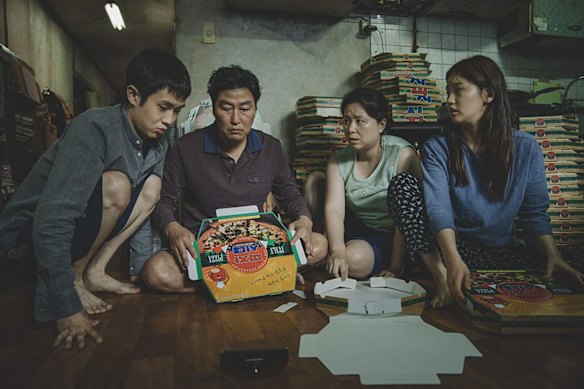
Parasite’s Oscar win was extraordinary, but its lasting impact on Korean cinema has arguably been even more impressive.
“We used to have these cultural movements that came mainly out of the West – Hollywood – and certain music genres from the US or UK. Hallyu has really upended and challenged that,” Morschel says. “And it’s showing other cultures how their stories could be platformed and shared, and that authentic storytelling, which is the very essence of hallyu, will always find audiences.”
Hallyu down under
Goyo, a Korean-Australian rapper in the hip-hop collective 1300, remembers the days when the only Korean television he could watch was on SBS or through ripped DVDs. Now, it’s far easier to access Korean pop culture here – after all, Australia is home to the seventh-largest Korean diaspora in the world. But he says there’s still a way to go.
“Hallyu is definitely growing, but there are sides of Korean culture that haven’t been represented yet – the more casual things, the things normal Korean or Korean-Australian people do on a daily basis,” he says. “Learning about Korea through K-Pop is great, but not everyone in Korea has blue hair and wears skinny jeans.”
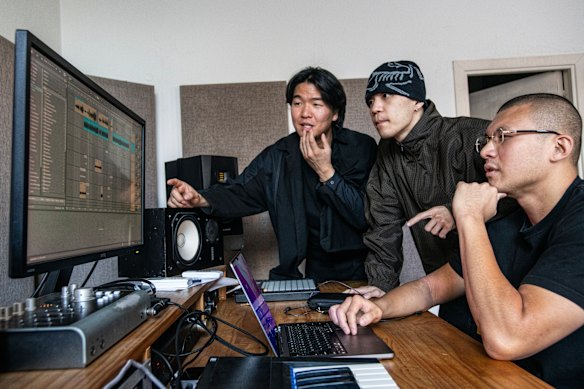
Merging Australian and South Korean culture has always come naturally to 1300.Credit: Steven Siewert
1300 aims to fill that gap. They’ve reimagined hallyu, incorporating Korean language and pop-cultural references (one of their tracks is inspired by Park Chan-wook’s Oldboy) with hip-hop beats and quintessential Aussie slang (like eshays).
Loading
“I think we can be the bridge that brings it all together and show people that, yes, K-pop is well-known, but there’s so much more to it. That’s just one end of the spectrum, and there’s so much more that goes in between,” Goyo says.
Morschel says the hallyu exhibition will highlight other ways in which hallyu is merging with Australian culture now, including Andrew Undi Lee’s horror series Night Bloomers and Korean-born chef Chae, who now runs an intimate Korean restaurant in regional Victoria.
“We’re shifting into this new phase of hallyu that’s much more distributed. It’s being remixed in local contexts all around the world and reimagined by diaspora communities,” she says. “This is a moment of cultural change and a real diversification of the stories we’ve seen.”
Hallyu! The Korean Wave will be at the National Museum of Australia from December 12 to May 10, 2026.
Must-see movies, interviews and all the latest from the world of film delivered to your inbox. Sign up for our Screening Room newsletter.