3 months ago
19
3 months ago
19
By Joanna Mendelssohn
November 29, 2025 — 5.30am
Dangerously Modern, curated by Wayne Tunnicliffe, Tracey Lock and Elle Freak, was first exhibited at the Art Gallery of South Australia. The Sydney showing is different, as the generous exhibition space at the Art Gallery of NSW, with its large open apertures and cut-throughs, enables different connections to be made between the paintings, prints, ceramics, and sculptures by these 50 women artists who travelled to Europe in the decades before World War II.
Near the beginning of the exhibition, in a dark alcove, the miniaturists – Bessie Gibson, Bernice Edwell and Justine Kong Sing – painted exquisite portraits on ivory, an Edwardian interpretation of an older tradition. While many women travelled with significant support from their families, Kong Sing saved her fare by working as a governess, finally reaching Europe when she was 43.
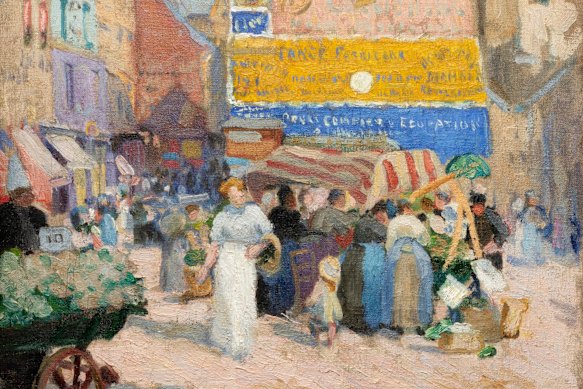
Ethel Carrick’s Rue Mouffetard (1910).Credit: Kerry Stokes Collection, Perth
In an exhibition where almost every work deserves what Robert Hughes called “The Long Look”, it seems wrong to single out only a few for notice, and lists of names are boring. But there are some works, and some artists, that by their very nature demand greater attention.
At separate times, both Ethel Carrick and Hilda Rix travelled to former French colonies in North Africa, where they found the busy markets of the walled city of Tangier to be an ideal setting for capturing the effect of light in paint. Hilda Rix’s little oil sketch, Two Women in the Market Place, was painted on the spot. She catches the folds in the clothes of two seated women, surrounded by a crowd of moving robes and indeterminate faces, each defined by a few rapid strokes of paint.
Along with many other Australian artists, Rix had a summer studio at Etaples in Brittany on the Atlantic coast. Her paintings of older Breton women are less sentimental than her fellow artist Iso Rae’s exquisite painting of a small pink child in a field of green, which manages to combine sentiment with colour theory.
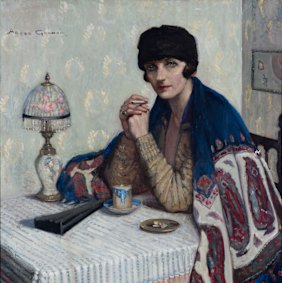
Agnes Goodsir’s Girl with cigarette (c1925).Credit: Bendigo Art Gallery, bequest of Amy E Bayne 1945, Photo: Ian Hill
Not all artist colonies were in France. Margaret Preston, Gladys Reynell and Edith Collier made summer expeditions to the isolated mining village of Bunmahon in Ireland. They painted simplified blocky shapes of the houses, patterns on the clothes of the residents and the luminous Irish light, encouraging each other’s experimentation in colour and form.
With the outbreak of war in 1914 Etaples, close to the English Channel, became the largest staging camp for British forces. Rae was one of the few artists who remained and her suddenly muted drawings capture the mood of the camp with its darkened rows of tents, and groups of soldiers on night patrol.
Major George Matson Nicholas of the AIF, stationed at Etaples, discovered Rix’s studio and when on on leave in London sought out the artist. Three days after they married, he returned to the front. Five weeks later he was dead.
Hilda Rix Nicholas’s response to his death was These Gave the World Away. Two dead bodies on a muddy battlefield, painted in grey, with tints of khaki. The figure of Major Nicholas has his arms outstretched, as though crucified. It is a painting to break your heart.
Not all artists painted their grief. Thea Proctor, always stylish, turned the unnerving experience of watching Zeppelins caught by floodlights over the skies of London into Stunting, an elegant pattern of diagonal lines and beautiful people.
Loading
In 1925, after they returned to Australia, Preston and Proctor held a joint exhibition. The newspapers described their art as “dangerously modern”. It was easier for artists to live abroad. The next generation of artists, including Grace Crowley, Dorrit Black, and Mary Cockburn Mercer found new ways of seeing as they explored aspects of cubism.
Agnes Goodsir and Bessie Davidson found liberation in both art and culture in Paris. Davidson’s Interior is a highly coloured celebration of domestic life with the clutter of a half-made bed, a robe casually draped over a chair. A reflection of her partner, Le Roy, is seen in the mirror. Goodsir’s constant subject, her muse, was Rachel “Cherry” Dunn. In Girl with a Cigarette she looks as though she is interrogating either the artist, or any viewer who chooses to interrupt her reverie.
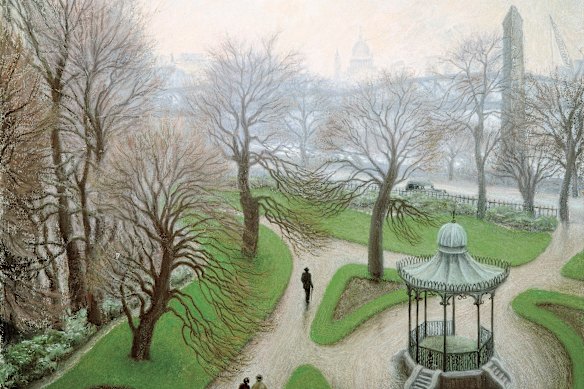
Stella Bowen’s Embankment Gardens (c1938).Credit: Art Gallery of South Australia, Elder Bequest Fund 1943
Loading
In the final room of the exhibition, the mood changes towards realism. The installation of bronze sculptures by Olga Cohn and Barbara Tribe shows a contrast of styles. Aesthetically Tribe’s baroque gestures have little in common with Cohn’s modernist refinement, but the medium unites them. Tough realist self-portraits by Stella Bowen and Nora Heysen show the cultural shift that came with the Great Depression and prelude to yet another war.
The last painting in the exhibition, just before the exit to the gift shop, says it all. Bowen’s Embankment Gardens, painted in 1938, evokes the mood of despair as bare trees wave their arms over the few figures walking without purpose down the defined paths.
Dangerously Modern: Australian Women Artists in Europe 1890-1940 is at the Art Gallery of NSW until February 15.
Most Viewed in Culture
Loading