3 months ago
19
3 months ago
19
Departing intelligence chief calls out Chinese intimidation as Australia monitors fresh flotilla
The country’s outgoing intelligence chief has accused China of seeking to intimidate Australia by sending a naval flotilla to circumnavigate the continent as he warned of the rising risk of a major conflict erupting in the region within a decade.
Defence Minister Richard Marles on Monday said the government was monitoring a Chinese navy task group in the Philippine Sea but was not yet sure whether it was headed to Australia in a repeat of a February expedition by the People’s Liberation Army.
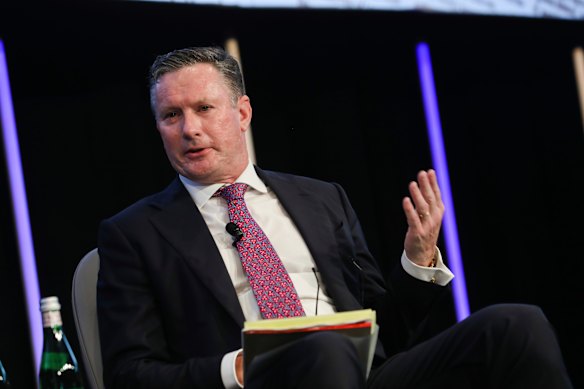
Andrew Shearer, head of the powerful Office of National Intelligence, will take up a new role as ambassador to Japan.Credit: afr
Office of National Intelligence (ONI) director-general Andrew Shearer, who is about to depart his post after five years in the job, told Senate estimates hearings on Monday night that the Indo-Pacific has become the “epicentre of global systemic rivalry” as he called out Beijing’s growing assertiveness.
“The guardrails that for decades separated competition from confrontation and conflict are weakening,” said Shearer, who has been nominated to be Australia’s next ambassador to Japan.
“Crises are overlapping and intersecting, bringing threats on shore faster, sometimes in real time. Warning times are shorter, meaning we have to act now if we are to be prepared for what may be coming, and some of the assumptions that underpinned international stability for decades can no longer be taken for granted.
“Most consequentially, should deterrence break down, notwithstanding the efforts of our government and our allies, we would face a rising risk of major conflict in our region within the next decade.”
Asked about the Chinese’s navy’s February circumnavigation of Australia, in which it conducted live-fire exercises in the Tasman Sea, Shearer told Liberal Senator Dave Sharma: “I won’t go into them in detail, but there were aspects of that particular deployment that, in our preliminary assessment, were intended to have an intimidatory effect on us, and, by extension, on other nearby countries.”
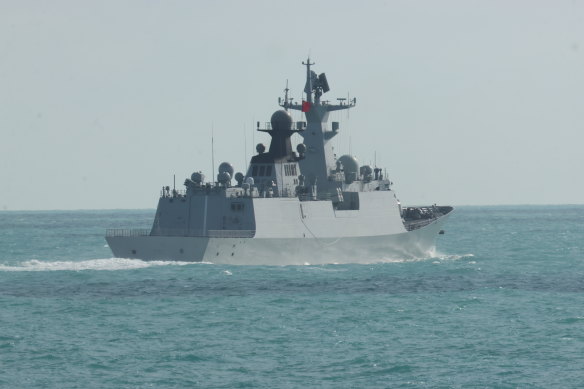
People’s Liberation Army-Navy frigate Hengyang was among those that circled Australia. Credit: ADF
Australia should prepare for more such visits by the Chinese military in future years, he said.
“We would expect them to become more frequent and to continue demonstrating that ability to project and sustain naval path further from mainland China,” he said.
He noted that Japan is “now being subjected to economic coercion in addition to military and paramilitary pressure tactics” after new prime minister Sanae Takaichi angered Beijing by speaking openly about the possibility of a war over the self-governing island of Taiwan.
Loading
Declaring that the nation’s intelligence operatives face “incessant cyberattacks, unrelenting espionage and interference efforts”, Shearer said: “Malign states are colluding with criminals and other non-state actors to enable hacking, sabotage, assassinations and political interference.
“The struggle for influence and strategic advantage in our region has intensified on every front. In the Pacific, efforts to build influence over elites have become more overt and sustained.”
Sherarer, who served as former prime minister Scott Morrison’s cabinet secretary, will be replaced by Kathy Klugman, who has been Prime Minister Anthony Albanese’s top foreign affairs adviser.
Klugman’s appointment was criticised by the opposition, which accused the government of a lack of consultation and argued Klugman lacked experience in the intelligence field.
Officials from the Department of Prime Minister and Cabinet revealed during the estimates hearings that an independent panel chose a shortlist of five names for Albanese, who then selected Krugman for the ONI role.
Cut through the noise of federal politics with news, views and expert analysis. Subscribers can sign up to our weekly Inside Politics newsletter.
Most Viewed in Politics
Loading