3 months ago
48
3 months ago
48
Gill DummiganNorth West health correspondent

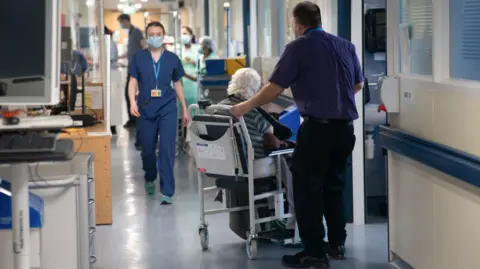 PA Media
Patients are lining up on trolleys or sitting on chairs due to a lack of beds
More than 52,000 patients waited longer than 24 hours to be admitted to hospitals across north-west England last year, a BBC investigation has revealed.
Known as "corridor care", patients are lining up on trolleys or sitting on chairs, stuck in A&E because there are no beds for them in the wards.
The Royal College of Nursing has described the situation as a "national emergency" and called on the government to end the practice.
NHS England said the NHS was currently experiencing its busiest winter on record and hospitals around the country had been "experiencing rising demand for a number of years".
Dr Michael Gregory, regional medical director for NHS England in the North West, said: "Providing care in corridors is not what we want for our patients, and we are working hard to reduce the use of corridor care and tackle long waits."
Every month the government publishes the number of people waiting more than 12 hours for a bed in a ward, after a clinician decides they need to be admitted to hospital.
It is important to note that the clock starts with this decision and it could be taken hours after that patient originally entered A&E.
Eight years ago, waits of more than 12 hours to be admitted were seen as unusual – more than a handful usually indicated a particular issue with a trust.
In December 2018 there were 101 in this region - 0.2% of the total number of people admitted - and most of those were down to a problem with one mental health trust.
By December 2025 that number had ballooned to 10,658 - nearly 18% of patients going into hospital from A&E.
In other words, nearly one in five people spending long hours stuck on a corridor, waiting room, or a bay, with no idea of when it was going to end.
But within that increase, there is an even darker truth: many of those 12+ hours waits are actually one, two or even three days.
The government does not publish those figures so we sent a Freedom of Information Request to every acute hospital trust in the region covering the whole of 2025. All of them answered, and the numbers are astounding.
In this region alone, 52,015 patients had to wait longer than 24 hours after that "decision to admit" to get a bed in a ward. Some 6,893 of them waited longer than 48 hours.
This is sometimes described by hospitals as "winter pressures" but our investigation revealed that 12,458 of those waiting longer than 24 hours and 1,342 patients waiting longer than 48 hours did so in the warmer months between May and August.
 AFP via Getty Images
The NHS said it was experiencing its busiest winter on record
Aside from the misery facing patients, the pressure on medical staff is huge.
The Royal College of Nursing has been campaigning on the issue for several years.
"We're hearing from members who are going to work, feeling anxious and upset. We've had members saying they're sitting in their car crying before they go into work," said Simon Browes, the college's North West regional director.
"It's because they can't do the job they want to do and they're faced with this distressing, relentless situation".
Corridor care is now so normalised in most hospitals that staff are assigned to it, like another ward.
Patients are monitored and treated but the lack of facilities and privacy, along with the intense pressure on medical staff, creates conditions which do little to help them recover.
Several families with recent experience of A&E waits told us they had seen patients in discomfort because there was no one to help them go to the toilet.
One said another patient had soiled himself waiting. The lack of dignity came up repeatedly with those who got in touch.
The Royal College of Emergency Medicine has described the situation countrywide as "a national shame", while the Royal College of Nursing has called it "a national emergency". Both are demanding an end to the practice.
Browes, who worked as a nurse before taking on his role at the RCN, said the health risks to patients of corridor care are well known.
"We're going to see people dying who should not die. We're going to see people leaving the profession because they can't work under those conditions any more," he said.
The data showed big variations between hospitals with Whiston, Royal Blackburn, Royal Preston and Arrowe Park particularly struggling with long waits. In contrast, the three Manchester hospitals, along with Fairfield General in Bury and Furness General in Barrow, saw comparatively few.
The reasons for the current situation are complex and most are out of the control of the hospitals themselves.
A major factor is the crisis in social care provision, which sees older, more frail patients trapped in hospital beds for days or even weeks because a suitable care package cannot be found.
Community health provision is also an issue. For years now successive governments have announced plans to shift healthcare away from hospital settings. But despite various initiatives, the demand for in-patient care keeps rising and the number of beds is far fewer than 20 years ago.
All of these factors contribute towards a situation which has now left many dreading the idea of going to A&E.
In January, Health Secretary Wes Streeting said the government would end corridor care by the end of the current parliament in 2029. Simon Browes said the situation demanded immediate action.
"We're already seeing a significant drop in applications for nursing degree programmes – over 30% reduction compared to five years ago. We've seen attrition rates from nursing programmes which we've never seen before," he said.
"Those are not things that will happen. Those things are happening".
Dr Michael Gregory, regional medical director for NHS England in the North West, said: "Accident and Emergency departments in the North West, and nationally, have been experiencing rising demand for a number of years and the NHS is currently experiencing its busiest winter on record.
"It is well known that we have an ageing population and people often have multiple, complex health conditions, which means our hospitals are seeing increasing numbers of acutely unwell patients who need to be admitted.
"Despite teams working incredibly hard in very difficult circumstances, this does mean that some patients are cared for by doctors and nurses in corridors and some patients experience longer waits that we would like for a bed.
"Providing care in corridors is not what we want for our patients, and we are working hard to reduce the use of corridor care and tackle long waits. This includes providing more care in people's homes to help them avoid hospital admissions or get home from hospital sooner, freeing up beds for those who need them."