3 months ago
17
3 months ago
17
Dozens of oil tankers in Russia’s shadow fleet will be hit by a fresh round of Australian sanctions in a bid to starve Vladimir Putin of revenue to fund his war machine as the federal government announces its first military support package for Ukraine in more than a year.
The new measures, however, will not silence growing calls for the government to go further by pledging to join the European Union and United Kingdom by committing to ban the import of any Russian-origin oil through intermediary countries.
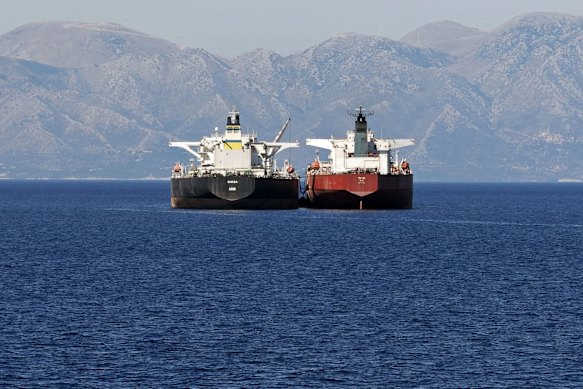
Russian oil tankers in the Mediterranean in September. Credit: Bloomberg
A leading sanctions law expert has blasted Australian efforts to target the trade of Russian-origin oil as “weak and slow”, arguing government policies need to be toughened to ensure Australians are not inadvertently helping funnel money to the Kremlin.
The government will on Thursday announce $95 million in military assistance for Ukraine, including its first contribution to the Prioritised Ukraine Requirements List (PURL), a NATO-administered initiative to fund and deliver critical US military equipment to Ukraine.
Australia will also provide $45 million in equipment – tactical air defence radars, munitions and combat engineering equipment – from the defence force’s stockpile and $2 million to assist Ukraine with drone technology.
Loading
This masthead revealed on Wednesday that the government is also in discussions with Ukraine about providing a batch of retiring Tiger attack helicopters to assist its war effort.
“Australia is unwavering in its support for Ukraine,” Defence Minister Richard Marles said.
“These commitments will make a tangible difference in Ukraine’s defence against Russia’s illegal and immoral invasion.”
The government’s most recent package of support, a donation of 49 M1A1 Abrams tanks, was announced last October. The final tranche of tanks is expected to be delivered to Ukraine in coming weeks.
The new imposts on 45 vessels in Russia’s shadow fleet – designed to evade international sanctions against Russia imposed since the full-scale invasion of Ukraine – will be welcomed by the Ukrainian-Australian community but are likely to have limited practical effects.

Blood oil: Australians have contributed an estimated $2 billion in tax revenue to Moscow.Credit: Artwork — Matthew Absalom-Wong
Analysis by the Centre for Research on Energy and Clean Air (CREA) has found that “shadow” tankers, which use false flags and other clandestine methods to evade sanctions, account for 62 per cent of shipped Russian crude oil exports.
The government previously sanctioned 60 “shadow fleet” vessels in June.
Anton Moiseienko, a senior lecturer at the Australian National University who has written two books on sanctions policy, told a parliamentary inquiry that Australia’s approach to sanctions against Russia lacks “vigour and ambition”.
“Australia is a major global market for refined petroleum originating in Russian crude oil,” Moiseienko wrote in his submission.
“The Australian response has been weak, slow and not commensurate to Australia’s position as a major global market for Russian oil. The Australian government has refused to commit to an EU/UK-style ban.”
This masthead’s “blood oil” series has highlighted the vast quantities of Russian-origin oil that have flowed into Australia since the war in Ukraine, largely from refineries in India.
Australians have paid at least $3.8 billion for petrol and diesel produced from Russian crude oil since February 2023, according to analysis by CREA.
Loading
Moiseienko, who has written two books on sanctions policy, called for the government to legislate to ban purchases of refined oil products originating in Russian crude oil, consistent with the EU and UK, and to sanction entire networks of actors involved in the Russian oil trade.
He argued that sanctions on Russia’s shadow fleet “are useful for ‘naming and shaming’ the vessels involved” but are unlikely to have any substantial practical effects because the vessels do not rely on access to Australian ports.
Foreign Minister Penny Wong said: “Australia’s sanctions complement those of key partners, including the United Kingdom, United States, New Zealand and the European Union, as part of a coordinated effort to starve Russia’s oil revenues and limit its ability to finance its invasion.
Most Viewed in Politics
Loading